Superior Roof Cleaning · London and the South East
Cleaning clay tile roofs
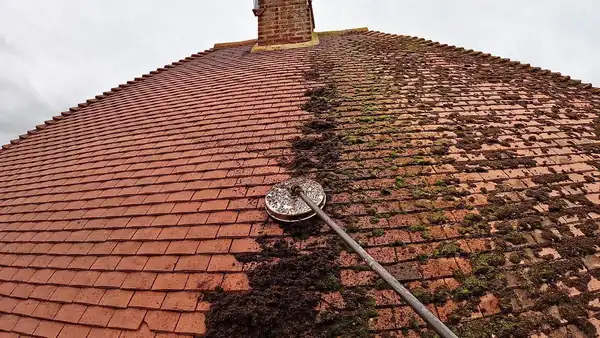
Clay tiles last a long time, but damp is their enemy. We clear moss from clay roofs by hand and with gentle methods only, and never use a pressure washer on them.
- Hand moss removal, working with the tiles
- Soft wash biocide and low-pressure steam where suitable
- Never pressure washed
How to recognise a clay tile roof
Clay tiles are fired clay, usually in shades of red, orange and brown that weather to softer, mixed tones over the years. The most common kind across the South East is the plain clay tile: small, rectangular and laid in many overlapping courses, often with a slight curve along its length. Handmade tiles are irregular, with uneven edges and a varied colour, and older ones may be hung on pegs. Machine-made plain tiles are more uniform. You may also see clay pantiles, with their S-shaped profile, and some modern clay interlocking tiles.
If you’re not sure what’s on your roof, a couple of photos from the ground are usually enough for us to tell you.
What moss does to clay tiles
Moss holds water like a sponge, so the tiles under it stay damp long after the rain stops. That matters more for clay than for most coverings. Roof tile manufacturer Wienerberger explains in its guidance on how to clean roof tiles that damp makes clay tiles in particular more prone to delamination, where the surface of the tile separates from its body. Water held in the tile can also freeze, and Wienerberger notes that hairline cracks can grow in freeze-thaw.
Plain tile roofs have a lot of laps, and moss packs into them, lifts in clumps, and gets washed into the gutters and downpipes, where it can block them. Moss on the ridge can crack the mortar. Lichen often grows on clay too, in crusty grey, yellow or orange patches. Our article on clay tile delamination and frost damage goes into more detail.
How we clean clay roofs
On clay we work gently and by hand:
- Hand moss removal. We scrape and brush the moss off with hand tools, working with the tiles rather than against them, and bag it for removal.
- Soft wash biocide. A biocide approved or authorised for this use in Great Britain is applied at low pressure to kill the remaining moss, algae and lichen and slow regrowth.
- Low-pressure steam, with care. On sound tiles, steam can lift stubborn growth without force. We decide that on the day, after looking at the tiles.
- Gutters cleared of the moss we remove, and run-off controlled so nothing goes into surface water drains.
Lichen clings hard, and scraping it can damage the face of a clay tile, so we usually treat it and leave it to weather off.
What we never do on clay
We never pressure wash clay tiles. Wienerberger advises against high-pressure jet washers on roofs because they can damage tile finishes and force water into the laps, and on a clay roof that already has some delamination, a jet can take off what’s left of the surface. We also keep off the tiles as much as we can, using roof ladders and other access suited to the roof, because walking on old clay cracks it. HSE’s advice is to treat every roof as fragile until a competent person has confirmed otherwise (HSE: roof work).
Repairs and coatings on clay
Older clay roofs often have a few slipped, cracked or missing tiles, and loose ridge tiles. If we find any, we’ll show you and quote for repairs before doing anything. Delaminating tiles can’t be cleaned back to new; they can only be cleaned gently or replaced.
A roof coating isn’t usually our recommendation for clay. Clay roofs need to breathe and dry out, a coating changes how the roof looks, and many clay roofs are on older homes in conservation areas or on listed buildings, where you should check with the council first. If you’re thinking about it, we’ll talk it through honestly.
How often to clean
Wienerberger suggests checking a roof every year and accessing it for maintenance every three to five years, or more often if it’s heavily shaded or often damp. For a clay roof, a gentle clean before the moss gets thick is far kinder than a big clean after years of growth. Read how often a roof should be cleaned.
Roof cleaning near you
Related
Cleaning clay tile roofs: common questions
Can you pressure wash a clay tile roof?
We don’t. Pressure can damage the surface of clay tiles and drive water into the laps. We clean clay by hand, with a soft wash biocide and, where the tiles are sound, low-pressure steam.
Does moss damage clay tiles?
It can. Moss keeps the tiles damp, and Wienerberger notes that damp makes clay tiles in particular more prone to delamination. It also blocks gutters and can crack ridge mortar.
Will my clay roof look new after cleaning?
It will be clear of moss and much cleaner, but clay weathers naturally and that character stays. Lichen stains fade over time after treatment rather than coming off on the day.
Should I coat my clay roof?
Usually not. Clay roofs need to breathe, a coating changes their look, and in a conservation area or on a listed building you should check with the council first. We’ll give you an honest view.
Do you replace broken clay tiles?
We can replace slipped, cracked or missing tiles found during a clean. We’ll show you what we find and quote before doing any repair.
Page updated 30 October 2026