Isle of Wight · Biocide roof treatment
St Helens roof biocide treatment
Careful roof biocide treatment for St Helens: a look at the job, a fixed price, the right method and a proper clear-up. Call for a fixed quote.
- Dark algae stains
- A shaded slope that turns green quickly
- The first patches of moss
Roof biocide treatment in St Helens
Protecting what’s below the roof is part of every treatment. Drains and gullies are covered, and nothing goes into surface water drains, which discharge directly to the environment. Plants and paths are protected as well. We are often asked to deal with lichen spots across the tiles and slowing moss coming back after cleaning, across roofs cleaned by hand, algae and black streaks and lichen patches.
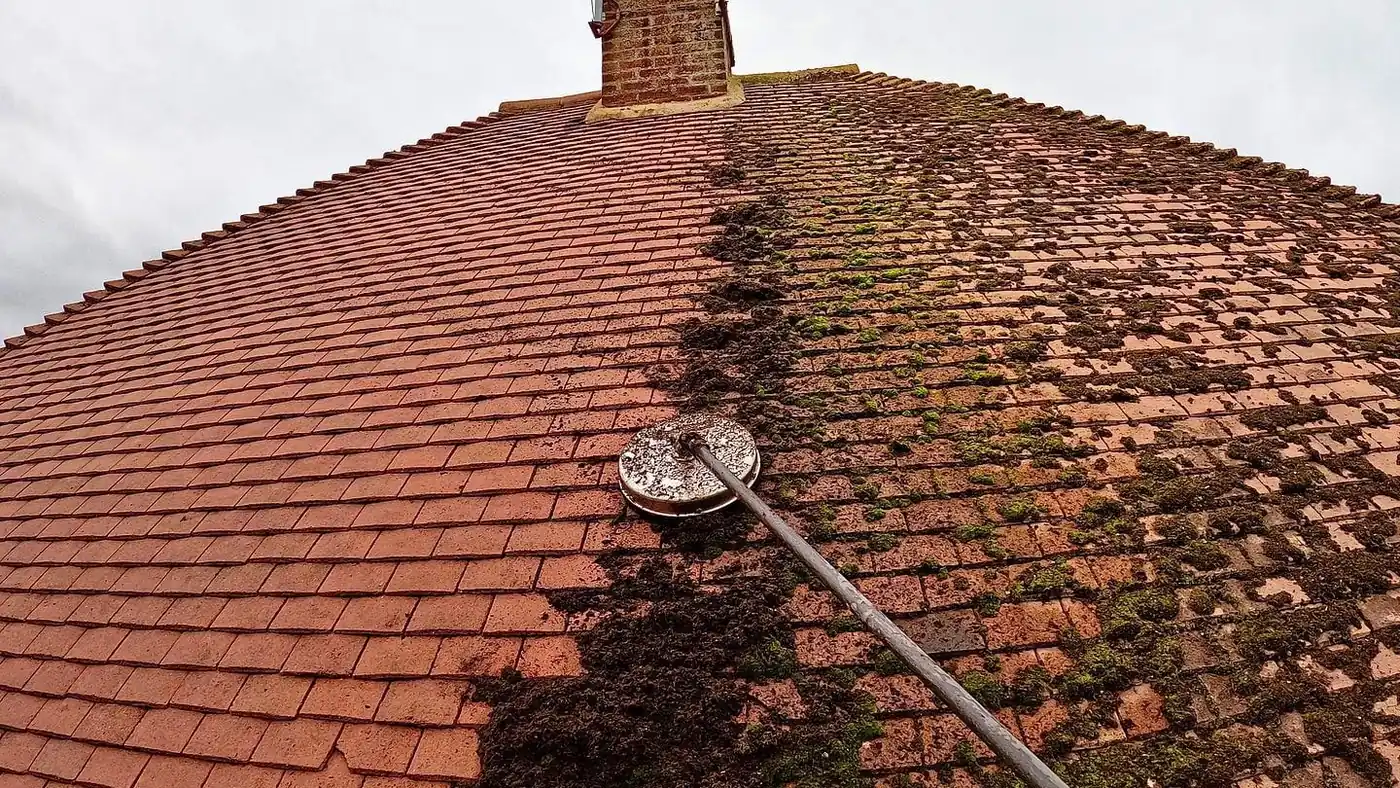
Villages like St Helens often include older cottages and barns with clay tiles or slate, alongside newer houses. Old clay tiles in particular can flake when they stay damp, so they’re cleaned by hand, gently, with no pressure washing.
Superior Roof Cleaning is fully insured, a Checkatrade member and has 20 years’ experience, and each job carries a written 12-month guarantee on our workmanship. It’s given in writing, so it’s there if you ever need it.
- Place
- St Helens (PO33)
- Wider area
- Isle of Wight
- Guarantee
- Written 12-month workmanship guarantee
- Quotes
- Fixed quote, agreed before any work
- Experience
- Fully insured, with 20 years’ experience
- Call
- 01342 344 936
- Reviewed
- 30 October 2026
Questions from St Helens
Is roof biocide treatment any different near the coast in St Helens?
It can. St Helens is within about 2 miles of the coast. Salt air and wind-driven rain keep a roof damp, which suits lichen and algae as much as moss.
Do you work in villages like St Helens?
Yes, smaller places are covered as well as towns. A few pictures and directions help us plan the visit.
Can letting agents book you?
Yes. Let us know who to contact and how to reach the tenant and we’ll handle the rest. We will let whoever booked us know about anything that needs attention.
What is a biocide treatment for roofs?
It treats the growth rather than removing it by force. Lichen in particular is best treated this way, since scraping can damage tiles and helps keep a cleaned roof clearer.
Are you on Checkatrade?
Yes, we are members of Checkatrade. We are fully insured too, with 20 years’ experience, plus a written 12-month workmanship guarantee on our work.
Do I need to tell my neighbours?
It’s a good idea to let them know, particularly where we will be near a shared boundary or drive. Their windows, cars and paths get the same protection as yours.
Can you treat the roof without cleaning it first?
That comes down to the build-up. Thick moss stops the biocide reaching the tiles and falls away slowly once it’s dead so we remove it by hand before treating and light growth can be treated right away.
Is the work guaranteed?
Every job comes with a written 12-month workmanship guarantee. It covers the quality of our work, not regrowth, because nobody can honestly promise that moss or algae won’t come back.
Aftercare tips
Growth and dirt come back in time, but good habits slow them down. Our tips:
- Let the biocide stay on the tiles
- Keep gutters running freely
- Watch for new green patches
- Do not wait for thick moss to return
Expect lichen to be the slowest to fade. It’s killed by the treatment but stays attached for a while, then weathers off. It’s better than scraping it off.
Cut back trees that shade the tiles. A roof that dries quickly regrows slowly and the gutters stay clearer.
What roof biocide treatment cannot fix
In fairness, some problems need a different fix:
- An instant result (dead growth weathers off over time)
- Weathering from age
- Broken ridge mortar
If in doubt, speak to us on 01342 344 936 or fill in the quote form and we will say what we think.
What we work on in St Helens
- Shaded roof slopes
- Tile and slate surfaces
- Roofs cleaned by hand
- Lichen patches
- Algae and black streaks
- Ridge and hip tiles
Roof biocide treatment in St Helens: the local picture
St Helens is within about 2 miles of the coast. Crusty lichen is a common sight on roofs near the sea, and because scraping it can mark the tiles, a biocide is the usual answer. Planning matters in St Helens go to Isle of Wight council. For listed homes, the council’s conservation officer is the person to ask before anything beyond gentle cleaning. Among the historic houses near St Helens is Yaverland Manor, some 2.1 miles south-west of St Helens. They are proof that a roof treated gently can stay in good order for a very long time.
If your home backs onto green space such as Alan Hersey Nature Reserve, about 1.5 miles north of St Helens, you are likely to see more shade, leaves and bird droppings. Where a slope gets little sun, moss usually comes back quicker after a clean. Traffic for St Helens Primary School can make the road outside hard to use at certain times of day. If that’s your road, mention it when you book, and setting up can be planned around the busy times.
St Helens is about 3 miles south-east of Ryde, in the Isle of Wight. If you need roof biocide treatment in St Helens, please get in touch on 01342 344 936, or through the quote form for a fixed quote. Our area covers London and the South East, St Helens included. Across the Isle of Wight, we cover 125 places, and St Helens is one of them. You can also see our page for Brighton, about 44 miles away.
Here we cover the PO33 postcode area for roof biocide treatment. Local streets include Station Road, Upper Green Road and Old Chapel Lane, and we cover them all for roof biocide treatment. If your home is just outside St Helens, we cover Gaskins (1 mile south-west), Brading (2 miles south-west), Yarbridge (2 miles south-west), Morton (2 miles south-west) and Yaverland (3 miles south-west). Further out, we also cover Newport (8 miles west), Ryde (3 miles north-west), Cowes (9 miles north-west), Sandown (4 miles south-west), Shanklin (5 miles south-west) and Ventnor (8 miles south-west). If your property is somewhere remote, the job takes a little more planning, so let us know when you get in touch.
Landmarks near St Helens
In St Helens, the houses around The Vine Inn fall within our area as well. For rail, the closest station is Brading station, about 1.8 miles south-west. Other landmarks nearby include Sandown Castle (3.2 miles south-west) and Cothey Bottom Heritage Centre (1.5 miles north-west). The countryside around St Helens includes Alan Hersey Nature Reserve and Bembridge Down.
For landlords and letting agents
Landlords, letting agents and property managers book us as well as homeowners. If a tenant lives there, we can agree access with them or through you, as suits you.
For anyone managing more than one property, the work can go on one quote. Each property is priced on what it needs, so the figures are easy to follow.
Part by part
Historic and listed roofs
Old roofs can be fragile. Access is planned to keep weight off the roof, and we will point out anything that needs a roofer.
Natural slate
Heavy moss on slate is hand-brushed first. The biocide then deals with the rest and slows regrowth.
Other services in St Helens
Fixed quotes for roof biocide treatment in St Helens
There’s no set price list, because properties vary so much. The quote depends on:
- Any repairs, which are always priced separately
- What’s below the work area
- The method, from hand removal to soft wash or steam
- The size of the roof or area
We don’t list prices on the website, because each job is priced on what it involves. Call for a fixed quote, and we will talk you through it.
Helping us quote
To help us quote quickly, please include:
- Details of any previous treatment
- Conservatories, porches or extensions under the area
- The route round the side or back of the property
- A wide photo of the whole roof or area, taken from the ground
There’s no standard price list, because no two properties are the same. Instead, we see the job first, from pictures or in person, and then send a fixed quote. To start, pick up the phone and call 01342 344 936 or fill in the quote form.
Common problems we fix in St Helens
Spores land on roofs constantly. They’re carried in the air and settle on the tiles, and when the roof stays damp, they grow. Treating the roof interrupts it for a while.
Signs it’s time to call us include:
- Lichen on clay or slate
- Clinging growth that would mark the tiles if scraped
- Black streaks down the slopes
- Algae on the slope that gets the least sun
If you live near St Catherine-by-the-Green, or on any of the older streets in St Helens, your roof may be clay or slate, which is cleaned gently by hand.
What to look for in a quote
- If the quote is a fixed price or an estimate
- How they’ll protect your property and control run-off
- Whether a biocide is included, and that it’s authorised for this use
- Whether the waste is taken away
How it works
When we arrive, we check the job matches what we quoted for. Anything unexpected, like damage that wasn’t visible from the ground, is raised with you before we go further. After that, the work takes part of a day for many homes, depending on the size of the roof and the access. Garden furniture and pots near the work are moved or covered first.
- First we decide whether treatment alone will do or a clean comes first.
- We fix the price and agree which slopes are treated.
- A dry spell is chosen, as the label requires.
- After protecting what’s below, we apply an authorised biocide gently.
- We clear up and explain that the treatment works slowly, not overnight.
Getting ready for the day
- Mention a conservatory or flat roof underneath
- Let neighbours know if we’ll be near a shared boundary or drive
- Make space on the drive by moving cars
Your fixed quote
Quoting starts with seeing what’s involved, from your photos or, where that isn’t enough, a visit. Then we give you a fixed price before any work is booked.