Isle of Wight · Roof cleaning
Roof Cleaning in St Helens
Roof cleaning for properties in St Helens and across the Isle of Wight. Checkatrade members with 20 years’ experience, fully insured.
- A roof left to grow over
- Moss on the ridge and hip tiles
- Green algae and black streaks on the tiles
Roof cleaning and moss removal in St Helens
The first sign is often moss you can spot from the road, or clumps landing on the drive. By then it has typically spread into the gaps between tiles and down into the gutters. A proper clean removes it by hand, empties the moss out of the gutters and, where agreed, treats the roof to slow regrowth. The work covers fibre cement slates, concrete interlocking tiles and valleys and verges, and people most often call us about a roof left to grow over and moss blocking the gutters and downpipes. People who type “roof cleaning near me” in St Helens usually want the moss gone and the gutters running again, and that’s exactly what we deal with, wherever you are in the Isle of Wight.
A soft wash biocide treatment follows where it’s agreed, to kill remaining moss, algae and lichen spores and slow regrowth. It is not permanent, but it typically lasts around one to a few years, depending on shade and aspect.
Older villages often have listed buildings and conservation areas, and if yours is one of them, gentle methods matter even more. Cleaning does not change how a roof looks, but a coating or a change of tiles can, so check with the council before anything like that.
There are two kinds of protection when we work for you. We are fully insured while we are on site, and afterwards a written 12-month workmanship guarantee covers our workmanship.
- Place
- St Helens (PO33)
- Region
- Isle of Wight
- Guarantee
- Workmanship guaranteed in writing for 12 months
- Price
- A fixed price before work begins
- Experience
- Checkatrade member with 20 years’ experience
- Phone
- 01342 344 936
- Updated
- 30 October 2026
How the job changes from site to site
Natural slate
Slates can crack underfoot and lift if water is forced under them. We plan access so we’re not walking on the slates, and no pressure washer is used.
Clay tiles
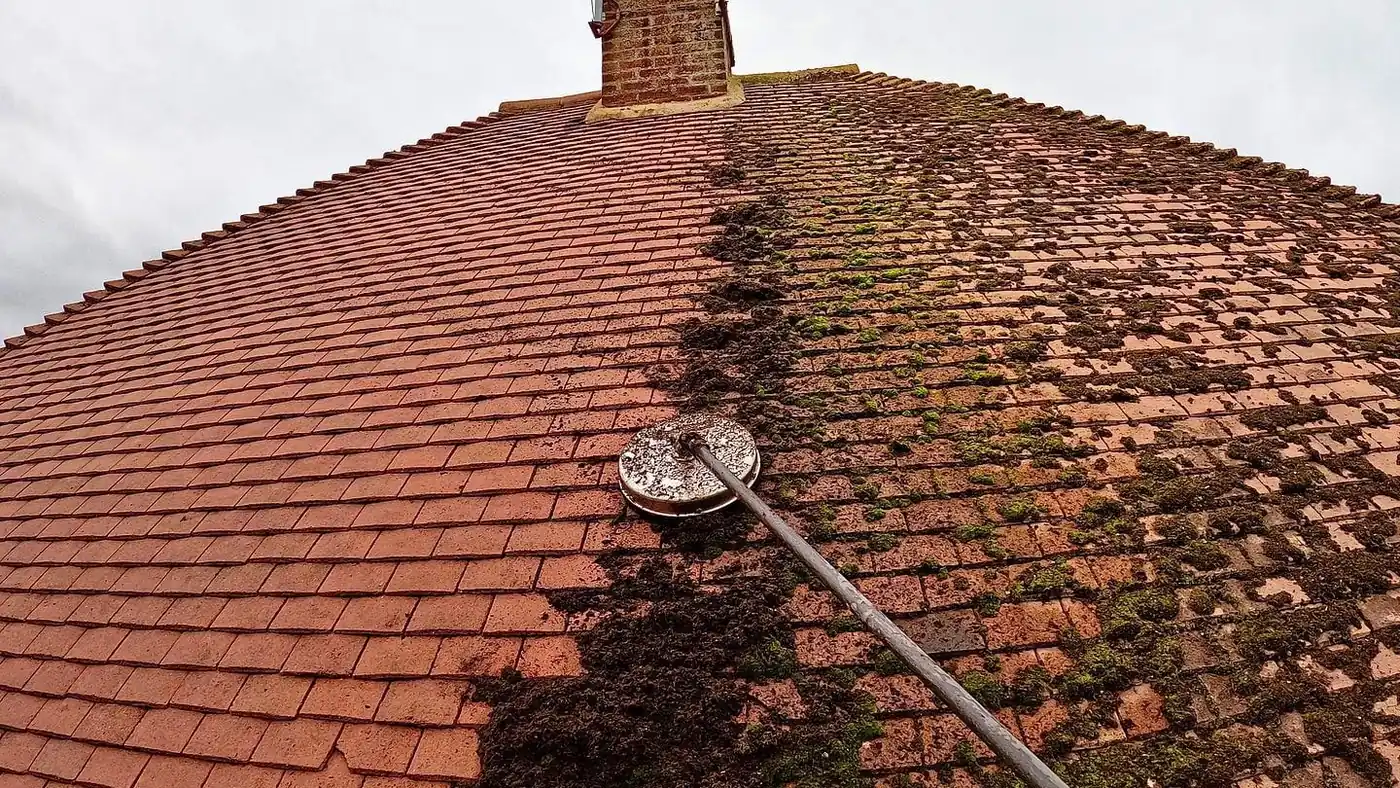
On a clay roof we scrape and brush the moss off by hand. A soft wash biocide can be applied afterwards at low pressure, but no jet washing, ever.
St Helens: your questions answered
Does living near the coast affect roof cleaning in St Helens?
It can. At about 2 miles from the coast, St Helens gets damp, salty sea air. Roofs near the sea often carry lichen as well as moss, and lichen is better treated than scraped.
Do trees near my home in St Helens make a difference to roof cleaning?
It often does. The nearest ancient woodland to St Helens is Eight Acre Copse, about 0.6 miles west of St Helens. Shade keeps a roof damp, and moss grows best on damp, shaded slopes, so roofs under trees may need cleaning more frequently.
Will you use a pressure washer on my roof?
High pressure isn’t safe for most roofs, which is why we rarely use it. We clean by hand first and use controlled pressure only on robust tiles we have checked and never on clay or slate.
How do you clean a roof?
We start with the gentlest method that suits the tiles. On most roofs, moss comes off by hand with scrapers and brushes, then a soft wash biocide can follow. Controlled pressure is only used on robust tiles after a check, never on clay, slate, old or fragile tiles.
Do I need to be in when you come?
We agree that when we book. The important thing is clear access to the work, including side gates and the back garden, plus cars moved off the drive and pets indoors.
Which method will you use?
It depends on the surface and its condition. Clay, slate and older tiles are cleaned by hand or at low pressure, while concrete tiles can sometimes take controlled pressure and solar panels only get soft brushes and clean water. We explain our choice before you book.
Do you work in St Helens?
Yes. We work in St Helens and across the Isle of Wight, within the London and South East area we cover. To book, send details through the quote form or ring us on 01342 344 936.
How should I prepare?
The main thing is clear access: cars off the drive, side gates open and pots or furniture out of the way. Shut any windows close to the work and keep pets indoors.
What we’re called out for in St Helens
The side of the roof that sees least sun nearly always grows most. Tiles that don’t get the sun dry out slowly after rain and that suits moss and algae perfectly. It’s common to see one slope green and the other almost clean.
These are the things we see most often:
- Crusty grey or yellow lichen patches
- A roof left to grow over
- The shaded side of the roof covered in growth
- A dull, dirty roof spoiling the look of the house
If your home is near St Helens Primary School or another school, the school run can fill the road twice a day. If that’s your road, mention it when you book, and setting up can be planned around the busy times.
What to look for in a quote
- What happens if they find damage, and whether repairs are quoted first
- If the quote is a fixed price or an estimate
- Whether VAT is included
- A written guarantee, and what it actually covers
Roof cleaning in St Helens: the local picture
From St Helens, the sea is no more than about 2 miles away. Sea air and wind-driven damp can mean lichen and algae as well as moss, so the clean is planned around all three. Ancient woodland is a feature around St Helens: about 19 areas lie within two miles, the closest being Eight Acre Copse, roughly 0.6 miles west of St Helens. If your roof is shaded by trees, it will stay damp for longer and moss will usually come back sooner than on an open roof. One of the historic houses in the area is Yaverland Manor, some 2.1 miles south-west of St Helens. They’re proof that a roof treated gently can stay in good order for a very long time.
If you live near Brading station, 1.8 miles south-west of St Helens, on-street parking may be busy in the day, and our van needs to be fairly close to the house, so let us know the options. Period houses close to churches such as St Catherine-by-the-Green tend to have clay or slate on top, and we only ever clean that kind of roof by hand.
St Helens is about 3 miles south-east of Ryde, in the Isle of Wight. From the centre of St Helens to the outskirts, we cover roof cleaning for every kind of home, from a terrace to a large detached house. St Helens is one of 125 towns, villages and districts in the Isle of Wight where we work for homeowners and landlords. You can also see our page for Brighton, about 44 miles away.
Work in PO33 is quoted and carried out the same way as anywhere else. Whether your home is on Station Road, Upper Green Road and Old Chapel Lane or anywhere close by, we can take on the work. We also cover Gaskins (1 mile south-west), Brading (2 miles south-west), Yarbridge (2 miles south-west), Morton (2 miles south-west) and Yaverland (3 miles south-west). Larger places within reach include Newport (8 miles west), Ryde (3 miles north-west), Cowes (9 miles north-west), Sandown (4 miles south-west), Shanklin (5 miles south-west) and Ventnor (8 miles south-west). Island and remote properties take a little more planning, so tell us where you are when you ask for a quote for roof cleaning.
What’s near St Helens
Roofs on the roads around The Vine Inn sit inside the area we work in. St Helens’s nearest station is Brading station, roughly 1.8 miles south-west of the centre. Other landmarks nearby include Sandown Castle (3.2 miles south-west) and Cothey Bottom Heritage Centre (1.5 miles north-west). Open spaces near St Helens include Alan Hersey Nature Reserve and Bembridge Down.
What’s safe to do yourself
It’s easy to damage a surface while scraping moss. Lichen in particular clings hard, and forcing it off can mark the tile surface, which is why it’s usually treated and left to weather away. For the roof itself, it’s safer to call us.
You can buy moss and algae treatments yourself, but only use one authorised for that job and follow the label to the letter. Applying it to a roof still means working at height, and run-off still has to be kept out of drains.
Looking after it afterwards
Our aftercare advice, in brief:
- Give the roof a yearly look from the garden
- Act when moss first appears
- Stay off the roof unless it’s safe and you’re trained
- Keep overhanging growth under control
The gutters are cleared of the moss we remove before we leave. Waste is bagged and taken away and paths and drives are swept and the protective sheeting comes up last.
Cutting back overhanging branches is one of the best things you can do. More sun and air on the tiles means they dry faster after rain, and fewer leaves end up in the gutters.
When it’s something else
A few issues sit outside what this work can do:
- Tiles worn out from age
- Leaks from failed flashing, felt or underlay
- Stopping new spores arriving
If in doubt, send a message through our quote form, or phone 01342 344 936 and we will say what we think before booking.
What the work covers
- Plain clay tiles
- Valleys and verges
- Natural slate
- Fibre cement slates
- Concrete interlocking tiles
- Ridge and hip tiles
For landlords and letting agents
Letting agents and property managers can book with us directly. Tell us the property, the work and the access arrangements and we’ll come back with a fixed quote.
On a let property, the outside is easy to overlook. Tenants don’t often check the roof or gutters, so planned work helps catch moss, blockages or slipped tiles before they grow into a bigger job.
Other services in St Helens
Step by step
The first job is protection: we cover or move anything that could be splashed or hit, and protect gullies and drains. Then the work starts. The job takes anything from part of a day to a few days, depending on the size of the roof and the access, and we clear up before we go. Garden furniture and pots near the work are moved or covered first.
- The roof is checked for tile type, condition and access.
- We fix the price and agree whether a biocide follows the clean.
- Everything below is protected and run-off kept out of surface water drains.
- Hand tools lift the moss, tile by tile, with controlled pressure only on robust tiles we have checked.
- We clear up, take the waste and tell you about any damaged tiles.
Before we arrive
- Let us know about any pets, and keep them inside on the day
- Tell us about anything you already know, such as leaks or loose tiles
- Have a word with next door if access is shared
Getting a quote
For a fixed quote, ring 01342 344 936 or send details through our quote form and tell us roughly what needs doing and where. Photos taken safely from the ground make it easier to price, though they aren’t essential.