Isle of Wight · Biocide roof treatment
Brading roof biocide treatment
For roof biocide treatment in Brading, one call is all it takes: quote, work and clear-up. Fully insured and a Checkatrade member.
- Algae on the slope that gets the least sun
- Light moss starting to show
- Crusty grey and yellow lichen
How we handle roof biocide treatment in Brading
The treatment goes on at low pressure, evenly across the roof. That suits every kind of roof, from clay and slate to concrete, because nothing is forced under the tiles. Heavy moss comes off by hand beforehand, so the treatment can reach the surface. The work covers shaded roof slopes, roofs cleaned by hand and algae and black streaks, and common reasons people get in touch are growth coming back on a treated roof and slowing moss coming back after cleaning.
Some homes in villages like Brading are listed or in a conservation area, and if yours is one of them, gentle methods matter even more. For anything beyond cleaning, such as a coating, the council’s conservation officer is the person to ask first.
If something about the work concerns you after we’ve gone, just give us a call. Your written 12-month workmanship guarantee covers the work we did, and it’s set out clearly so you know what’s included.
- Place
- Brading (PO36)
- Region
- Isle of Wight
- Guarantee
- Written 12-month workmanship guarantee
- Quotes
- A fixed quote up front
- Experience
- Fully insured, with 20 years’ experience
- Telephone
- 01342 344 936
- Updated
- 30 October 2026
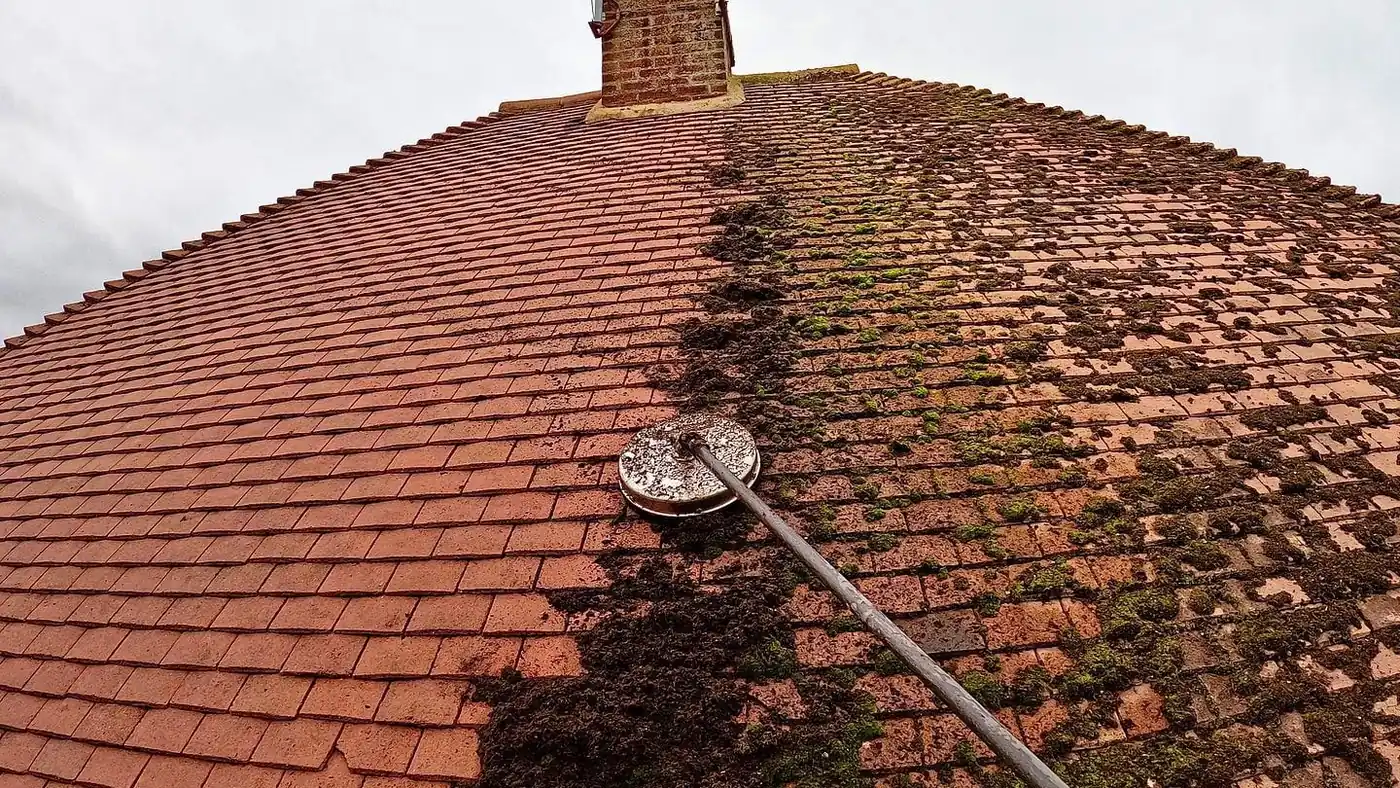
What roof biocide treatment looks like in Brading
Brading is within about 2 miles of the coast. Near the sea, roofs can collect lichen and green algae as well as moss, and lichen is treated with biocide rather than scraped, as scraping can damage the tile surface. Kelly's Copse, about 0.2 miles west of Brading, is the nearest of about 26 ancient woods within a couple of miles of Brading. If your roof is shaded by trees, it will stay damp for longer and moss will normally come back sooner than on an open roof. Historic buildings nearby include Morton Manor, about 0.4 miles south of Brading. Roofs on buildings like that have lasted because they were looked after, not because they were left alone.
Streets near a church such as St. Mary's Church often include older homes, and older clay or slate roofs need hand cleaning rather than pressure. Kerb space close to Brading station, close to the centre of Brading, can fill up early on a weekday, so tell us where a van can park when you book.
Brading is about 3 miles south of Ryde, in the Isle of Wight. Whether you’re in the middle of Brading or further out, roof biocide treatment is available for all kinds of property, from bungalows to large family homes. Brading is one of 125 places in the Isle of Wight where we work for roof biocide treatment. You can also see our page for Brighton, roughly 46 miles from Brading.
We work across the PO36 postcode area for roof biocide treatment and the streets around it. You will find streets such as Station Road, High Street and Wrax Road, and we cover them all for roof biocide treatment. With the A3055 close by, Brading is simple for us to get to with everything the job needs. We also cover the places around Brading: Yarbridge (1 mile south), Morton (1 mile south-west), Adgestone (1 mile south-west), Yaverland (1 mile south) and Gaskins (1 mile north-east). Further out, we also cover Newport (7 miles west), Ryde (3 miles north), Cowes (9 miles north-west), Shanklin (4 miles south-west), Ventnor (6 miles south-west) and East Cowes (8 miles north-west). Remote and island homes need a little more planning, so please mention your location when you reach us by phone on 01342 344 936, or through the quote form.
Near you in Brading
In Brading, the houses around The Bugle Inn and Sandown Bay Academy are on our patch, like the rest of Brading. There’s a railway station in Brading itself: Brading station. Well-known places in the area include Sandown Castle (1.5 miles south) and Brading Waxworks (within half a mile north). Green spaces nearby include Brading Marshes RSPB reserve and Brading Down.
Common questions in Brading
Who can tell me if my home in Brading is listed?
That’s Isle of Wight council. Its planning or conservation team can tell you whether your home is listed or in a conservation area. For listed homes, the council’s conservation officer is the person to ask before anything beyond gentle cleaning.
Do you work in villages like Brading?
Yes, smaller places are covered as well as towns. Just mention lanes, gates or anything else about getting there when you book.
What does roof biocide treatment cost?
The cost depends on the size of the job, the access, the condition of the surface and the method. Ask us for a fixed quote and we will explain what’s included.
What is a biocide treatment for roofs?
It kills moss, algae and lichen, including spores left after cleaning, and slows regrowth. It isn’t permanent, typically working for around one to a few years, depending on shade and aspect.
Can you treat the roof without cleaning it first?
It varies with the roof. Heavy moss blocks the treatment and ends up in the gutters as it dies, so it’s best removed first and light growth can be treated straight away.
Where does the dirty water go?
We control it from start to finish. We protect gullies and drains, and moss sludge, dirty water and biocide are kept out of surface water drains, because those drains discharge directly to the environment.
Will you tell me if you find any damage?
We stop and talk to you. Nothing extra is done without your agreement; repairs are quoted first, at a fixed price. The price for the original job stays as agreed.
Is the biocide you use approved?
Biocides used on roofs have to be approved or authorised for that use in Great Britain, and ours are. We apply them exactly as the label directs.
From first look to clear-up
If the job involves water, the run-off is controlled. Moss sludge, dirty water and any biocide are kept out of surface water drains, because those drains discharge directly to the environment. On site, it takes part of a day for many homes, depending on the size of the roof and the access. Garden furniture and pots near the work are moved or covered first.
- We check whether a treatment alone will do, or the roof needs a clean first.
- You get a fixed quote and a date planned around the weather.
- We protect drains and gullies first.
- Heavy growth comes off by hand, then the biocide is applied by soft wash.
- We clear up and go through anything you need to know.
Preparing for the work
- Keep windows close to the work closed
- Mention any problems you’ve noticed
- Leave side gates unlocked so we can reach the back
Pricing your job
Need a price for roof biocide treatment? Please pick up the phone and call 01342 344 936 or fill in the quote form with a few details. We will explain the method we’d use and send you a fixed quote before anything is booked.
Read more
Part by part
Clay tiles
Clay roofs are well suited to a low-pressure treatment. Damp makes clay tiles in particular more prone to delamination, Wienerberger notes so slowing regrowth is worthwhile.
Fibre cement slates
From the ground, artificial slates can look just like natural slate. We confirm the material before starting because it changes how we work.
Honest limits
In fairness, there are a few things this work will not fix:
- Heavy moss cushions
- Lichen vanishing on the day
- Damaged tiles
If in doubt, have a word with us on 01342 344 936 or send details through the form on our contact page and we’ll say what we think.
What we clean
- Shaded roof slopes
- Algae and black streaks
- Ridge and hip tiles
- Roofs cleaned by hand
- Lichen patches
- Tile and slate surfaces
Other services in Brading
Do you need roof biocide treatment in Brading?
Algae often show as a green film or black streaks. Wet seasons let it spread, and it makes the surface easier for moss and lichen to colonise.
The problems we are asked about most are:
- Growth on tiles too fragile to scrape hard
- Small tufts of moss on the tiles
- Regrowth since the roof was last cleaned
- Dark algae stains
Around Brading Marshes RSPB reserve, within half a mile of the centre of Brading, gardens often border trees and hedges, and that brings shade. A roof that sits in shade for part of the day tends to grow moss sooner.
Comparing quotes
- Whether the waste is taken away
- Which parts of the property the price covers
- If the quote is a fixed price or an estimate
- Whether any biocide used is authorised in Great Britain for the job
Fixed quotes for roof biocide treatment in Brading
The quote reflects the property in front of us. We take into account:
- Any repairs, which are always priced separately
- Combining work, like the roof and the gutters
- The method, from hand removal to soft wash or steam
- Any extra work added to the job
Doing several jobs in one visit, for example the roof and the gutters, can make the booking more efficient. Mention everything you need, and you’ll get one fixed quote.
Helping us quote
The more you tell us, the more accurate the quote. With your enquiry, it helps to include:
- Any side gates, passages or tight spots we’d need to get through
- Anything below the work, such as a conservatory, porch or extension
- The address and the type of property
- Any past cleaning, coating or repairs you know about
There’s no standard price list, because no two properties are the same. Instead, we see the job first, from photos or in person, then send you a fixed quote. To start, call 01342 344 936, or send photos through the quote form.
Keeping it in good shape
A little care between visits keeps things looking better for longer. We recommend:
- Let more sun reach the tiles
- Expect gradual change
- Never scrape lichen yourself
- Keep off treated areas until they’ve dried
Expect lichen to be the slowest to fade. It’s killed by the treatment but stays attached for a while before rain and weather take it away. That’s normal and part of doing it safely.
A light brush down each season, as the SPAB recommends, keeps growth from settling. It needs safe access, but it makes each treatment go further.
What happens if it’s left?
Leaving lichen and algae untreated lets them keep spreading. Algae holds moisture and paves the way for moss while lichen keeps spreading across the tiles. A treatment slows all of it. On older homes, original tiles, render and paving can be hard to match, so caring for what’s there makes sense.
What you pay depends on the size of the area, how easy it is to reach and how much there is to clear. You get a fixed price before any work starts, so you know where you stand.
Why Brading homeowners choose us
- Checkatrade member
- We’re fully insured
- 20 years’ experience in roof and exterior cleaning
- One phone number across our whole area
Read how roof cleaning is priced or our methods by tile type.