Essex · Roof coating and sealing
Great Stambridge roof coating
Careful roof coating for Great Stambridge: a fixed quote first, then the work, done gently, and a full clear-up. Ask us for a fixed quote.
- Wondering what a coating would mean for upkeep later on
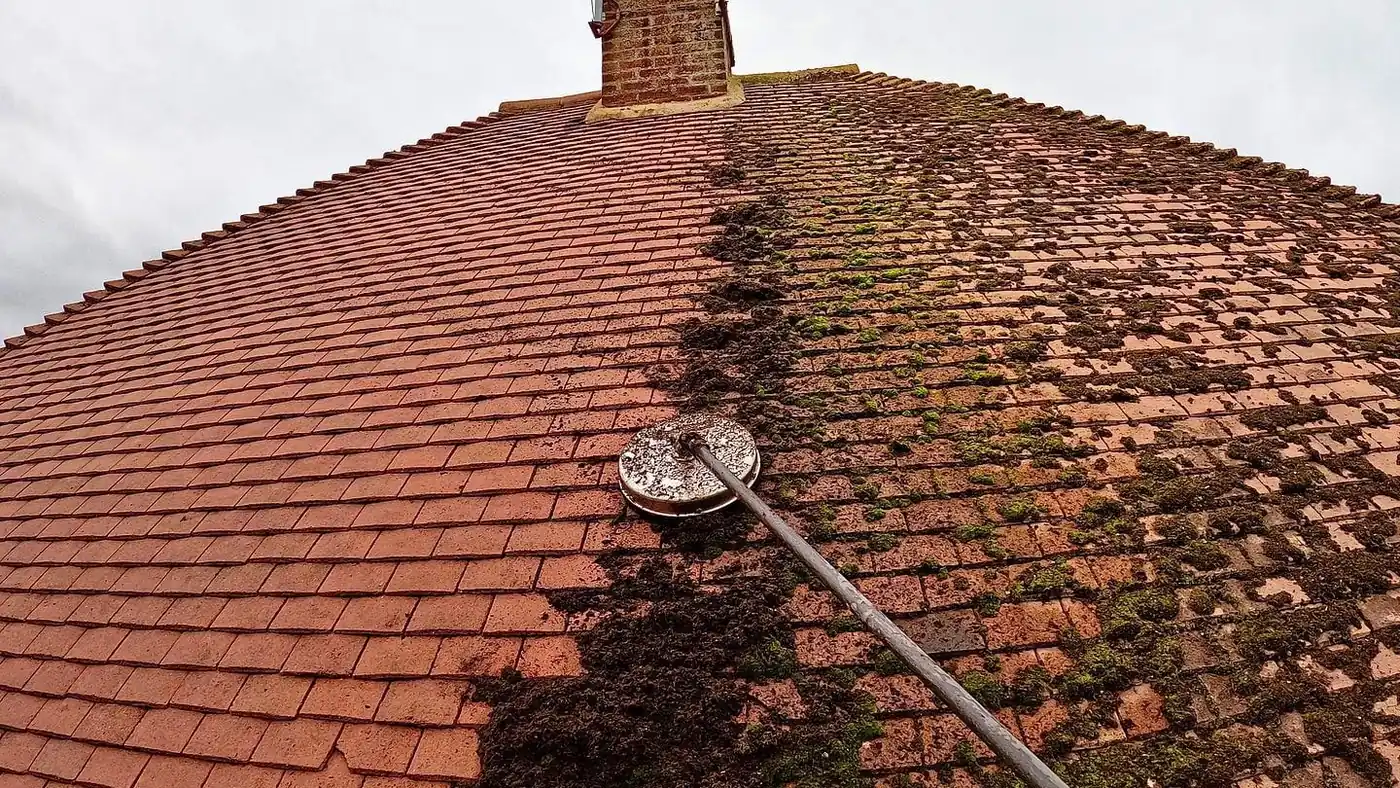
- A roof with a mottled, uneven colour
- Uneven colour after moss has been removed
About our roof coating in Great Stambridge
We’ve cleaned roofs for 20 years, and coating is one option we offer after a clean. Plenty of roofs simply need cleaning and checking every few years. Where a coating does make sense, we’ll say so and give our reasons, and if it does not, we will say that too. The work covers concrete interlocking tiles, extension roofs and ridge and hip tiles, and people most often call us about concerns about breathability and trapped damp and wondering what a coating would mean for upkeep later on.
Older villages often have listed buildings and conservation areas, and if yours is one of them, gentle methods matter even more. Cleaning does not change how a roof looks, but a coating or a change of tiles can, so check with the council before anything like that.
Every job is backed by a written 12-month workmanship guarantee, set out on paper. It covers the work we do, and we are fully insured as well.
- Place
- Great Stambridge (SS4)
- Region
- Essex
- Guarantee
- 12-month workmanship guarantee, in writing
- Price
- Fixed, not estimated
- Track record
- Checkatrade member with 20 years’ experience
- Call
- 01342 344 936
- Checked
- 30 October 2026
Roof coating in Great Stambridge: the local picture
Close to Great Stambridge is Hyde Wood, an area of ancient woodland roughly 1.9 miles north-west of Great Stambridge. Woods nearby can mean leaves on the tiles and shade for much of the day, and moss does well in both. Great Stambridge lies roughly 37 miles from central London, comfortably inside the patch we cover. Our 20 years’ experience and full insurance stand behind every job. Historic buildings nearby include Southchurch Hall, roughly 3.9 miles south of Great Stambridge. Buildings like that show how long clay and slate roofs can last when they are looked after.
If you live near Rochford station, 1.9 miles south-west of Great Stambridge, on-street parking may be busy in the day, and ladders have to be carried from the van, so the closer the space the better. If your home is near Stambridge Primary School or another school, the school run can fill the road twice a day. It’s worth a mention when you book, as the van and ladders need space outside. Period houses close to churches such as Church of St Mary and All Saints tend to have clay or slate on top, and we only ever clean that kind of roof by hand.
Great Stambridge is about 2 miles east of Rochford, in Essex. For roof coating in and around Great Stambridge, please reach us by phone on 01342 344 936, or through the quote form for a fixed quote. We work across London and the South East, Great Stambridge included. 644 places in Essex are on our list, large and small. You can also see our page for Maidstone, roughly 24 miles from Great Stambridge.
We take on work all over the SS4 postcode area for roof coating and the streets around it. You will find streets such as Stambridge Road, Wheatfields and Ash Tree Court, and we cover them all for roof coating. Nearby, we also carry out roof coating in Sutton (2 miles south-west), Paglesham (2 miles east), Stonebridge (2 miles south), Barling (2 miles south-east) and Little Wakering (3 miles south-east). Larger places within reach include Chelmsford (15 miles north-west), Basildon (12 miles west), Maldon (10 miles north), Canvey Island (8 miles south-west), Billericay (14 miles west) and Rayleigh (6 miles west).
Around Great Stambridge
Locally, the streets close to King Edmund School and The Royal Oak pub sit inside the area we work in. Great Stambridge’s nearest station is Rochford station, about 1.9 miles south-west. Well-known places in the area include Rayleigh Windmill Museum (1.7 miles south-west). Open spaces near Great Stambridge include Lion Creek and Lower Raypits.
What happens on the day
The first job is protection: we cover or move anything that could be splashed or hit, and protect gullies and drains. After that, we get on with the roof coating. It takes a little longer than a standard clean, since the tiles have to be clean, dry and sound first, and we clear up before we go. Narrow lanes and long drives are part of rural work, so mention them when you book.
- We begin with a straight answer on whether coating suits this roof.
- If the home is listed or in a conservation area, council advice comes before any date is set.
- Moss and dirt are taken off with the gentlest method that will do the job.
- Slipped or cracked tiles are put right, and the roof is left until it’s fully dry.
- On a dry, settled day the coating goes on, then we clear the site.
Preparing for the work
- Check with neighbours if we need to use a shared drive
- Let us know about any pets, and keep them inside on the day
- Mention any problems you’ve noticed
Your fixed quote
Every quote starts with a look at the job, from your pictures or, where that isn’t enough, a visit. Then we give you a fixed price so you know the cost up front.
Related advice
When it’s something else
Even careful work has limits, and we’d like you to know them:
- Approval for changes in a conservation area
- Sagging or uneven roof structures
- Leaks around chimneys, valleys or flashings
If in doubt, call 01342 344 936, or send photos through the quote form and we will say what we think.
What we clean
- Extension roofs
- Concrete interlocking tiles
- Roofs cleaned and fully dried
- Pitched garage roofs
- Sound, well-fixed coverings
- Ridge and hip tiles
Landlords, letting agents and property managers
If you manage properties from a distance, we let you know when the work is done and flag anything that needs attention, such as a slipped tile or a downpipe that is not running. Any repair is quoted separately and only done with your agreement.
Empty periods between tenancies or holiday bookings suit outside work well because access is easy then. Let us know the window you are working to and we will try to fit around it.
What happens if it’s left?
Regular cleaning and a coating aren’t either-or. Coated roofs still need checking and, now and then, a gentle clean, while plenty of uncoated roofs stay in good order with cleaning alone. Where trees and hedges keep things shaded, growth returns faster, so regular care matters more.
Combining work into one visit, for example the roof and the gutters, can make the booking more efficient. Tell us everything you’d like done, and you’ll get one fixed quote.
Why Great Stambridge homeowners choose us
- We are fully insured
- The waste bagged and taken away
- A written guarantee on our workmanship for 12 months
- One phone number across our whole area
Aftercare tips
Once we’ve finished, these simple steps help:
- Put right damaged tiles as soon as they show
- Allow for checks and upkeep of the coating over time
- Avoid walking on the tiles
- Keep the gutters clear so water runs off the roof properly
Keep the gutters clear after a coating, just as before. A coating does not stop leaves and silt landing in them, and blocked gutters can still cause damp below.
Treating the roof with biocide after a clean helps slow moss coming back. It isn’t permanent, typically lasting around one to a few years, depending on shade and aspect.
Also near Great Stambridge
Also in Great Stambridge
DIY or a professional?
Scraping moss off sounds simple, but technique matters. Lichen grips tightly, so scraping it can damage the tile, which is why it’s normally treated and left to weather away. For the roof itself, it’s safer to call us.
A pressure washer from a hire shop might look like a quick fix for the roof. Tile manufacturer guidance warns against high-pressure jet washers on roofs, as it can damage the surface, strip colour from concrete tiles and drive water under the laps.
What the work involves, part by part
Natural slate
Slates crack easily if walked on, so we plan access to keep weight off the slates. A gentle clean is all many slate roofs need.
Listed and historic roofs
Conservation areas come with controls on some changes to how buildings look. Because a coating changes the roof’s appearance, ask the council first.
FAQs for Great Stambridge
Where will your van park in Great Stambridge?
It helps to have space for the van close to the house. If you live near Rochford station, roughly 1.9 miles south-west of Great Stambridge, street parking can fill up in the day, so let us know the options.
Who do I check with about listed building consent in Great Stambridge?
Great Stambridge comes under Rochford council. Its planning or conservation team can tell you whether your home is listed or in a conservation area. Listed homes get our gentlest methods, and anything that would alter the roof’s character is one for the council to see first.
Are the products you use a risk to pets and plants?
Plants, ponds and borders below the work are protected and keep run-off under control. Biocides are applied at low pressure and as the label directs, and we only use ones approved or authorised for this use in Great Britain. Pets are best kept inside until we’re done.
What happens if there’s a nest?
We plan the work around it. Nesting birds are protected by law, so we check first and leave any active nest alone, coming back to that section later if needed.
Is coating suitable for clay or slate roofs?
Clay and slate are the roofs we think hardest about. Their natural finish is normally the point, and a coating changes it. We will give you a straight answer, including when we’d leave it alone.
Can you quote from pictures?
Often, yes. With good photos from the ground and a few details, we can price many jobs. If we can’t see enough, we arrange a visit.
How long does the job take?
Your quote will say how long we expect to be there. For a typical property, it takes more than one visit, as the clean, the drying time and the coating are separate steps.
Do I need permission to coat my roof?
Where the home is listed or sits in a conservation area, speak to the council before going ahead. A listed building is protected, and changes to its character need consent, and coating changes how the roof looks.