Milton Keynes · Biocide roof treatment
Roof Biocide Treatment in Great Brickhill
Professional roof biocide treatment in and around Great Brickhill, with the area protected and left tidy and backed by a 12-month written guarantee covering our workmanship.
- Lichen crusts along the ridge
- An old treatment that has worn off
- Lichen on clay or slate
About our roof biocide treatment in Great Brickhill
The treatment goes on at low pressure, evenly across the roof. That suits every kind of roof, from clay and slate to concrete since no water is driven into the laps. Thick moss is removed by hand first, so the biocide reaches the tile. If you have small tufts of moss on the tiles and orange or yellow lichen on the ridge, we can help, from algae and black streaks, tile and slate surfaces and shaded roof slopes onwards.
In a village like Great Brickhill, many homes are older, and clay peg tiles, handmade plain tiles and slate are often found on cottages and farmhouses. Older clay and slate need a gentle touch: hand scraping and brushing, never a jet wash.
Some firms suggest their work will keep things looking new for years. We prefer to be honest: growth comes back in time, faster in shade and damp. What you do get from us is a written 12-month workmanship guarantee on the work we carry out.
- Where
- Great Brickhill (MK17)
- Region
- Milton Keynes
- Cover
- A written 12-month guarantee on our workmanship
- Price
- Fixed price, set before we begin
- Background
- Checkatrade member, fully insured
- Call
- 01342 344 936
- Page updated
- 30 October 2026
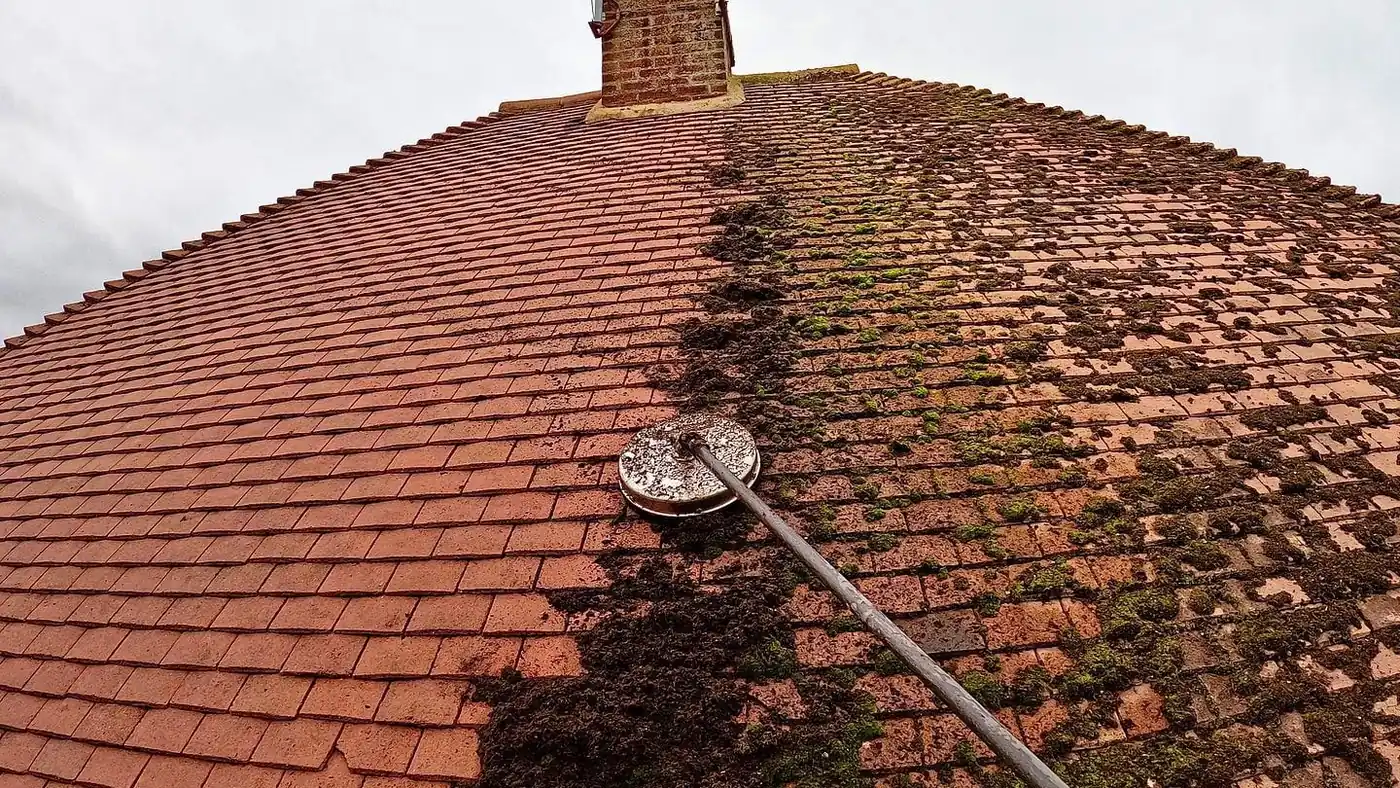
Different parts, different methods
Concrete tiles
Older concrete tiles regrow quickly. Treating them slows regrowth though it isn’t permanent.
Clay tiles
A biocide suits clay tiles because it’s applied without force. Damp makes clay tiles in particular more prone to delamination, Wienerberger notes, so keeping growth down helps.
Places near Great Brickhill
More services for Great Brickhill
What roof biocide treatment can’t fix
Some problems need a different service or another trade:
- Keeping growth away permanently (it slows regrowth; it is not permanent)
- Broken ridge mortar
- An instant result (dead growth weathers off over time)
If in doubt, reach us by phone on 01342 344 936, or through the quote form and we will say what we think.
Surfaces we cover
- Roofs cleaned by hand
- Algae and black streaks
- Tile and slate surfaces
- Ridge and hip tiles
- Lichen patches
- Shaded roof slopes
Why act early in Great Brickhill
Lichen can be scraped or treated. Because it bonds to the tile, scraping can damage it, while a biocide kills it and lets it weather off over time. The longer growth is left, the longer surfaces stay wet.
Every property is different, so each one gets its own fixed quote. Size, height, access, the condition of the surface and the method all play a part.
Why Great Brickhill homeowners choose us
- One phone number across our whole area
- Each job backed by a written guarantee on our workmanship for 12 months
- Run-off controlled and drains protected
- A Checkatrade member
See how roof cleaning is priced and which method suits your roof.
When to call us in Great Brickhill
Green or black staining on a roof is typically algae. Wet seasons let it spread, and it makes the surface easier for moss and lichen to colonise.
These are the things we see most often:
- The first patches of moss
- Slowing moss coming back after cleaning
- Lichen that will not scrape off
- Lichen best left to a treatment rather than a scraper
Places like Stockgrove Country Park, about 1 mile south-east of Great Brickhill, can bring trees and birds close to the houses around them. Leaves on the tiles and in the gutters hold damp, and moss thrives on damp.
What your quote should include
- How they’ll keep drains, plants and paths protected
- Whether the figure could change on the day
- Whether the quote shows VAT
- What happens if they find damage, and whether repairs are quoted first
How it works
There are three stages on the day: setting up, the work itself and the clear-up. Setting up covers protection, access and planning where any water will go, while clearing up means bagging the waste and taking it away. Most of the time goes on the work, which takes part of a day for many homes, depending on the size of the roof and the access. Narrow lanes and long drives are part of rural work, so mention them when you book.
- First we decide whether treatment alone will do or a clean comes first.
- We fix the price and agree which slopes are treated.
- The date is set for dry weather, following the label.
- We protect the area below and apply the biocide by soft wash.
- We clear up and explain that the treatment works slowly, not overnight.
Helping the day go smoothly
- Let us know about any pets, and keep them inside on the day
- Move garden furniture, pots and washing away from the work
- Mention a conservatory or flat roof underneath
Your fixed quote
Every quote starts with a look at the job, from your pictures or, where that isn’t enough, a visit. After that, you get a fixed price before any work is booked.
Related advice
Looking after it afterwards
Checking things once a year makes a difference. Beyond that:
- Keep off treated areas until they’ve dried
- Leave lichen to weather off after treatment
- Keep gutters running freely
- Retreat when regrowth first appears
Expect lichen to be the slowest to fade. The dead crust clings on for some time before rain and weather take it away. It’s better than scraping it off.
Trimming branches over the roof helps a treatment last longer. A roof that dries quickly regrows slowly and the gutters stay clearer.
What roof biocide treatment looks like in Great Brickhill
Great Brickhill has about 12 areas of ancient woodland within two miles, the closest being Bragenham Wood, some 1.2 miles south-east of Great Brickhill. Homes near woodland like this tend to get more shade and leaf litter, and moss grows best on damp, shaded roofs. Older buildings in the area include Bletchley Park, some 3.4 miles north-west of Great Brickhill. Roofs on buildings like that have lasted because they were looked after, not because they were left alone. Great Brickhill lies roughly 41 miles from central London, comfortably inside the patch we cover. Each job carries a 12-month written guarantee covering our workmanship.
Around a church like St Mary the Virgin, the houses are often some of the oldest in the area, and clay or slate on a roof like that gets scrapers and brushes, never a jet. Living close to High Ash Church of England Primary School can mean parked cars and crowds at the start and end of the school day. If that’s your street, mention it, and the ladders can go up before the road fills.
Great Brickhill is about 3 miles south-east of Bletchley, in Milton Keynes. Whatever kind of property you have in Great Brickhill, we can take on roof biocide treatment. One number covers every area we work in, which keeps things simple. 73 places in Milton Keynes are on our list, large and small. We also work in Reading, around 38 miles away.
All of MK17 is covered for roof biocide treatment, from the main roads to the quietest streets. That includes homes on Cuff Lane, Heath Road and Holts Green and the roads around them. Nearby, we also carry out roof biocide treatment in Little Brickhill (1 mile north) and Woburn (3 miles north-east). We also work in nearby towns such as Milton Keynes (6 miles north-west), Bletchley (3 miles north-west), Newport Pagnell (9 miles north), Bletchley and Fenny Stratford (3 miles north-west), Furzton (4 miles north-west) and Whitehouse (7 miles north-west).
Near you in Great Brickhill
Locally, the streets close to Sir Herbert Leon Academy, Old Red Lion pub and Stockgrove Country Park fall within our area as well. The closest station to Great Brickhill is Bow Brickhill station, about 2.9 miles north. Nearby you’ll also find Woburn Heritage Centre (3.3 miles north-east) and Hangmans Hill (3.9 miles west). Open spaces near Great Brickhill include Blue Lagoon and Kings and Bakers Woods and Heaths.
For landlords and letting agents
If you look after several properties, the work can go on one quote. Every address is priced on its own job, so you can see what each one involves.
Between tenancies is often a good time for outside work, when access is simple. Let us know the window you are working to and we’ll do our best to fit the work in.
Your questions about roof biocide treatment in Great Brickhill
Which council covers Great Brickhill for listed buildings and conservation areas?
The council to speak to is Buckinghamshire council. The council’s conservation officer can say whether your home is listed and what needs consent. If your home is listed, listed building consent is needed for works that affect its special character, so check with the council before a coating or any change to how the roof looks.
I live in a conservation area in Great Brickhill: does that affect roof biocide treatment?
For cleaning, very little changes, though we keep to gentle methods; a coating or anything that alters the roof’s look is one to check with Buckinghamshire council. For reference, the Great Brickhill conservation area lies roughly 0.5 miles north-west of central Great Brickhill.
What about my pets and plants?
Plants, ponds and borders below the work are protected and keep run-off under control. Biocides are applied at low pressure and as the label directs, and we only use ones approved or authorised for this use in Great Britain. Keep pets indoors until we’ve finished.
Can you treat the roof without cleaning it first?
That depends on the growth. Where growth is light, treating may be all that’s needed but thick moss always needs removing first.
Do you pressure wash?
Sometimes, after checking the surface. Most hard paving, and robust concrete tiles in good condition, can take controlled pressure, while clay, slate, older tiles and solar panels cannot. We’ll tell you which method we’d use before booking.
How does a roof biocide work?
It treats the growth rather than removing it by force. Lichen in particular is best treated this way, since scraping can damage tiles and helps keep a cleaned roof clearer.
Will the work affect next door?
Any access over a neighbour’s land needs their permission, so it’s worth asking them early. Otherwise, we keep to your side with anything nearby protected.
How long does a biocide treatment take?
It takes a few hours on the day, while the treated growth weathers away over the following months. Your quote will say how long to expect.