Milton Keynes · Biocide roof treatment
Furzton roof biocide treatment
Roof biocide treatment in Furzton from a team with 20 years’ experience. Fully insured, Checkatrade members and a written 12-month workmanship guarantee.
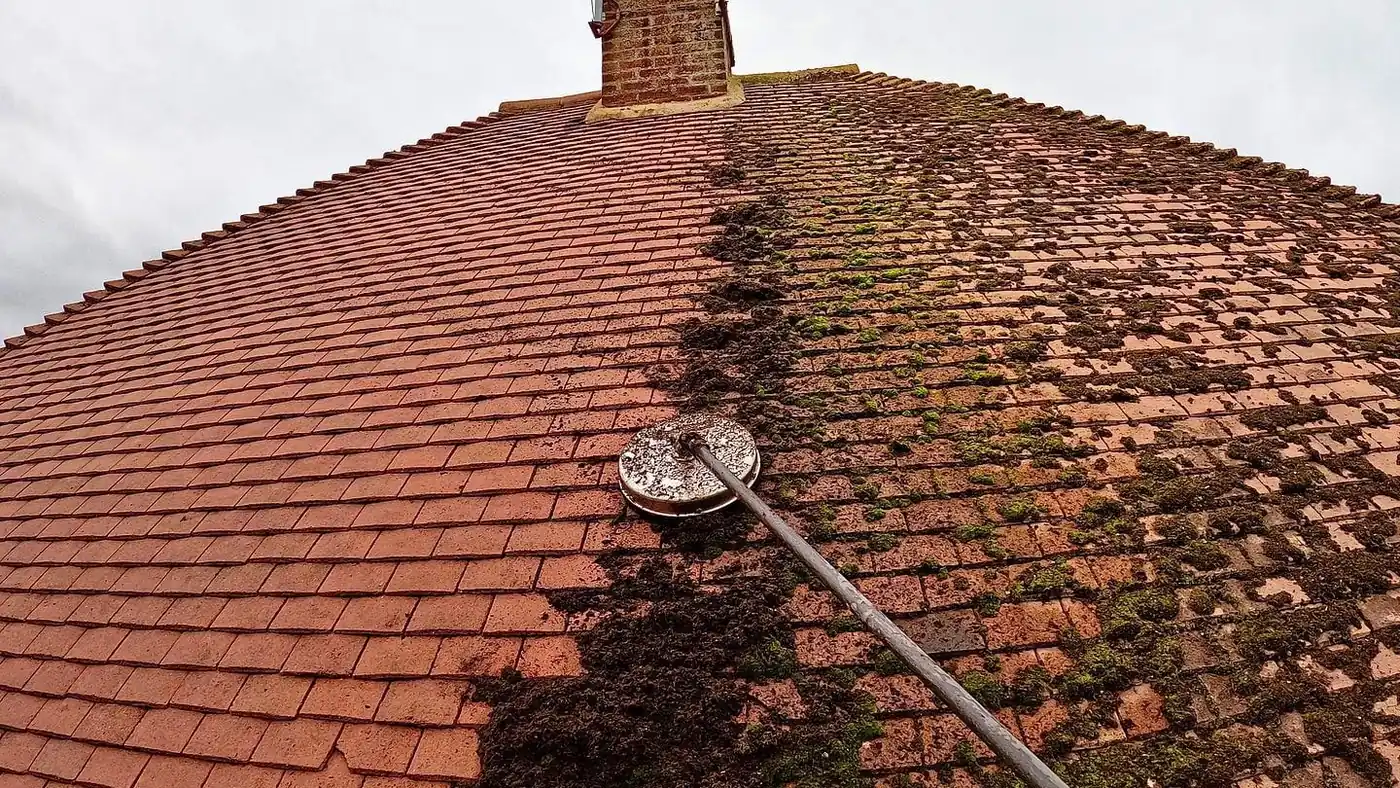
- Growth coming back on a treated roof
- Clinging growth that would mark the tiles if scraped
- Growth on delicate tiles that can’t be jet washed
Roof biocide treatment in Furzton, done properly
We take care of the ground, plants and drains below. Drains and gullies are covered and we make sure no biocide runs into surface water drains. Plants and paths are protected as well. We are often asked to deal with new moss on a cleaned roof and wanting to slow regrowth after a hand clean, across tile and slate surfaces, ridge and hip tiles and lichen patches.
In a place like Furzton, low roofs on bungalows and extensions can often be reached from ladders, while taller houses may need a tower. Access is planned after we have seen the roof, from the ground, from photos or on a visit.
Some firms suggest their work will keep things looking new for years. We prefer to be honest: growth comes back in time, faster in shade and damp. What you do get from us is a written 12-month workmanship guarantee on the work we carry out.
- Location
- Furzton (MK3, MK4)
- Wider area
- Milton Keynes
- Guarantee
- 12 months on workmanship, in writing
- Quote
- Fixed quote, agreed before any work
- Track record
- 20 years’ experience; Checkatrade member
- Phone
- 01342 344 936
- Reviewed
- 30 October 2026
DIY or a professional?
Shop-bought moss treatments are an option for some surfaces, but check the product is authorised for that use and follow the label exactly. On a roof, applying it carries the same height risks as any roof work, and run-off still has to be kept out of drains.
Please don’t walk on the tiles. Tiles and slates can crack under your weight, sometimes with hairline cracks you cannot see, and frost can open those cracks up over the following winters. Access should always be planned to suit the roof.
Between visits
Here’s our aftercare advice, short and simple:
- Let more sun reach the tiles
- Leave the treated roof alone
- Do not wait for thick moss to return
- Look for regrowth on the shady slope once a year
The day after treatment, the roof may look much the same. Over the following weeks and months, the growth dies back and weathers away, so the full effect builds slowly. We will tell you what to expect.
The SPAB suggests a seasonal brushing down to control the build-up. Only where it’s safe to reach the roof and helps treatments last.
Why it’s worth doing now in Furzton
No treatment keeps a roof clear forever. How long depends on shade and aspect, typically around one to a few years, because new spores keep arriving. Treating again when regrowth appears is lighter work than starting from scratch. Shade keeps surfaces damp, so homes near trees benefit most from regular cleaning.
What you pay reflects the actual work. That’s why we look at the job first, from photos or in person, and why the quote is fixed before any work starts.
Why us?
- A full clear-up before we leave
- We’re fully insured
- Covering London and the South East
- Safe access planned for every job
What we do, step by step
If the work is close to a neighbour’s property, we protect their side too, and a word with them beforehand helps. Windows, cars and paths close by are covered or kept clear of splashes. On site, it takes an hour or two for a small roof and longer for a large one. A space on the drive in Furzton makes the visit easier.
- First we check the tiles and what’s growing.
- We fix the price and agree any hand removal first.
- A dry day is chosen and plants, paths and drains are protected.
- We apply the treatment evenly, following the label.
- We tidy up and explain how the growth will fade over time.
A few things to sort first
- Tell us about parking restrictions near the property
- Mention a conservatory or flat roof underneath
- Make sure we can get to the side and back of the property
How to get a quote
Quotes are simple. Send a few details and pictures, and we’ll come back to you with a fixed price. Where we need a closer look, we arrange a time to come round.
Read more
Do you need roof biocide treatment in Furzton?
Regrowth is quickest where the roof stays damp. North-facing slopes and areas under trees stay wet after rain and they need treating most often.
If you notice any of these, it’s worth a closer look:
- Keeping a freshly cleaned roof clearer for longer
- Lichen best left to a treatment rather than a scraper
- Moss returning after a clean
- A green film over the tiles
Around South Loughton Valley park, about 1.5 miles north of Furzton, gardens often border trees and hedges, and that brings shade. A roof that sits in shade for part of the day tends to grow moss sooner.
What to look for in a quote
- What access equipment they’ll use, if any
- Which treatment they’ll apply, if any
- Exactly what’s included, area by area
- Whether extra work needs your agreement
Furzton roofs and what affects them
Furzton has about 3 conservation areas within two miles; the closest is the Bletchley conservation area, some 1.1 miles south-east of the middle of Furzton. Gentle cleaning is simple maintenance in a conservation area; it’s changes to a roof’s appearance, such as new tiles, that Milton Keynes council may need to agree. One of the historic houses in the area is Bletchley Park, about 1.1 miles south-east of Furzton. Old roofs like those last because they are maintained, and gentle cleaning is part of that. Central London is about 45 miles away, and Furzton is firmly within our roof biocide treatment area. Each job carries a 12-month written guarantee covering our workmanship.
Traffic for Barleyhurst Park Primary can make the road outside hard to use at certain times of day. If that’s your street, mention it, and the ladders can go up before the road fills. Period houses close to churches such as Church of the Servant King tend to have clay or slate on top, and we only ever clean that kind of roof by hand.
Furzton is about 1 mile north-west of Bletchley, in Milton Keynes. Whether you’re in the middle of Furzton or further out, roof biocide treatment is available for all kinds of property, from a terrace to a large detached house. Our area takes in 73 places across Milton Keynes, large and small. There’s also a page for Reading, roughly 40 miles from Furzton.
Postcode districts we cover here for roof biocide treatment: MK3 and MK4. Roof biocide treatment is available to homes on Tay Road, Trent Road and Hodder Lane and the roads around them. You will find Furzton on the A421, so it’s easy for us to get to with our equipment. Neighbouring places we cover for roof biocide treatment include Denbigh (1 mile east), Westcroft (1 mile west), Shenley Church End (2 miles north-west), Loughton (2 miles north) and Woughton on the Green (2 miles north-east). Larger places within reach include Newport Pagnell (6 miles north), Whitehouse (3 miles north-west), Middleton (4 miles north-east), Olney (11 miles north), Broughton (4 miles north-east) and Kingston (4 miles north-east). Being one of Milton Keynes’s larger places, Furzton has a wide mix of homes, and we cover all of them for roof biocide treatment.
What’s near Furzton
Around Furzton, homes near Lord Grey School, Dolphin pub and South Loughton Valley park fall within our area as well. The closest station to Furzton is Bletchley station, about 1.4 miles south-east. A little further out are Central Milton Keynes Shopping Centre (2.7 miles north) and The Holley/Cornelius Collection (1 mile south-east). Green spaces nearby include Furzton Lake and Blue Lagoon Park.
Furzton: your questions answered
Do you need parking for a job in Furzton?
It helps to have space for the van close to the house. Streets near Bletchley station, 1.4 miles south-east of Furzton, can be busy with commuter parking, so tell us about your drive or the nearest space when you book.
Who can tell me if my home in Furzton is listed?
Furzton comes under Milton Keynes council. The council’s conservation officer can say whether your home is listed and what needs consent. If your home is listed, listed building consent is needed for works that affect its special character, so check with the council before a coating or any change to how the roof looks.
Do you give a guarantee?
We give a written 12-month workmanship guarantee on each job. It covers our workmanship; it is not a promise that growth will not return.
How do you decide on the method?
We choose after looking at the job. Speed never decides it: we pick whatever does the job with the least risk to your property, and we will explain why.
How long is a biocide treatment visit?
Size and access decide it. Typically it takes a few hours on the day, while the treated growth weathers away over the following months, and the growth keeps dying back afterwards.
Can letting agents book you?
Yes. Landlords, letting agents and property managers book us as well as homeowners. We can agree access with you or directly with the tenant.
Where does the dirty water go?
Where water is part of the job, we plan where it goes before any work starts. We catch debris, protect drains and keep the sludge contained, and nothing is hosed into the road.
How does a roof biocide work?
A biocide kills remaining growth and spores on the roof, and slows regrowth. How long it lasts depends on shade and aspect, typically around one to a few years.
When something else is needed
It’s worth knowing the limits before booking:
- Stopping new spores landing
- An instant result (dead growth weathers off over time)
- Colour lost over the years
If in doubt, reach us by phone on 01342 344 936, or by the quote form and we will say what we think.
What the work covers
- Lichen patches
- Algae and black streaks
- Shaded roof slopes
- Roofs cleaned by hand
- Tile and slate surfaces
- Ridge and hip tiles
Different parts, different methods
Concrete tiles
Algae and moss are common on concrete roofs. We scrape out the interlocks before treating, so the treatment reaches the tile.
Fibre cement slates
Fibre cement slates are checked before treatment. Older ones may contain asbestos, so they need a careful, low-impact approach, and we will advise on what’s suitable.