Kent · Soft wash roof cleaning
Soft wash roof cleaning in Donkey Street, Kent
Soft wash roof cleaning in Donkey Street, done the careful way. Safe access planned for the job, the area protected and the waste taken away.
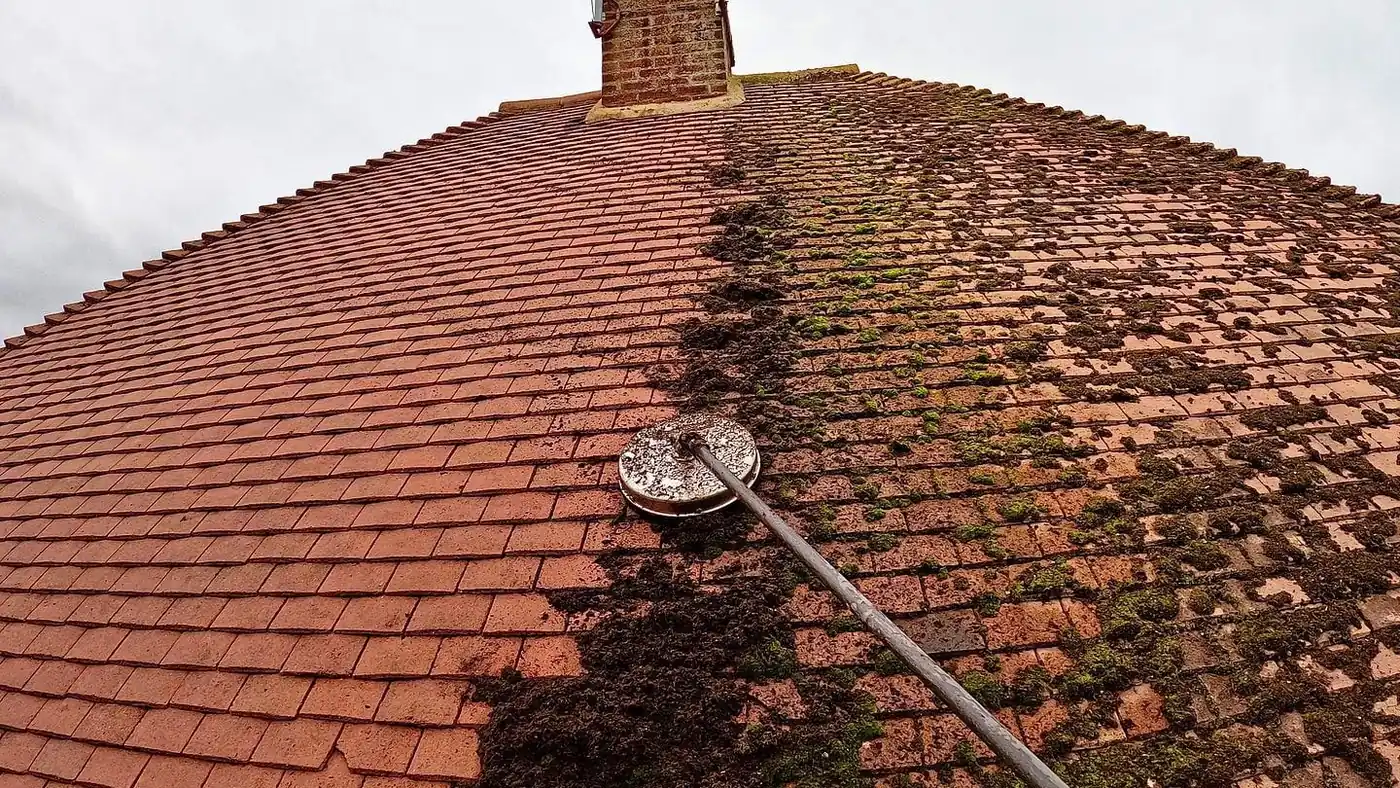
- A roof turning green
- Lichen gathering on the ridge line
- Tiles that cannot take a jet wash
Soft wash roof cleaning for homes in Donkey Street
A soft wash is roof cleaning at low pressure. A biocide goes onto the tiles gently and does the work, killing growth and the spores left behind and then holds regrowth back for a while. It suits roofs that shouldn’t see a pressure washer. If you are dealing with new moss on a roof cleaned a few years ago and tiles that need a clean without force, we can help.
Some homes in villages like Donkey Street are listed or in a conservation area, which makes gentle cleaning even more important. Cleaning doesn’t change how a roof looks, but a coating or a change of tiles can, so check with the council before anything like that.
It’s worth knowing exactly what a guarantee covers. Ours is a written 12-month workmanship guarantee, and it covers the quality of our work. Nobody can honestly promise that growth or dirt won’t come back outdoors, so we do not.
- Where
- Donkey Street (TN29)
- Wider area
- Kent
- Our guarantee
- 12 months on workmanship, in writing
- Quotes
- Fixed price, set before we begin
- Experience
- Checkatrade member with 20 years’ experience
- Phone
- 01342 344 936
- Page updated
- 30 October 2026
What soft wash roof cleaning can’t fix
Some problems need a different service or another trade:
- An instant finish on the day (dead growth weathers away over time)
- Colour lost over years of exposure
- Damaged tiles
If you are not sure, just send a message through our quote form, or phone us on 01342 344 936 and we will give you a straight answer.
What we clean
- Natural slate
- Shaded roof slopes
- Clay tiles
- Concrete tiles
- Ridge and hip tiles
- Fibre cement slates
What we are called out for in Donkey Street
Run-off from mossy areas carries spores down the roof. Lines of algae trace the path water takes so the lower courses often look worst.
Look out for these signs:
- New moss on a roof cleaned a few years ago
- A tired, stained roof before a sale
- Crusty growth along ridge and hip tiles
- Algae spreading across a north-facing slope
Around Tolsford Hill, roughly 4.8 miles north-east of Donkey Street, gardens often border trees and hedges, and that brings shade. Shade slows how quickly a roof dries, and a roof that stays damp suits moss.
What your quote should include
- What insurance they carry
- Whether the workmanship is guaranteed in writing
- Exactly what’s included, area by area
- Whether the figure could change on the day
Part by part
Natural slate
We brush heavy moss from slate before treating. The soft wash then deals with what remains to hold growth back.
Fibre cement slates
Fibre cement slates are looked at closely before any soft wash. Older fibre cement slates may contain asbestos and need a careful, low-impact approach and we’ll give you honest advice.
What’s safe to do yourself
Shop-bought moss treatments are an option for some surfaces, but check the product is authorised for that use and follow the label exactly. On a roof, applying it carries the same height risks as any roof work, and it must be kept away from drains and ponds.
Some jobs are fine to do yourself, from the ground: check the roof from the garden each year, keep paths and gullies clear of fallen moss and watch how the gutters cope in heavy rain. Anything higher than that is best left to us.
Looking after it afterwards
Here’s our aftercare advice, short and simple:
- Treat early rather than late
- Keep off treated surfaces until they’ve dried
- Check gutters flow after heavy rain
- Avoid high pressure on your tiles
We clear up before we leave: protection comes up, the ground is cleaned and run-off is dealt with properly. Nothing is left to wash into surface water drains.
Clear gutters keep the eaves drier. Blocked gutters keep the bottom courses damp, so clearing them helps the whole roof.
Leave it or put it right?
Leaving algae and lichen alone is an option, as they are slower to cause trouble than thick moss. But they hold moisture on the surface and prepare the way for moss and dark streaks make the house look tired. Moss and algae hold water, and that is the start of most problems.
Where the work is at height, access can make a big difference. If a tower, scaffold or powered access is needed, it goes into the quote, and we explain why it’s needed.
Why Donkey Street homeowners choose us
- Checkatrade member
- A fixed price, not an estimate
- Access planned to suit the property
- One phone number across our whole area
Towns and villages near Donkey Street
Also in Donkey Street
How it works
At the end, you can look over the work with us if you’re in. Anything we noticed, such as a slipped tile or a blocked downpipe, is pointed out there and then. The job takes anything from a few hours to a day, depending on the size of the roof and how it’s reached. Tell us if anything blocks access to the work, from a gate to a parked car.
- First we see what’s growing and on which tiles.
- Thick moss is planned for hand removal and the price is fixed.
- We pick a dry spell and protect plants, paths and drains.
- We soft wash the roof with a biocide approved for the job.
- Run-off is managed, the site cleaned and the next few months explained.
How to prepare
- Tell us about anything you already know, such as leaks or loose tiles
- Keep pets indoors while we work
- Close windows, doors and roof lights near the work
Get a fixed quote
We don’t publish a price list, because every job is different. We look at yours first, from pictures or on a visit, and then send a fixed quote. To start, get in touch on 01342 344 936, or use the quote form.
Related advice
Donkey Street roofs and what affects them
Donkey Street lies within about 2 miles of the sea. Damp, salty air can suit lichen and algae on roofs, and lichen clings hard, so it’s usually treated with biocide and left to weather off rather than scraped. Planning matters in Donkey Street go to Folkestone and Hythe council. If your home is listed, listed building consent is needed for works that affect its special character, so check with the council before a coating or any change to how the roof looks. Donkey Street is about 57 miles from central London, well inside the area where we carry out soft wash roof cleaning across London and the South East. We’re fully insured, and our work comes with a written 12-month guarantee on our workmanship.
Around a church like Church of All Saints, the houses are often some of the oldest in the area, and clay or slate on a roof like that gets scrapers and brushes, never a jet.
Donkey Street is about 4 miles south-west of Hythe, in Kent. Soft wash roof cleaning in Donkey Street is quoted and carried out the same way as everywhere else: a fixed price first, careful work, a full clear-up and a 12-month written guarantee covering our workmanship. Our area takes in 922 places across Kent, large and small. For properties nearby, see our Maidstone page, about 26 miles away.
Here we cover the TN29 postcode area for soft wash roof cleaning. If your home is just outside Donkey Street, we cover Dymchurch (1 mile south), West Hythe (2 miles north-east), Lympne (2 miles north-east), Palmarsh (2 miles north-east) and Berwick (2 miles north-east). We also work in nearby towns such as Ashford (9 miles north-west), Dover (14 miles north-east), Folkestone (7 miles east), Hythe (4 miles north-east), Tower Hamlets (14 miles north-east) and Hawkinge (8 miles north-east).
Near you in Donkey Street
Around Donkey Street, homes near The Shepherd And Crook Public House are all within our usual area. The closest station to Donkey Street is Westenhanger station, about 3.4 miles north-east. Other landmarks nearby include Lympne Castle (1.7 miles north-east) and Hythe Museum (3.6 miles east). For a walk, there’s Tolsford Hill.
Questions from Donkey Street
Is soft wash roof cleaning any different near the coast in Donkey Street?
It can. Donkey Street is within about 2 miles of the coast. Roofs near the sea often carry lichen as well as moss, and lichen is better treated than scraped.
Do you work in villages like Donkey Street?
Yes. Villages and rural homes across the South East are part of our work, Donkey Street included. A few photos and directions help us plan the visit.
Should I do it myself?
Some things, yes, if they can be done from the ground. A yearly check from the ground and clearing up fallen moss is sensible DIY, but please don’t walk on tiles or use a jet washer on a roof.
Are you insured?
Yes. Superior Roof Cleaning is fully insured, and we can share the details if you need them.
Will the chemicals harm my garden?
Pets and plants are something we always plan for. Where a biocide is used, it’s one approved or authorised for this use in Great Britain, applied as the label says, and plants below are protected. Please keep pets indoors on the day.
What about my neighbours?
Any access over a neighbour’s land needs their permission, so it’s worth asking them early. Otherwise, we keep to your side and protect anything close by.
Which method will you use?
We use the gentlest method that works. That might be hand scraping and brushing, a low-pressure soft wash with biocide, steam, or controlled pressure on robust surfaces, chosen after we’ve looked at the surface.
My home is listed. Can you help?
Yes. Older and listed buildings get the gentlest approach, such as careful hand removal and low-pressure steam where it suits. For anything that would change the appearance, such as a coating, check with the council first, as listed building consent is needed for works that affect a listed building’s special character.