Hampshire · Roof moss removal
Roof Moss Removal in Longparish
Roof moss removal in Longparish, with your property protected throughout. We plan the access, protect the area and take the waste with us.
- A tree-shaded roof covered in moss
- Moss creeping under the tile edges
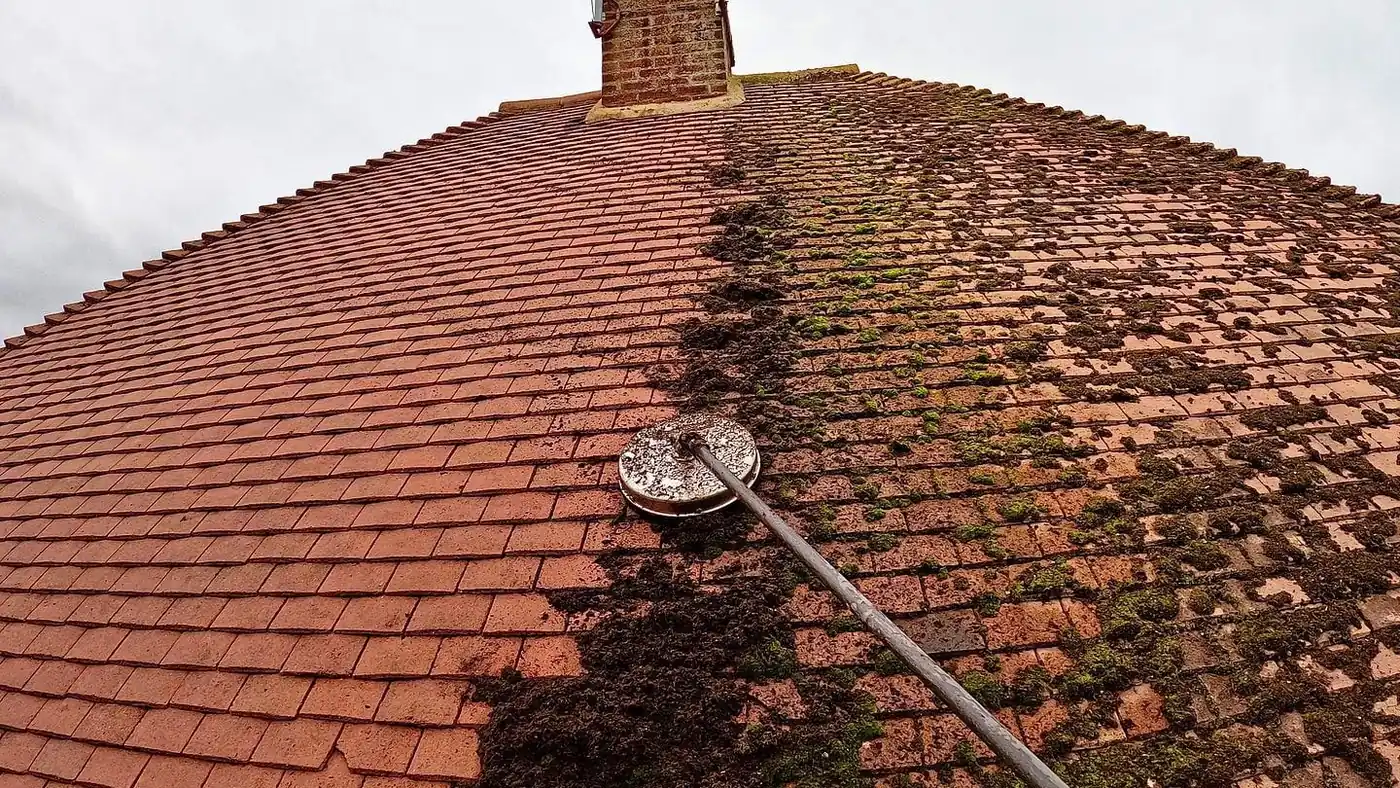
- Thick cushions of moss on the tiles
How we handle roof moss removal in Longparish
Moss doesn’t just sit on top of a roof. It soaks up rain, keeps the tiles wet, creeps into the joints and ends up in the downpipes. Hand removal deals with the moss and lets the roof dry out. The work covers verges and eaves, gutters below the roof and ridge and hip tiles, and common reasons people get in touch are moss growing in the laps and interlocks and moss bulging out from between the tiles.
In a village like Longparish, many homes are older, and clay peg tiles, handmade plain tiles and slate are often found on cottages and farmhouses. Older clay and slate need a gentle touch: hand scraping and brushing, never a jet wash.
The guarantee is not a handshake. You get a written 12-month workmanship guarantee with each job, which covers our workmanship. Keep it somewhere safe in case you need it.
- Where
- Longparish (SP11)
- Region
- Hampshire
- Our guarantee
- A written 12-month guarantee on our workmanship
- Quote
- One fixed price, quoted in advance
- Background
- Fully insured, with 20 years’ experience
- Phone
- 01342 344 936
- Updated
- 30 October 2026
Keeping it in good shape
Aftercare is simple, and it helps at the next visit:
- Do not blast moss off with a pressure washer
- Stay off the roof yourself
- Do not wash fallen moss into the gullies
- Think about treating the roof once the moss is off
The work is covered by a 12-month workmanship guarantee in writing. It covers how we did the job, not whether moss returns, since spores keep landing on every roof.
The SPAB recommends a seasonal brushing down to control the build-up of moss. It needs safe access, so it suits some roofs better than others and small amounts are far easier to shift.
What roof moss removal can’t fix
A few issues sit outside what this work can do:
- Leaks from flashing, felt or underlay problems
- Faded colour on aged tiles
- Lichen bonded to the tile surface
Not sure which it is? You can call 01342 344 936 or send a few lines through the quote form and we will tell you honestly before you book.
What the work covers
- Verges and eaves
- Valleys
- Tile interlocks and laps
- Moss on the tile courses
- Gutters below the roof
- Ridge and hip tiles
Also near Longparish
Also in Longparish
Roof moss removal in Longparish: the local picture
There are about 6 areas of ancient woodland within two miles of Longparish, the nearest being Harewood Peak, about 1.1 miles north-west of Longparish. A roof close to old woodland often dries slowly after rain, which gives moss the damp it needs. Longparish is about 59 miles from central London, well inside the area where we carry out roof moss removal across London and the South East. With 20 years’ experience, we’re fully insured and a Checkatrade member.
If your home is near Longparish Church of England Primary School or another school, the school run can fill the road twice a day. A quick note about it when you book helps us plan where to unload. Living near Mill Lake, 4.8 miles west of Longparish, can mean more trees, shade and leaf fall. Shade slows how quickly a roof dries, and a roof that stays damp suits moss.
Longparish is about 5 miles east of Andover, in Hampshire. Whatever kind of property you have in Longparish, roof moss removal is something we can help with. One number covers every area we work in, so booking is simple. Longparish is one of 683 towns, villages and districts in Hampshire where we work for homeowners and landlords. There’s also a page for Reading, roughly 25 miles from Longparish.
Every address in SP11 is within our area for roof moss removal, from busy streets to back roads. If you need roof moss removal at a property on Mill Lane and Southside Road or anywhere close by, we can take on the work. Other places close to Longparish include Middleton (1 mile west), Barton Stacey (2 miles south), Egypt (3 miles south-east), Sutton Scotney (3 miles south-east) and Hunton (4 miles south-east). Further out, we also cover Basingstoke (13 miles east), Winchester (10 miles south), Andover (5 miles west), Chandler's Ford (14 miles south), Romsey (15 miles south) and Tadley (15 miles north-east).
Around Longparish
Around Longparish, homes near The Cricketers Inn are on our patch, like the rest of Longparish. The closest station to Longparish is Whitchurch (Hampshire) station, roughly 3.5 miles north-east. A little further out are Finkley Down Farm Museum (3.6 miles north-west). Not far away are Anton Lakes and Mill Lake.
Why it’s worth doing now in Longparish
Moss left in place keeps holding water against the tiles. Wienerberger notes it can block water channels in interlocks and crack ridge mortar, and damp makes clay tiles in particular more prone to delamination. Taking it off is the straightforward answer. On older homes, original tiles, render and paving can be hard to match, so caring for what’s there makes sense.
Where the work is at height, access can make a big difference. Anything beyond ladders, such as a tower, scaffold or powered access, is built into the quote, and we explain why it’s needed.
What you get with us
- We take the waste with us
- Every job backed by a 12-month workmanship guarantee in writing
- Sludge and dirty water kept out of surface water drains
- 20 years’ experience in roof and exterior cleaning
See how roof cleaning is priced or how we choose the method.
Common questions in Longparish
Who should I ask about a listed home in Longparish?
The council to speak to is Test Valley council. The council’s conservation officer can say whether your home is listed and what needs consent. If your home is listed, listed building consent is needed for works that affect its special character, so check with the council before a coating or any change to how the roof looks.
We have trees close to the house in Longparish. Does that matter?
Typically, yes. Harewood Peak, an ancient wood, is some 1.1 miles north-west of Longparish. Trees mean shade and leaf litter, so moss normally comes back sooner and gutters fill faster.
Can letting agents book you?
Yes. Let us know who to contact and how to reach the tenant, and we will arrange the visit. Anything we notice is passed on to whoever booked the work.
How do you choose the method?
The surface decides it. Clay, slate and older tiles are cleaned by hand or at low pressure, robust concrete tiles may take controlled pressure after a check, and solar panels get soft brushes and clean water. We explain our choice before booking.
Will you jet wash it?
Not by default. We use the gentlest method that works: hand scraping, soft wash or steam for most roofs, with pressure kept for surfaces that can take it. High pressure can damage tile finishes, strip colour from concrete tiles and force water under the laps.
Is it safe to do it myself?
Ground-level jobs, yes; roof work, no. Keeping an eye on the roof and gutters and sweeping up fallen moss is sensible, but walking on tiles or jet washing a roof can do real damage.
Will moss removal damage my tiles?
Our hand method is chosen to protect the tiles. Scrapers and brushes lift the moss without forcing water under the tiles and if we find damaged tiles, we’ll tell you.
Do you cover Longparish?
Yes. Our area takes in London and the counties of the South East, Longparish included.
What we do, step by step
We arrive at the time agreed with you and take a look around before anything else. Anything below or beside the work is protected first, from plants and paths to cars and windows. The work itself takes a morning on a small, lightly mossed roof and two or three days on a big, thickly covered one. Tell us if anything blocks access to the work, from a gate to a parked car.
- We look at how much moss there is and what the tiles are.
- A fixed quote is agreed, with any biocide follow-up included if you want it.
- We protect the ground below and set up safe access.
- By hand, the moss is scraped and brushed from the tiles and bagged.
- We clear the gutters of the moss we remove and take the bags away.
How to prepare
- Have a word with next door if access is shared
- Let us know about anything fragile below, like a glass roof
- Let us know where we can park
Pricing your job
We do not publish a price list, because each job is different. Instead, we see the job first, from pictures or in person, and then send a fixed quote. To get going, get in touch by phone on 01342 344 936, or through the quote form.
Related advice
When to call us in Longparish
Damp is what moss needs most. Spores carried on the wind settle in the texture of the tiles and wherever the tiles stay wet, they take hold.
Things you may spot from the ground include:
- Moss on a porch, bay or extension roof
- Moss returning a few years after cleaning
- Downpipes clogged by moss washed off the roof
- Tile joints hidden under moss
If you live near Church of St Nicholas, or on any of the older streets in Longparish, your roof may be clay or slate, which is cleaned gently by hand.
Comparing quotes
- Which treatment they’ll apply, if any
- Exactly what’s included, area by area
- Whether they’ll use hand removal, soft wash, steam or pressure
- Who clears up afterwards
What the work involves, part by part
Concrete tiles
Even on tough concrete tiles, moss comes off by hand first. Controlled pressure is only considered on robust tiles after a check since high pressure can take the colour off.
Clay tiles
Moss on clay tiles is always removed by hand. Damp makes clay tiles in particular more prone to delamination, Wienerberger notes, so the moss needs to come off, but gently.
What’s safe to do yourself
If you do use a ladder for a quick look, make sure it’s on firm, level ground, footed or tied, and do not overreach. Never step off it onto the roof and never do it on your own.
Scraping moss off sounds simple, but technique matters. Lichen in particular clings hard, and forcing it off can mark the tile surface, which is why it’s usually treated and left to weather away. Leave the roof to someone with the right access.