East Sussex · Roof moss removal
Moss removal in Cackle Street
Roof moss removal in Cackle Street, with a fixed quote before work begins. Checkatrade member, fully insured, with 20 years’ experience.
- Moss scattered across paths after wind or rain
- Moss returning a few years after cleaning
- A tree-shaded roof covered in moss
When it’s something else
Before you book, it helps to know what’s not included:
- Staining and fading from years of weather
- Missing tiles
- Leaks from flashing, felt or underlay problems
If in doubt, pick up the phone and call 01342 344 936, or use the quote form and we will say what we think before booking.
What the work covers
- Moss on the tile courses
- Tile interlocks and laps
- Ridge and hip tiles
- Valleys
- Verges and eaves
- Gutters below the roof
Roof moss removal for homes in Cackle Street
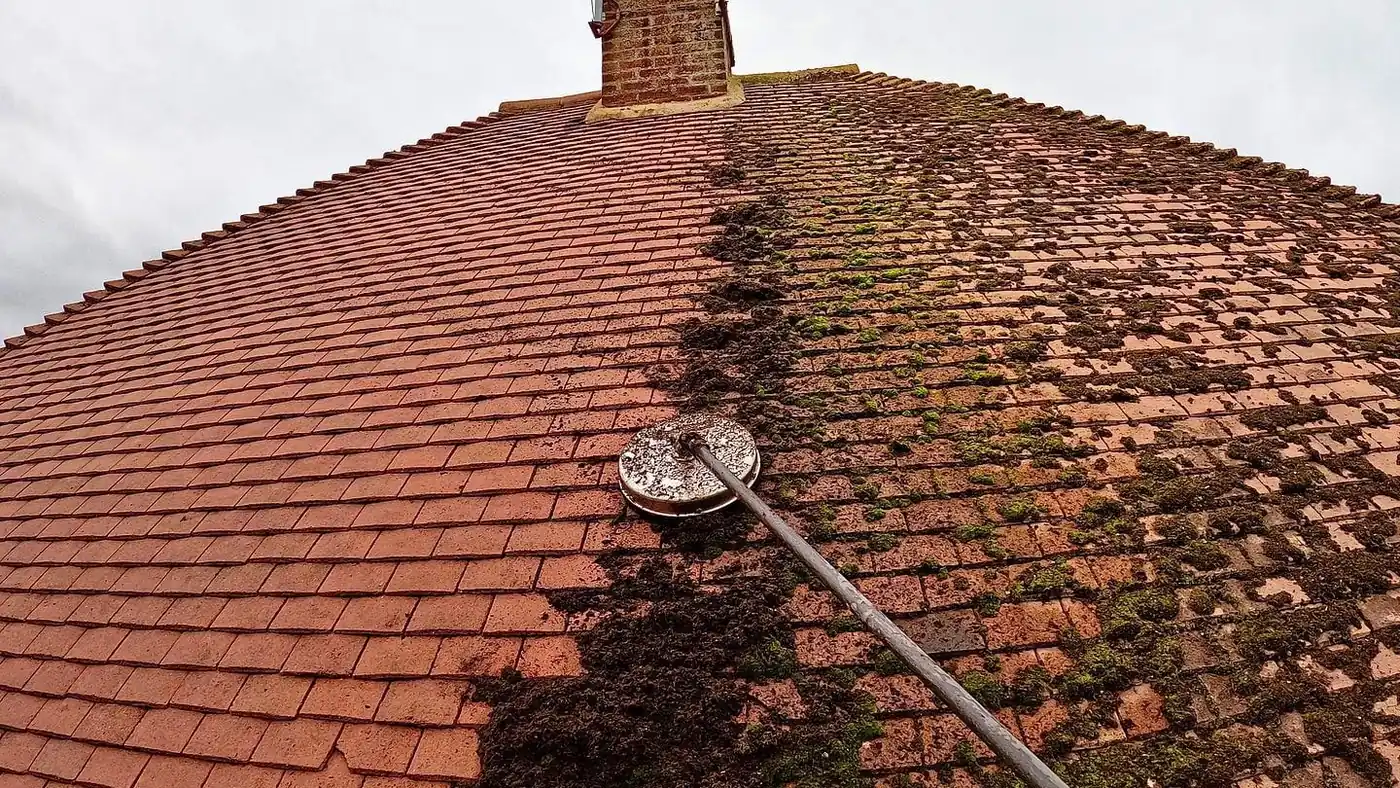
Plenty of roofs look in a bad way under a coat of moss. Once the moss is off, you can see the tiles clearly, and any slipped or cracked tiles can be dealt with before they cause a leak. Repairs are always quoted separately. The work covers moss on the tile courses, gutters below the roof and tile interlocks and laps, and people most often call us about moss packed between the tiles and gutters blocked with moss.
Long drives, lanes and big gardens are part of working in a village like Cackle Street, so tell us about the route and where we can park when you book. Mature trees around a home in a village like Cackle Street tend to mean heavier moss and fuller gutters.
There are two kinds of protection when we work for you. We are fully insured while we’re on site, and afterwards a written 12-month workmanship guarantee covers our workmanship.
- Location
- Cackle Street (TN31)
- Region
- East Sussex
- Our guarantee
- 12 months on workmanship, in writing
- Price
- Fixed price, set before we begin
- Experience
- 20 years’ experience, fully insured
- Call
- 01342 344 936
- Checked
- 30 October 2026
Cackle Street questions
Who do I check with about listed building consent in Cackle Street?
That’s Rother council. The council’s conservation officer can say whether your home is listed and what needs consent. A plain clean leaves a roof looking as it did; a coating or new tiles on a listed home are matters for the council.
Does tree cover around Cackle Street affect roof moss removal?
Trees can make a real difference. Ancient woodland such as Mount Ephraim Shaw lies roughly 0.2 miles south-west of Cackle Street. Leaves on the tiles and shade over the roof both keep it damp, and damp is what moss needs.
How do you choose the method?
The gentlest method that does the job is always our starting point. That might be hand scraping and brushing, a low-pressure soft wash with biocide, steam, or controlled pressure on robust surfaces, chosen after we have looked at the surface.
Where does the waste go?
We bag what we remove and take it away with us, from moss and leaves to silt and broken tiles. None of it is left on site.
Will the work affect next door?
Any access over a neighbour’s land needs their permission, so please ask them in advance. Otherwise, we keep to your side with anything nearby protected.
Can a spray deal with roof moss on its own?
With light growth, a biocide alone can do the job. Heavy moss is scraped off by hand, then the roof can be treated to slow regrowth.
Could the price change on the day?
Our quotes are fixed rather than a rough estimate. That’s why we look at the job properly first, from photos or on a visit.
What time of year is best for moss removal?
Spring and autumn are popular, but moss can be removed for most of the year in dry weather. We avoid frost, heavy rain and high wind, and we check for nesting birds first, since active nests are protected by law.
Roof moss removal around Cackle Street: what to know
Mount Ephraim Shaw, some 0.2 miles south-west of Cackle Street, is the nearest of about 70 ancient woods within a couple of miles of Cackle Street. Tree cover means shade, and shade means moss, so a roof near woods may need cleaning more frequently. Older buildings in the area include Durhamford Manor, about 3.1 miles west of Cackle Street. Old roofs like those last because they are maintained, and gentle cleaning is part of that. Cackle Street lies roughly 49 miles from central London, comfortably inside the patch we cover. With 20 years’ experience, we are fully insured and a Checkatrade member.
Streets near stations such as Doleham station, 1.6 miles south-east of Cackle Street, can be busy with commuter parking, so tell us where a van can park when you book. If your home backs onto green space such as Flatropers Wood, roughly 3.7 miles north-east of Cackle Street, you’re likely to see more shade, leaves and bird droppings. Where a slope gets little sun, moss usually comes back quicker after a clean.
Cackle Street is about 5 miles north of Hastings, in East Sussex. From the centre of Cackle Street to the outskirts, roof moss removal is available for all kinds of property, from a terrace to a large detached house. We cover 289 places across East Sussex, from busy towns to small villages. For properties nearby, see our Royal Tunbridge Wells page (20 miles or so).
Work in TN31 follows the same fixed quote, careful work and written 12-month workmanship guarantee as everywhere else we cover. Local streets include Cackle Street, St Marys Close and Pottery Lane, and we cover them all for roof moss removal. Nearby, we also carry out roof moss removal in Brede (1 mile south), Westfield (2 miles south), Sedlescombe (3 miles west), Mill Corner (3 miles north) and Kent Street (3 miles south-west). Larger places within reach include Hastings (5 miles south), Bexhill-on-Sea (8 miles south-west), St Leonards (6 miles south), Hastings Old Town (6 miles south), Belmont (6 miles south) and Heathfield (15 miles west).
Landmarks near Cackle Street
Properties near The Red Lion Public House fall within our area as well. The nearest railway station is Doleham station, roughly 1.6 miles south-east of the centre. Other landmarks nearby include Barn Theatre and Museum (3 miles south). The countryside around Cackle Street includes Senlac Hill and Flatropers Wood.
What’s safe to do yourself
Cleaning solar panels yourself is rarely worth the risk. Follow the panel maker’s care guidance, and do not use a pressure washer or harsh chemicals. Most panels sit on a roof, so the same height warnings apply.
There are still useful things you can do from the ground: check the roof from the garden each year, keep paths and gullies clear of fallen moss and watch how the gutters cope in heavy rain. Anything at height is best left to a professional.
Signs you need roof moss removal in Cackle Street
Roof moss tends to grow in dense, rounded cushions. Those cushions hold water and grit so every clump makes the next one easier.
Most people get in touch after spotting one of these:
- Moss thriving on a roof that gets little sun
- Downpipes clogged by moss washed off the roof
- Moss scattered across paths after wind or rain
- Moss returning a few years after cleaning
If you live near The Parish Church of St George, or on any of the older streets in Cackle Street, your roof may be clay or slate, which is cleaned gently by hand.
What to look for in a quote
- If the quote is a fixed price or an estimate
- Whether extra work needs your agreement
- Exactly what’s included, area by area
- How they’ll protect your property and control run-off
Why act early in Cackle Street
A roof without moss can dry, drain and be checked. Rain runs off into the gutters as it should and damage that was hidden can be seen. That’s the real benefit of doing it properly. The longer growth is left, the longer surfaces stay wet.
Where the work is at height, access can make a big difference. Anything beyond ladders, such as a tower, scaffold or powered access, is built into the quote, and we explain why it’s needed.
Why choose Superior Roof Cleaning in Cackle Street
- A fixed price, not an estimate
- Fully insured
- A Checkatrade member
- A written 12-month guarantee on our workmanship
Take a look at how our quotes work or how we choose the method.
Different parts, different methods
Fibre cement slates
We look closely at fibre cement slates first. Older fibre cement slates may contain asbestos and need a careful, low-impact approach, and we’ll advise on what’s suitable.
Clay tiles
Plain clay tiles overlap closely, and moss works into the laps. Each lap is worked clear by hand, never with pressure.
What happens on the day
We bring everything the job needs, including covers, tools and whatever access the work calls for. You just need to give us clear access and space to park nearby. The job takes longer on a big, heavily mossed roof than on a small one with light growth, from a few hours to a few days. Plants, borders and anything below the work are protected before any work starts.
- First we look at the roof, from the ground, from photos or on a visit.
- We check for nesting birds, as they’re protected by law.
- Access is chosen to suit the roof, and the ground below is covered.
- By hand, never by jet wash, the moss is lifted from every slope.
- We clear up, take the moss away and walk you through the result.
Before we arrive
- Let us know about any pets, and keep them inside on the day
- Tell us about any conservatory, glass roof or extension below the work
- Let neighbours know if we’ll be near a shared boundary or drive
Get a fixed quote
Photos are often the quickest route to a quote: a wide shot of the whole area, a closer one of the worst part and one showing how we’d get to it. Please take them from the ground, never from a ladder.
Advice
Keeping it in good shape
Nothing outdoors stays clean for ever, but care slows the build-up. A few tips:
- Keep high pressure away from your tiles
- Let more sun reach the tiles
- Keep gutters and downpipes running freely
- Sweep up fallen moss so it does not block drains
You get a written guarantee on our workmanship for 12 months. It covers how we did the job, not whether moss returns, since spores keep landing on every roof.
Keep gutters, valleys and downpipes clear. Blocked gutters keep the bottom courses wet, and that’s where moss often grows thickest.