Hampshire · Roof cleaning
Roof cleaning in Lower Swanwick, Hampshire
For roof cleaning and moss removal by hand, with soft washing or steam where they suit the tiles in Lower Swanwick, one call is all it takes, from quote to clear-up. Checkatrade member and fully insured.
- Moss creeping under the tile edges
- Growth gathering behind the chimney stack
- Moss landing on the patio and car
Roof cleaning in Lower Swanwick
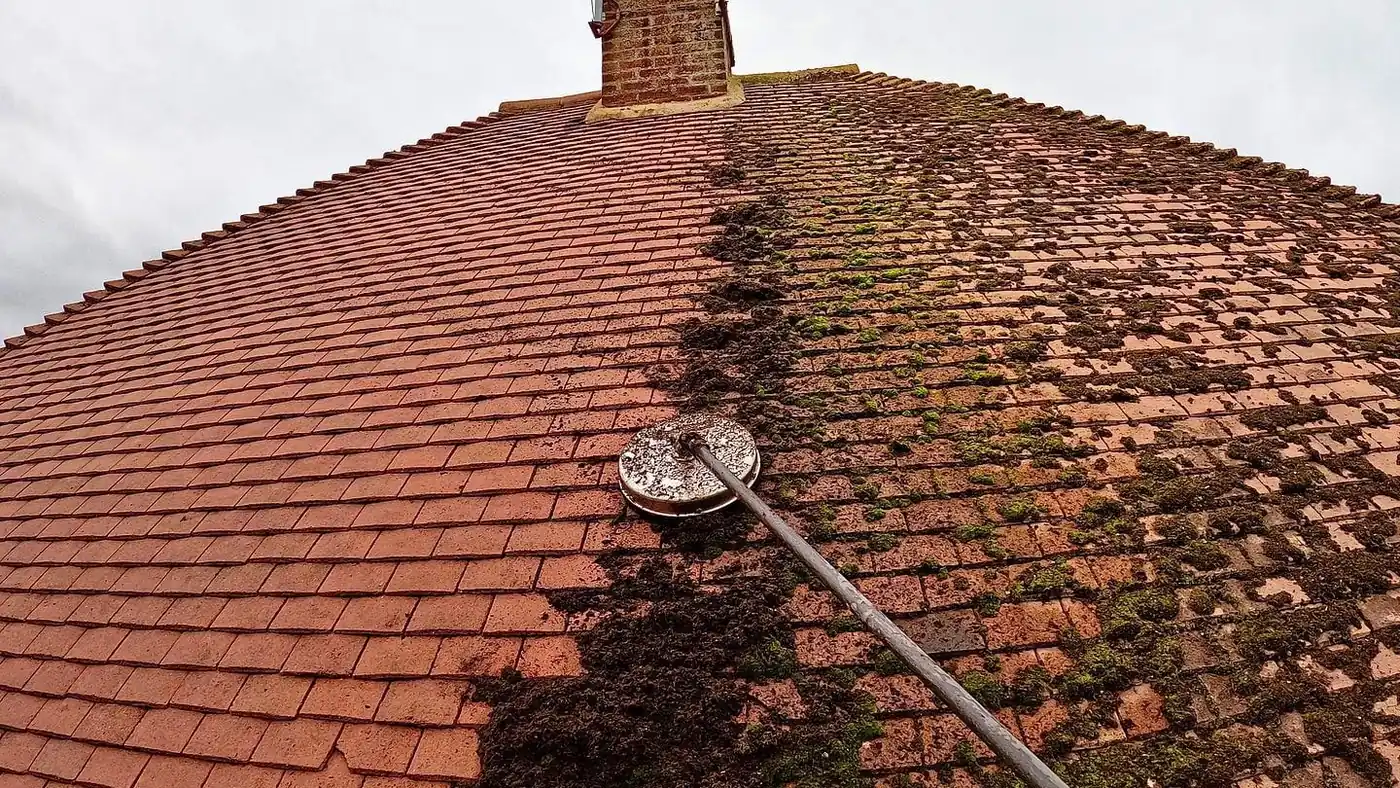
Homeowners in Lower Swanwick tend to call us for a handful of practical reasons: gutters that keep overflowing, a sale coming up, or moss that’s clearly getting worse. Whatever the reason, the job follows the same careful routine: look first, protect below, clean gently, clear up. If you have the shaded side of the roof covered in growth and green algae and black streaks on the tiles, we can put it right. For roof cleaning and moss removal in Lower Swanwick, the first step is a fixed quote and a written 12-month workmanship guarantee on the work.
After the moss is off, a biocide can be applied by soft wash, at low pressure so the spores left behind are killed and regrowth is slowed. It slows regrowth rather than stopping it for good, and how long it lasts depends on shade and aspect.
Some homes in villages like Lower Swanwick are listed or in a conservation area, which makes gentle cleaning even more important. Cleaning does not change how a roof looks, but a coating or a change of tiles can, so check with the council before anything like that.
Each job gets the benefit of 20 years’ experience, and we are fully insured and Checkatrade members. Each job also carries a written 12-month workmanship guarantee, set down in writing.
- Location
- Lower Swanwick (SO31)
- Wider area
- Hampshire
- Guarantee
- 12-month workmanship guarantee, in writing
- Quote
- Fixed, not estimated
- Track record
- Two decades in the trade, fully insured
- Phone
- 01342 344 936
- Updated
- 30 October 2026
For landlords and letting agents
It helps if tenants know we are coming, so cars can be moved and pets kept in. The date can be agreed with you or with the tenant, whichever is easier.
Empty periods between tenancies or holiday bookings suit outside work well because access is easy then. Tell us the dates you have and we will do our best to fit the work in.
Honest limits
Every service has its limits, and it’s fair to set them out:
- Colour loss and weathering from years of exposure
- Damp from a problem under the tiles
- Damaged tiles, which cleaning will not mend
If in doubt, send details through the quote form, or phone us on 01342 344 936 and we’ll say what we think.
What the work covers
- Natural slate
- Valleys and verges
- Concrete interlocking tiles
- Plain clay tiles
- Ridge and hip tiles
- Fibre cement slates
How it works
Weather matters for most outdoor work. If frost, heavy rain or strong wind is forecast, we may suggest another day, as safety and the result come first. Once we’re under way, the job takes one to two days for many homes, depending on the roof, the access and how much moss there is. Tell us about the route to your home in Lower Swanwick, especially narrow lanes or gates.
- It starts with a look at the roof, so we know the tiles and their condition before we quote.
- You get a fixed quote and an agreed method that suits the tiles.
- On the day, we set up access to suit the roof and cover what’s underneath.
- The growth comes off by hand first, then the agreed wash, steam or biocide follows.
- The moss is cleared from the gutters, the site is tidied and we talk you through the finished roof.
Helping the day go smoothly
- Mention any nests you know about
- Tell us about anything you already know, such as leaks or loose tiles
- Make sure we can get to the side and back of the property
Getting a quote
There’s no standard price list, because every job is different. We look at yours first, from pictures or on a visit, then give you a fixed quote. To get going, reach us by phone on 01342 344 936, or by the quote form.
Read more
What roof cleaning looks like in Lower Swanwick
Lower Swanwick is within about 2 miles of the coast. Wind off the sea drives rain into a roof, and the damp that follows suits algae and lichen as much as moss. Lower Swanwick has about 21 areas of ancient woodland within two miles, the closest being Catland/Fosters/Bottom Copses, roughly 0.7 miles north of Lower Swanwick. If your roof is shaded by trees, it will stay damp for longer and moss will usually come back sooner than on an open roof. Older buildings in the area include Medieval Merchant's House, about 4.8 miles west of Lower Swanwick. Buildings like that show how long clay and slate roofs can last when they are looked after.
Roads near schools such as Bursledon Church of England Infant School can be busy at drop-off and pick-up. A quick note about it when you book helps us plan where to unload. Living near Swanwick Lakes, 0.7 miles east of Lower Swanwick, can mean more trees, shade and leaf fall. Moss grows fastest on shaded, damp slopes. Around a church like Church of St Leonard, the houses are often some of the oldest in the area, and clay or slate on a roof like that gets scrapers and brushes, never a jet.
Lower Swanwick is about 2 miles west of Whiteley, in Hampshire. If you need roof cleaning in Lower Swanwick, it’s easy to get a fixed quote: please speak to us on 01342 344 936 or fill in the quote form. We work across London and the South East, Lower Swanwick included. Lower Swanwick is one of 683 places in Hampshire where we work for roof cleaning. For properties nearby, see our Guildford page, about 40 miles away.
Here we cover the SO31 postcode area for roof cleaning. You’ll find streets such as Green Lane, Bridge Road and Station Road, all of which we cover for roof cleaning. Other places close to Lower Swanwick include Swanwick (1 mile south-east), Sarisbury (1 mile south-east), Sarisbury Green (1 mile south), Park Gate (2 miles south-east) and Burridge (2 miles east). Further out, we also cover Winchester (12 miles north), Gosport (8 miles south-east), Havant (14 miles east), Eastleigh (6 miles north), Fareham (5 miles south-east) and Horndean (13 miles east).
Local landmarks in Lower Swanwick
In Lower Swanwick, the houses around Brookfield Community School and Language College and The Old Ship Inn are all part of the area we cover. Lower Swanwick has its own railway station: Bursledon station. A little further out are St Andrew's Castle (2.4 miles south) and Bursledon Brickworks Industrial Museum (less than half a mile north-east). For a walk, there’s Swanwick Lakes.
What’s safe to do yourself
It’s easy to damage a surface while scraping moss. Lichen in particular clings hard, and forcing it off can mark the tile surface, so it’s better treated and allowed to weather off. For the roof itself, it’s safer to call us.
You can buy moss and algae treatments yourself, but only use one authorised for that job and follow the label to the letter. Applying it to a roof still means working at height, and it must be kept away from drains and ponds.
FAQs for Lower Swanwick
My house in Lower Swanwick is in a conservation area. What should I know?
For a clean, very little beyond our usual gentle approach; anything that changes the roof’s appearance is a question for Fareham council. The nearest to Lower Swanwick is the Swanwick Shore conservation area, roughly 0.3 miles south of central Lower Swanwick.
We have trees close to the house in Lower Swanwick. Does that matter?
Trees can make a real difference. The nearest ancient woodland to Lower Swanwick is Catland/Fosters/Bottom Copses, about 0.7 miles north of Lower Swanwick. Shade keeps a roof damp, and moss grows best on damp, shaded slopes, so roofs under trees may need cleaning more frequently.
Is Lower Swanwick in your area?
Yes. Our area takes in London and the counties of the South East, Lower Swanwick included.
When should I book roof cleaning?
Many people book in spring or autumn, but most of the year works, as long as it’s dry. We avoid frost, heavy rain and high wind, and a biocide needs a dry spell to work.
How will my roof be cleaned?
It depends on the tiles, but the gentlest method that works always comes first. Moss is scraped and brushed off by hand, then a soft wash biocide can follow. We never use pressure on clay, slate, old or fragile tiles.
Will dirty water go down the drains?
Where water is part of the job, we plan where it goes before we start. We catch debris, protect drains and keep the sludge contained, and we don’t wash sludge into the street.
What if birds are nesting nearby?
We always check for active nests before we start, because the law protects them. An active nest means that part of the job waits until the nest is no longer in use, and we will talk you through the options.
How do you decide on the method?
The gentlest method that does the job is always our starting point. That might be hand scraping and brushing, a low-pressure soft wash with biocide, steam, or controlled pressure on robust surfaces, depending on what we find.
More services for Lower Swanwick
What affects the quote in Lower Swanwick
Some jobs are bigger than they look from the street, and some are smaller. What affects the quote:
- Height and roof pitch
- The amount of build-up
- Tile or surface type, and its condition
- Extras such as gutter clearing or a biocide treatment
One house or several rental properties, we price it on the same basis: what needs doing, how we reach it and how long it takes. The price is fixed before we start.
Helping us quote
Before you ask for a quote, gather:
- The route round the side or back of the property
- Any signs of trouble, from cracked tiles to blocked downpipes
- Whether the building is listed
- Anything below the work, such as a conservatory, porch or extension
The quickest way to a quote is often a few photos: a wide shot of the whole area, a closer one of the worst part and one showing how we’d get to it. Please take them from the ground, never from a ladder.
How the job changes from site to site
Historic and listed roofs
Old roofs often have handmade tiles, old fixings and fragile mortar. Every step is careful and unhurried, and we point out anything that needs a roofer’s attention.
Natural slate
Slates can crack underfoot and lift if water is forced under them. Access is planned to keep weight off the slates and jet washing is ruled out.
Between visits
Aftercare is simple, and it makes the next visit easier:
- Clear small patches before they spread
- Think about a soft wash biocide after the clean
- Keep high pressure away from your tiles
- Leave roof access to people with the right equipment
You will see the difference on the day. Weathering, old staining and colour loss from years of exposure do not always come out completely, and we’d rather tell you that than overpromise.
Copper strips or sacrificial lead at drip points can inhibit growth, according to the SPAB. Rainwater running over the metal carries traces down the slope, which some roofs benefit from.