Kent · Biocide roof treatment
Biocide roof treatment in Wierton, Kent
For biocide roof treatment in Wierton, one call is all it takes: quote, work and clear-up. Checkatrade member and fully insured.
- Growth on tiles too fragile to scrape hard
- Black streaks down the slopes
- Moss returning after a clean
Roof biocide treatment for homes in Wierton
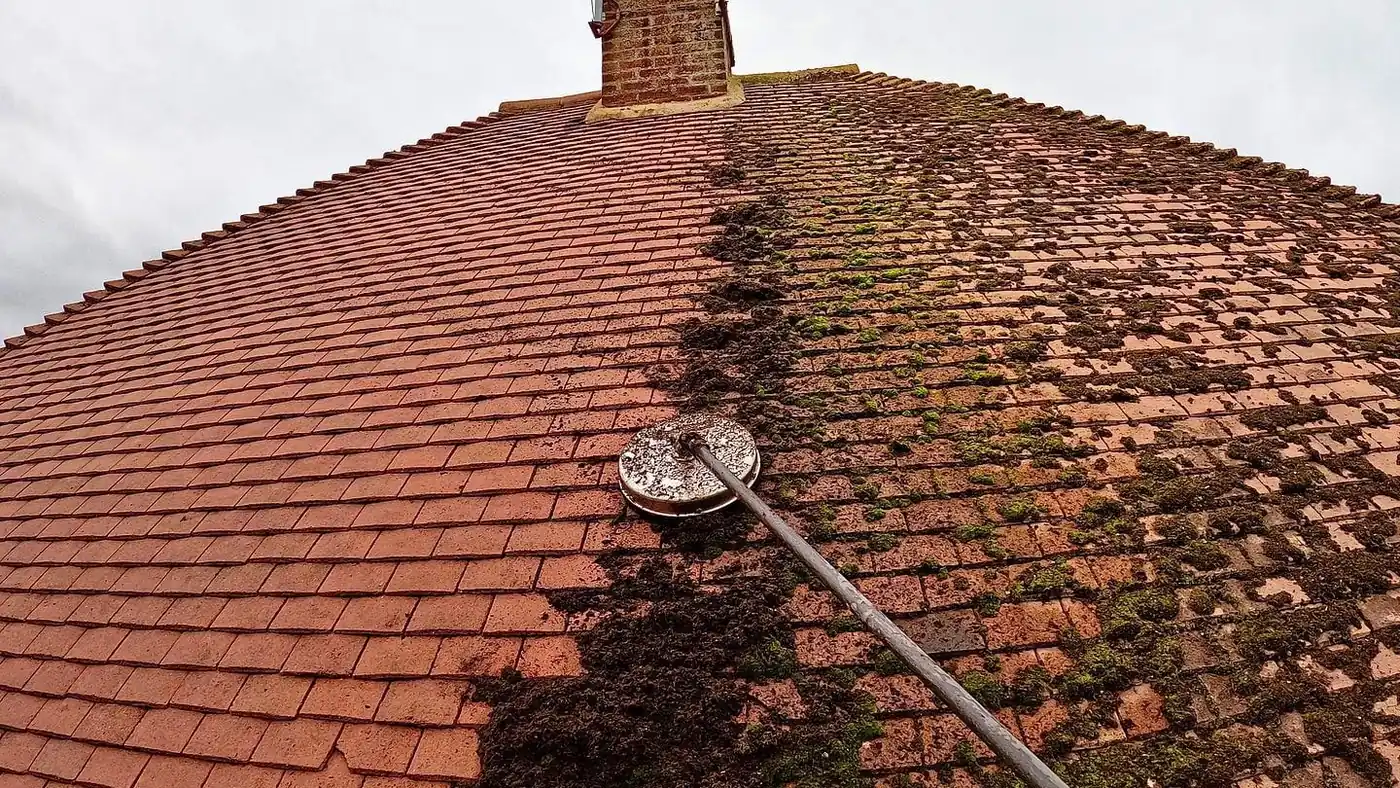
Lichen is the growth that most often needs a biocide. Trying to scrape it away risks marking the tiles, so we treat it instead and let the weather finish the job. It fades over the following months. Typical jobs include growth on tiles too fragile to scrape hard and a roof cleaned a few years ago that needs retreating, on shaded roof slopes, roofs cleaned by hand and ridge and hip tiles.
Villages like Wierton often include older cottages and barns with clay tiles or slate, alongside newer houses. Old clay tiles in particular can flake when they stay damp, so they’re cleaned by hand, gently, with no pressure washing.
Every job gets the benefit of 20 years’ experience, and we’re fully insured and Checkatrade members. Each job also carries a written 12-month workmanship guarantee, so there’s something in writing if you need it.
- Where
- Wierton (ME17)
- Region
- Kent
- Cover
- Written 12-month workmanship guarantee
- Quotes
- One fixed price, quoted in advance
- Track record
- 20 years’ experience, fully insured
- Call
- 01342 344 936
- Last updated
- 30 October 2026
DIY or a professional?
Working on a roof is risky, and not only for amateurs. HSE says almost one in five deaths in construction work involve roof work, and its advice is to treat every roof as fragile until a competent person says otherwise. If the job means climbing onto a roof, please leave it to a professional.
It’s easy to damage a surface while scraping moss. Lichen grips tightly, so scraping it can damage the tile, so it’s better treated and allowed to weather off. For the roof itself, it’s safer to call us.
More services for Wierton
Roof biocide treatment in Wierton: the local picture
River Wood, about 1.1 miles west of Wierton, is the nearest of about 13 ancient woods within a couple of miles of Wierton. Tree cover means shade, and shade means moss, so a roof near woods may need cleaning more frequently. Older buildings in the area include Stoneacre, about 2.5 miles north-east of Wierton. Old roofs like those last because they are maintained, and gentle cleaning is part of that. About 34 miles out from central London, Wierton is part of the South East area where we carry out roof biocide treatment. Our 20 years’ experience and full insurance stand behind every job.
Homes on school roads, near Boughton Monchelsea Primary School for instance, can face busy mornings and afternoons. A quick note about it when you book helps us plan where to unload. Streets near a church such as Church of St Peter often include older homes, and older clay or slate roofs need hand cleaning rather than pressure.
Wierton is about 3 miles south of Maidstone, in Kent. Roof biocide treatment in Wierton is quoted and carried out the same way as everywhere else: carefully, with a fixed price and a 12-month written guarantee covering our workmanship. Wierton is one of 922 towns, villages and districts in Kent where we work for homeowners and landlords.
Every address in ME17 is within our area for roof biocide treatment, from busy streets to back roads. If you need roof biocide treatment at a property on East Hall Hill and Wierton Hill or anywhere close by, we can take on the work. We also cover the places around Wierton: Chart Sutton (1 mile north-east), Boughton Monchelsea (1 mile north-west), Boughton Green (1 mile north-west), Park Wood (1 mile north) and Five Wents (2 miles east). Further out, we also cover Maidstone (3 miles north), Ashford (15 miles east), Sittingbourne (12 miles north-east), Royal Tunbridge Wells (14 miles south-west), Tonbridge (12 miles west) and Kings Hill (7 miles north-west).
What’s near Wierton
Properties near Cornwallis Academy and The Cock Inn are all within our usual area. The closest station to Wierton is Staplehurst station, roughly 3.3 miles south. Nearby you will also find The Mall Maidstone (3.9 miles north) and Kent Fire Brigade Museum (3.2 miles north-west).
What the work involves, part by part
Natural slate
Slate is brittle and can be lifted by pressure. The treatment goes on at low pressure, with access planned to keep weight off the slates.
Historic and listed roofs
On a historic roof, a low-pressure treatment is one of the gentler options. We look at the tiles, fixings and mortar beforehand, and treat lichen rather than scraping it.
What affects the quote in Wierton
Before we fix a price, we need to know a few things. We check:
- Glass roofs, conservatories or extensions underneath
- How much moss, algae or dirt there is
- Any repairs, which are always priced separately
- Whether several jobs are done in one visit
A single home or a handful of properties, we price it on the same basis: the work involved, the access and the time on site. You’ll have a fixed price before we start.
Photos for a quote
Photos taken from the ground are often enough to price the job. The most useful are:
- Problems you’ve spotted, like loose tiles or water spilling from gutters
- Photos showing the whole area to be worked on
- How we’d get to the work, such as a side passage or back garden
- Whether the building is listed
The quickest way to a quote is often a few photos: the whole area, the worst patches and the way in. Please take them from the ground, never from a ladder.
Keeping it in good shape
How long the results last depends on shade, damp and care. We suggest:
- Keep gutters running freely
- Judge the result after a few months, not a few days
- Don’t rinse the roof after treatment
- Retreat when regrowth first appears
Your treatment comes with a 12-month workmanship guarantee in writing. It’s about our workmanship, not a promise that growth will not return, since no biocide is permanent.
Clear drainage helps the treated roof. Water backing up keeps the eaves damp, which is where regrowth often starts.
For landlords and letting agents
If you look after several properties, we can quote for them together. Every address is priced on its own job, so you can see what each one involves.
It helps if tenants know we are coming, so cars can be moved and pets kept in. The date can be agreed with you or with the tenant, whichever works best.
What we do, step by step
At the end, you can look over the work with us if you are in. Anything we noticed, such as a slipped tile or a blocked downpipe, is pointed out there and then. On site, the work takes an hour or two for a small roof and longer for a large one. Mention ponds, greenhouses or anything fragile near the work.
- First we decide whether to treat or clean and treat.
- You get a fixed quote and a date planned around the weather.
- Gullies and drain outlets are protected so nothing reaches surface water drains.
- We hand-clear thick moss before treating at low pressure.
- The area is cleaned down and precautions explained.
Helping the day go smoothly
- Let neighbours know if we will be near a shared boundary or drive
- Move cars off the drive and away from the work
- Leave side gates unlocked so we can reach the back
Ask for a quote
Some jobs can be priced from pictures; others need us to see them. Where access is tricky or the area is hard to see in photos, we normally come and look. Either way, you get a fixed price before we start.
Related advice
FAQs for Wierton
Do you work in villages like Wierton?
Yes, smaller places are covered as well as towns. A few photos and directions help us plan the visit.
My home in Wierton is near trees: does that matter?
Normally, yes. Ancient woodland such as River Wood lies some 1.1 miles west of Wierton. Trees mean shade and leaf litter, so moss typically comes back sooner and gutters fill faster.
What happens if there’s a nest?
Nesting birds are protected by law, so we check first. An active nest means that part of the job waits until the nest is no longer in use, and we will agree a plan with you.
Should the moss be removed before treatment?
It varies with the roof. Heavy moss blocks the treatment and ends up in the gutters as it dies, so it’s best removed first and light growth can be treated right away.
Is the price fixed?
The quote is a fixed price for the work we’ve described. Anything new we find, like hidden damage, is quoted separately, and it’s your choice whether to go ahead.
What precautions do you take with the biocide?
Protecting the area below is part of the job. Plants, paths and drains are protected, and run-off is controlled so no biocide reaches surface water drains. We will advise on pets and children on the day.
How do you decide on the method?
We use the gentlest method that works. Options include hand removal, soft washing with a biocide, low-pressure steam and, only where the surface can take it, controlled pressure, depending on what we find.
Do you work on listed or historic buildings?
Yes. We use the gentlest methods on historic roofs and walls, like hand brushing and low-pressure steam where suitable. A coating, or anything else that changes the look, needs a word with the council first, as listed building consent is needed for works that affect a listed building’s special character.
When something else is needed
Roof biocide treatment cannot fix everything, and we’d rather say so up front. It won’t put right:
- A roof that stays clear forever
- Deep moss in the interlocks
- Fading and old staining in the tile
If you’re not sure, just speak to us on 01342 344 936 or fill in the quote form and we will give you a straight answer before booking.
What the work covers
- Roofs cleaned by hand
- Algae and black streaks
- Tile and slate surfaces
- Lichen patches
- Shaded roof slopes
- Ridge and hip tiles