Greater London · Biocide roof treatment
Biocide roof treatment in Whitechapel, Greater London
Roof biocide treatment for Whitechapel and the surrounding area: a look at the job, a fixed price, the right method and a proper clear-up. Call for a fixed quote.
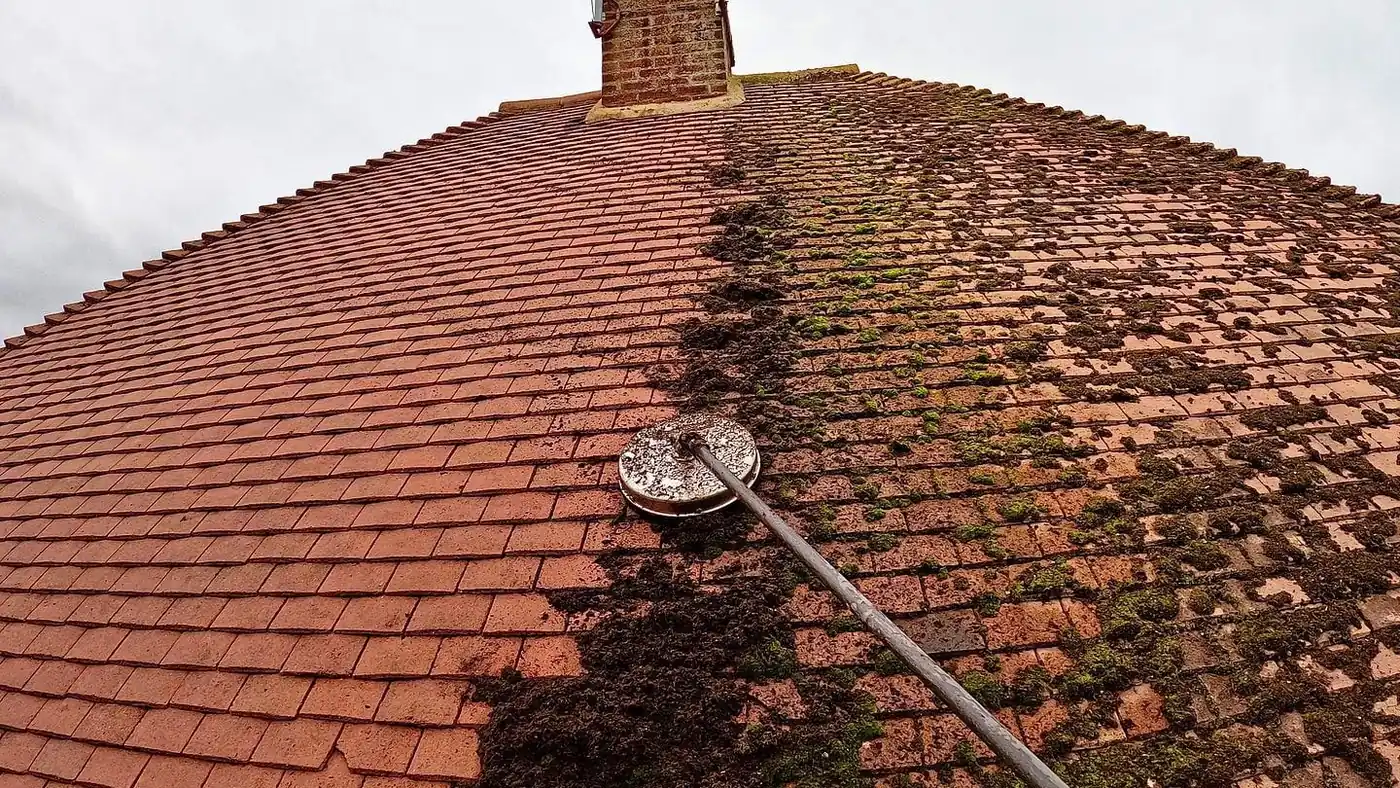
- Lichen best left to a treatment rather than a scraper
- A roof cleaned a few years ago that needs retreating
- Green algae on the roof
Roof biocide treatment for homes in Whitechapel
Cleaning takes growth off a roof; a biocide treatment helps keep it off. The treatment reaches the spores and traces of growth that hand removal leaves behind and holds back new growth. How long it lasts depends on shade and aspect, typically around one to a few years. Common call-outs are for lichen crusts along the ridge and small tufts of moss on the tiles, across lichen patches, ridge and hip tiles and tile and slate surfaces.
Across London, many homes are Victorian or Edwardian terraces, with slate or clay tiles on the front slope and a valley or butterfly roof hidden behind a parapet at the back. For a home like that in Whitechapel, the moss that matters is often in a valley gutter or behind the parapet, out of sight. That’s why we look at the whole roof, not just the slope you can see from the road.
Some firms suggest their work will keep things looking new for years. We’d rather be straight with you: in damp, shady spots, growth returns sooner. What we do give you is a written 12-month workmanship guarantee covering our work.
- Place
- Whitechapel (E1, E2, E1W)
- Region
- Greater London
- Cover
- Workmanship guaranteed in writing for 12 months
- Quote
- A fixed quote up front
- Background
- Checkatrade member with 20 years’ experience
- Phone
- 01342 344 936
- Checked
- 30 October 2026
What a clean won’t put right
We’ll always give you a straight answer, so here’s what this work cannot put right:
- Keeping growth away permanently (it slows regrowth; it isn’t permanent)
- Thick moss (it needs removing by hand first)
- An instant result (dead growth weathers off over time)
Not sure which it is? You can get in touch by phone on 01342 344 936, or through the quote form and we will tell you honestly before you book.
Surfaces we cover
- Shaded roof slopes
- Lichen patches
- Tile and slate surfaces
- Ridge and hip tiles
- Algae and black streaks
- Roofs cleaned by hand
Keeping it in good shape
How long the results last depends on shade, damp and care. We suggest:
- Keep pets in while it dries
- Do not rinse the roof after treatment
- Leave lichen to weather off after treatment
- Clear leaves from the gutters each autumn
Regrowth is slowed for typically around one to a few years; shade and aspect decide how long. A yearly look tells you how it’s doing and retreat when the first signs come back.
A light brush down each season, as the SPAB recommends, keeps growth from settling. Only where it’s safe to reach the roof and helps treatments last.
How a job runs
Every job follows the same order: cover and protect what’s nearby, set up the access the job needs, carry out the roof biocide treatment, clear up and remove what we have cleared. The job itself takes a few hours on the day, while the treated growth weathers away over the following months. For a job in Whitechapel, let us know where a van can stop and whether a visitor permit is needed.
- First we decide whether to treat or clean and treat.
- The price is fixed and the date chosen for dry weather.
- Gullies and drain outlets are protected so nothing reaches surface water drains.
- We hand-clear thick moss before treating at low pressure.
- We clear up and go through anything you need to know.
Getting ready for the day
- Let us know if birds are nesting under the eaves
- Make space on the drive by moving cars
- Let neighbours know if we will be near a shared boundary or drive
Your fixed quote
Quotes are simple. Tell us about the job, add a few pictures if you can, and we will give you a fixed price. If we need to see it first, we’ll arrange a visit.
Read more
What affects the cost of roof biocide treatment
We settle the price before we arrive. We base it on:
- How heavy the growth or dirt is
- The access the job needs, from ladders to scaffold
- The method that suits the surface
- Combining work, like the roof and the gutters
Whatever the property, the quote works the same way: the size of the job, the access, the condition and the method. Call for a fixed quote and we will go through it with you.
Asking for a quote
When you call or use the quote form, these details help:
- Shots of the heaviest build-up
- A wide photo of the whole roof or area, taken from the ground
- The address and the type of property
- Conservatories, porches or extensions under the area
If you need roof biocide treatment in Whitechapel, speak to us on 01342 344 936 or fill in the quote form. Tell us the address and what you’d like done, plus anything that affects access, such as no side gate or a glass roof underneath. We will then give you a fixed quote.
What the work involves, part by part
Historic and listed roofs
Old roofs can be fragile. We avoid walking on old tiles and flag any repairs worth doing.
Clay tiles
Clay roofs are well suited to a low-pressure treatment. Damp makes clay tiles in particular more prone to delamination, Wienerberger notes so slowing regrowth is worthwhile.
Signs you need roof biocide treatment in Whitechapel
A rough tile surface gives growth more to hold. Aged tiles tend to green up again sooner and why treatment matters on older roofs.
These are the things we see most often:
- Growth coming back on a treated roof
- Orange or yellow lichen on the ridge
- Wanting to slow regrowth after a hand clean
- The first patches of moss
If you live near Whitechapel station, about 0.5 miles north-east of Whitechapel, on-street parking may be busy in the day, and our van needs to be fairly close to the house, so let us know the options.
Comparing quotes
- How they’ll handle anything unexpected
- What insurance they carry
- If the quote is a fixed price or an estimate
- Whether the workmanship is guaranteed in writing
Your questions about roof biocide treatment in Whitechapel
Does a conservation area in Whitechapel change anything about roof biocide treatment?
Cleaning is fine; it’s changes to how the roof looks, such as a coating, that should be checked with Tower Hamlets council first. There are about 129 conservation areas less than two miles from the centre of Whitechapel, the nearest being the Whitechapel High Street conservation area, roughly 0.1 miles south-west of central Whitechapel.
Will you need a parking permit or a pavement licence in Whitechapel?
It depends on the job and the street. If a scaffold or tower has to stand on the pavement, a licence from the council may be needed, and the van may need a visitor permit or a suspended bay. This is covered when we quote, so there are no surprises.
What happens to the waste?
We collect it and take it with us. Moss, leaves and debris are gathered as the work goes on, so it doesn’t end up in gutters, drains or borders.
Will the quote change once you start?
Our quotes are fixed, not an estimate. That’s why we look at the job properly first, either in pictures or in person.
How should I prepare?
Let us know the important things when you book: a conservatory underneath, birds nesting or a drive you share. On the day, moving cars and keeping pets in is typically all that’s needed.
Do I need to tell my neighbours?
If we need access across a shared drive or from next door, they’ll need to agree, so it’s worth asking them early. Otherwise, the work is kept to your property and protect anything close by.
My home is listed. Can you help?
Yes, with care. We don’t use pressure on historic surfaces, and we won’t apply a coating without the council’s advice, and we will pick the gentlest method that does the job. The council’s conservation officer can tell you if consent is needed.
Should I do it myself?
If it means going up a ladder or onto a roof, we’d advise against it. Almost one in five deaths in construction work involve roof work, according to HSE, and HSE advises treating all roofs as fragile. Work at ground level is another matter.
Places near Whitechapel
More services for Whitechapel
What happens if it’s left?
A biocide is not permanent, whatever anyone tells you. It typically works for around one to a few years, depending on shade and aspect, because new spores keep arriving. A repeat treatment is simpler than a full clean. In Whitechapel, as across London, a planned clean is far less disruptive than a bigger job later.
The price reflects the work, not guesswork. That’s why we look at the job first, from pictures or in person, and the price agreed before work begins.
Why book with us
- 20 years’ experience
- Workmanship guaranteed in writing for 12 months
- We are fully insured
- Safe access planned for each job
See how roof cleaning is priced or how we choose the method.
Roof biocide treatment around Whitechapel: what to know
Count the conservation areas within two miles of Whitechapel and you get about 129; the nearest is the Whitechapel High Street conservation area, some 0.1 miles south-west of the middle of Whitechapel. If your home is in a conservation area, cleaning is fine, but a coating or anything that changes the roof’s look should be checked with Tower Hamlets council first. London roofs often have hidden valleys and parapet gutters at the back, where moss collects out of sight, so the whole roof is looked at, not just the front. The area’s older buildings include Mansion House, roughly 0.9 miles west of Whitechapel. Roofs on buildings like that have lasted because they were looked after, not because they were left alone.
Homes near open spaces like Finsbury Circus, roughly 0.8 miles west of Whitechapel, often have more trees around them. Leaves on the tiles and in the gutters hold damp, and moss thrives on damp. Older homes, like many found near churches such as St Mary Matfelon, often have clay tiles or slate that call for a gentle approach.
Whitechapel is about 2 miles north-east of London, in Greater London. Whether your home in Whitechapel is a terrace, a semi or a detached house, we can take on roof biocide treatment. One number covers every area we work in, so booking is simple. Whitechapel is one of 764 towns, villages and districts in Greater London where we work for homeowners and landlords.
Every address in E1, E2 and E1W is covered for roof biocide treatment, from the main roads to the quietest streets. That includes homes on New Road, Mark Lane and Idol Lane and nearby roads. Whitechapel sits on or near the A3 and A10, so getting to you is simple for the job. Neighbouring places we cover for roof biocide treatment include Spitalfields (1 mile west), Aldgate (1 mile south-west), Bishopsgate (1 mile west), East End of London (1 mile east) and St George in the East (1 mile south-east). Within a short drive, we also cover City of Westminster (4 miles west), Marylebone (3 miles west), Kensington (6 miles west), Walthamstow (5 miles north), Hampstead (5 miles north-west) and Ruislip (15 miles west). As one of the bigger places in Greater London, Whitechapel has a wide mix of homes, all within our area for roof biocide treatment.
Around Whitechapel
Roofs on the roads around Makers Academy, The White Hart pub and Finsbury Circus are all part of the area we cover. You’ll also find Bishopsgate Institute Special Collections and Archives (0.5 miles west), London Enterprise Academy (within half a mile south-east) and St Mary-at-Hill (0.8 miles south-west). The closest station to Whitechapel is Whitechapel station, about 0.5 miles north-east. Well-known places in the area include Surrey Quays Shopping Centre (1.7 miles south-east) and Tower of London (0.6 miles south-west). For a walk, there’s St. James's Park Lake and Lavender Pond.