Buckinghamshire · Biocide roof treatment
Roof Biocide Treatment in Wheeler End
Roof biocide treatment for Wheeler End and the surrounding area: a look at the job, a fixed price, the right method and a proper clear-up. Call for a fixed quote.
- Keeping a freshly cleaned roof clearer for longer
- Algae on an older roof
- An old treatment that has worn off
Roof biocide treatment for homes in Wheeler End
Using a biocide on a roof isn’t something to take lightly. We only use biocides approved or authorised for this use in Great Britain, as the law requires and we follow its label to the letter. That covers the dose, the conditions and the precautions. If you’re dealing with lichen best left to a treatment rather than a scraper and green algae on the roof, we can help.
Villages like Wheeler End often include older cottages and barns with clay tiles or slate, alongside newer houses. Older clay and slate need a gentle touch: hand scraping and brushing, never a jet wash.
We bring Checkatrade membership, full insurance and 20 years’ experience to every job. On top of that, each job comes with a written 12-month guarantee on our workmanship, so there’s something in writing if you need it.
- Location
- Wheeler End (HP14)
- Region
- Buckinghamshire
- Our guarantee
- Written 12-month workmanship guarantee
- Price
- One fixed price, quoted in advance
- Track record
- 20 years’ experience, fully insured
- Telephone
- 01342 344 936
- Updated
- 30 October 2026
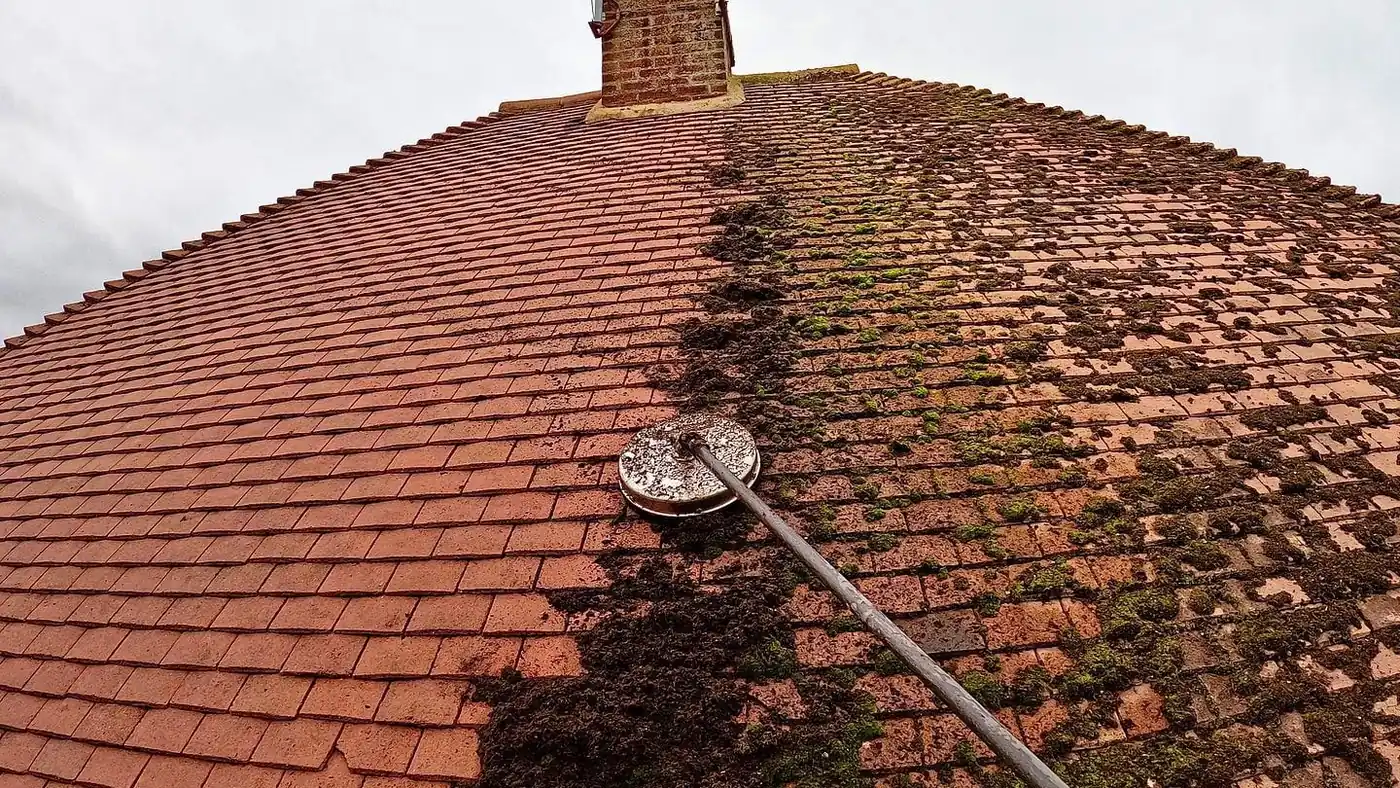
Step by step
We start by comparing what we see with what we priced. If anything is different, such as damage we couldn’t see before, we talk to you before carrying on. After that, the work takes a few hours on the day, while the treated growth weathers away over the following months. In a village like Wheeler End, a long drive, a narrow lane or a gate can affect access, so directions help.
- We start by checking what’s growing and where.
- The price is fixed and thick moss planned for removal before treatment.
- Dry weather matters, so we pick the day and protect the ground below.
- The treatment goes on at low pressure, evenly across the tiles.
- The site is cleared and you are told what to expect over the coming months.
How to prepare
- Mention any problems you’ve noticed
- Close windows, doors and roof lights near the work
- Let us know about any pets, and keep them inside on the day
Get a fixed quote
Getting a quote doesn’t take long. Tell us about the job, add a few photos if you can, and we will give you a fixed price. If we need to see it first, we will arrange a visit.
Related advice
What affects the cost of roof biocide treatment
You’ll get a fixed price before we start. It’s based on:
- How heavy the growth or dirt is
- What’s below the work area
- Repair work, if it’s needed, on its own quote
- Any extra work added to the job
No two properties are the same, so we price each job on its own. Size, height, access, the condition of the surface and the method all play a part.
Asking for a quote
Please do not climb a ladder to take photos: shots from the garden, the street or an upstairs window are fine. The most helpful are:
- Where the property is and whether it’s a house, bungalow or flat
- Anything below the work, such as a conservatory, porch or extension
- Shots of the heaviest build-up
- Where we could park, and any restrictions
The price is only part of a proper quote. Ours covers the work, the method and the access, and the price is fixed. For yours, pick up the phone and call 01342 344 936 or fill in the quote form.
Roof biocide treatment in Wheeler End: the local picture
The Chilterns National Landscape starts within about 4 miles of Wheeler End. Homes near protected countryside like the Chilterns can include many older properties with clay or slate roofs, and trees and damp hillsides can mean heavier moss. At about 33 miles from central London, Wheeler End sits well inside the area we cover for roof biocide treatment. We’re a Checkatrade member with 20 years’ experience. Historic buildings nearby include West Wycombe Park House, about 1.7 miles north-east of Wheeler End. They’re proof that a roof treated gently can stay in good order for a very long time.
Living near Yoesden, about 3.2 miles north of Wheeler End, can mean more trees, shade and leaf fall. Shade slows how quickly a roof dries, and a roof that stays damp suits moss. If you live near Church of the Holy Trinity, or on any of the older streets in Wheeler End, your roof may be clay or slate, which is cleaned gently by hand. Homes on school roads, near Lane End Primary School for instance, can face busy mornings and afternoons. Tell us about it when you ask for a quote, and the start can be timed to suit.
Wheeler End is about 4 miles west of High Wycombe, in Buckinghamshire. For roof biocide treatment in and around Wheeler End, it’s easy to get a fixed quote: please pick up the phone and call 01342 344 936 or fill in the quote form. Our area covers London and the South East, including Wheeler End. Our area takes in 263 places across Buckinghamshire, from busy towns to small villages. Our Reading page covers homes nearby (14 miles or so).
Postcode districts we cover here for roof biocide treatment: HP14. Whether your home is on Bullocks Farm Lane, Bolter End Lane and Piddington Lane or anywhere close by, we can take on the work. If your home is just outside Wheeler End, we cover Bolter End (1 mile south-west), Piddington (1 mile north-east), Lane End (1 mile south-east), Cadmore End (1 mile west) and Studley Green (1 mile north-west). We also work in nearby towns such as Aylesbury (13 miles north), High Wycombe (4 miles east), Chesham (11 miles north-east), Marlow (5 miles south-east), Amersham (11 miles east) and Beaconsfield (8 miles east).
Local landmarks in Wheeler End
Locally, the streets close to The Brickmakers Arms are all within our usual area. The closest station to Wheeler End is Saunderton station, roughly 3.2 miles north. A little further out are High Wycombe Castle (3.8 miles east) and Eden (3.5 miles east). For a walk, there’s Yoesden.
For landlords and letting agents
Outside maintenance is easy to forget on a rental. Few tenants look up at the roof or into the gutters, so planned work helps catch moss, blockages or slipped tiles before they grow into a bigger job.
If you manage properties from a distance, we will tell you how the job went and point out anything that needs looking at, such as a slipped tile or a downpipe that is not running. Nothing extra is done without your say-so.
Places near Wheeler End
More services for Wheeler End
Wheeler End questions
How does a conservation area in Wheeler End affect roof biocide treatment?
It mainly matters for changes, not cleaning: a coating or new tiles alter how the roof looks, so check those with Buckinghamshire council. For reference, the Wheeler End Common conservation area lies some 0.1 miles north-west of the middle of Wheeler End.
My home in Wheeler End is near trees: does that matter?
Often, yes. The nearest ancient woodland to Wheeler End is Great/Hellbottom Woods, about 0.8 miles east of Wheeler End. A shaded roof dries slowly, which suits moss, so a biocide treatment after cleaning can help slow regrowth.
Do you control the run-off?
The run-off is controlled from start to finish. We protect gullies and drains, and moss sludge, dirty water and biocide are kept out of surface water drains, because those drains discharge directly to the environment.
What do I need to do before you arrive?
Please move cars, leave gates unlocked and keep pets inside, and tell us about a conservatory, glass roof or nesting birds.
Are you a Checkatrade member?
Yes, we are Checkatrade members. We also have 20 years’ experience and full insurance, plus a written 12-month workmanship guarantee on our work.
How long will the treatment take to apply?
Allow a few hours on the day, while the treated growth weathers away over the following months. Your quote will say how long to expect.
Should I do it myself?
That depends on the job. A patio or drive is fine to tackle yourself, as long as dirty water stays out of surface water drains, while roofs, high gutters and solar panels are best left to us.
What about plants and pets during treatment?
We protect plants, paths and drains below and follow the label’s precautions. Run-off is controlled and kept out of surface water drains, and we’ll tell you how long to keep pets and children off treated areas.
What roof biocide treatment cannot fix
We won’t book work that doesn’t solve the problem, so here are the limits:
- Broken ridge mortar
- Thick moss (it needs removing by hand first)
- Lichen vanishing on the day
If you’re not sure, just reach us by phone on 01342 344 936, or use the quote form and we’ll give you a straight answer before you book.
What we clean
- Lichen patches
- Ridge and hip tiles
- Algae and black streaks
- Tile and slate surfaces
- Shaded roof slopes
- Roofs cleaned by hand
What happens if it’s left?
Buying a moss killer and doing it yourself means working at height with a regulated product. The label has to be followed, run-off kept out of surface water drains and the roof treated as fragile until a competent person says otherwise and that’s hard to do well from a ladder. On older homes, original tiles, render and paving can be hard to match, so caring for what’s there makes sense.
What you pay reflects the actual work. That’s why we look at the job first, from pictures or in person, and the price agreed before we start.
What you get with us
- Fixed prices, agreed before any work
- Every job backed by a 12-month workmanship guarantee in writing
- Biocides approved or authorised for this use in Great Britain, as the law requires
- Sludge and dirty water kept out of surface water drains
Take a look at how our quotes work and which method suits your roof.
What’s safe to do yourself
Solar panels need particular care. The manufacturer’s care guidance comes first, and do not use a pressure washer or harsh chemicals. Most panels sit on a roof, so the same height warnings apply.
You can buy moss and algae treatments yourself, but check the product is authorised for that use and follow the label exactly. Applying it to a roof still means working at height, and run-off still has to be kept out of drains.
How the job changes from site to site
Historic and listed roofs
On a historic roof, a low-pressure treatment is one of the gentler options. We still check the roof closely first and avoid scraping old surfaces.
Fibre cement slates
Treatment is a low-impact option for fibre cement. It’s often the most suitable approach once we’ve checked them.