West Berkshire · Biocide roof treatment
Biocide roof treatment in Weston, West Berkshire
We work in Weston on biocide roof treatment. Fixed quotes, careful work and a written 12-month workmanship guarantee with each job.
- Algae on an older roof
- Slowing moss coming back after cleaning
- Lichen best left to a treatment rather than a scraper
Roof biocide treatment for homes in Weston
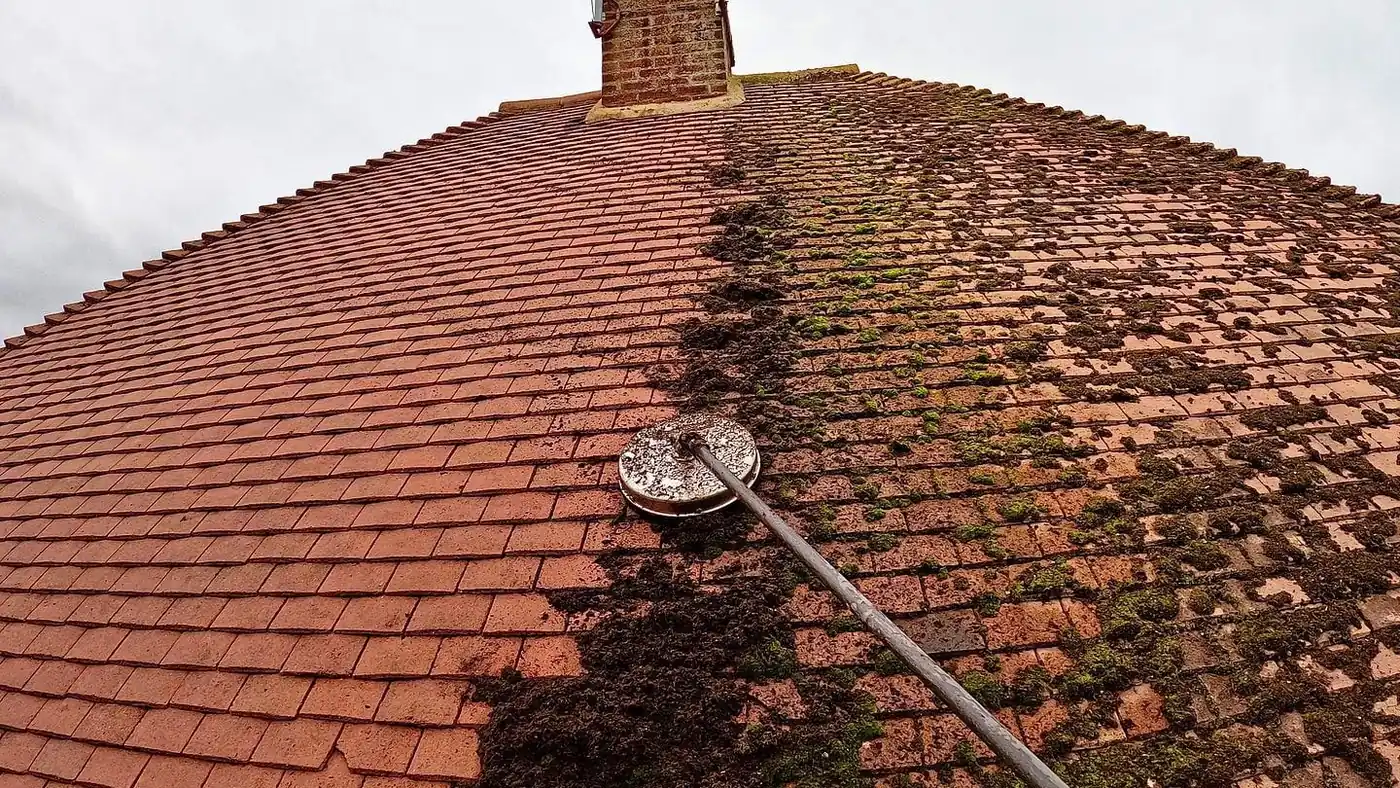
In Weston, as everywhere, a biocide needs the right weather. It needs a dry spell to work, as the label sets out so the forecast decides the date. Frost and high wind put it on hold too. We’re often asked to deal with wanting to slow regrowth after a hand clean and growth coming back on a treated roof, on shaded roof slopes, ridge and hip tiles and algae and black streaks.
Some homes in villages like Weston are listed or in a conservation area, and if yours is one of them, gentle methods matter even more. For anything beyond cleaning, such as a coating, the council’s conservation officer is the person to ask first.
The guarantee is not a handshake. You get a written 12-month workmanship guarantee with every job, covering the work we carried out. File it with your other house papers in case you need it.
- Location
- Weston (RG20)
- Wider area
- West Berkshire
- Our guarantee
- Written 12-month workmanship guarantee
- Quotes
- A fixed price before any work starts
- Background
- Two decades in the trade, fully insured
- Telephone
- 01342 344 936
- Reviewed
- 30 October 2026
Common questions in Weston
I live in a conservation area in Weston: does that affect roof biocide treatment?
Cleaning is fine; it’s changes to how the roof looks, such as a coating, that should be checked with West Berkshire council first. The closest one to Weston is the Great Shefford conservation area, about 1.4 miles north-west of the centre of Weston.
Does tree cover around Weston affect roof biocide treatment?
Often, yes. Ancient woodland such as Mantclose Copse lies roughly 0.8 miles south of Weston. Shade keeps a roof damp, and moss grows best on damp, shaded slopes, so roofs under trees may need cleaning more frequently.
What about my pets and plants?
Pets and plants are something we always plan for. Where a biocide is used, it’s one approved or authorised for this use in Great Britain, applied as the label says, with planting below covered or protected. Keep pets inside while we work.
Is the price fixed?
We give you a fixed price before work begins, and it covers the work we agreed. Nothing extra is added without your agreement.
Do nesting birds affect the work?
Active nests are protected under the Wildlife and Countryside Act 1981, so we check before working near gutters, eaves and roof spaces. Let us know if you’ve noticed birds nesting when you book.
Do you use a pressure washer?
It depends on the surface. Driveways and patios normally take a pressure washer well, but on roofs we use controlled pressure only on robust tiles after checking them. We never pressure wash clay, slate, old or fragile tiles, or solar panels.
What happens to the waste?
We bag what we remove and take it away with us, from moss and leaves to silt and broken tiles. None of it is left on site.
Is it safe to do it myself?
Ground-level jobs, yes; roof work, no. A yearly check from the ground and clearing up fallen moss is sensible DIY, but please don’t walk on tiles or use a jet washer on a roof.
DIY or a professional?
Walking on a tiled roof does more harm than people think. Weight on a tile can leave hairline cracks that aren’t visible, and frost can open those cracks up over the following winters. Access should always be planned to suit the roof.
Cleaning solar panels yourself is rarely worth the risk. Follow the panel maker’s care guidance, and do not use a pressure washer or harsh chemicals. Since most panels are on a roof, the risk is the same as any roof work.
Keeping it in good shape
To keep things in good shape between visits:
- Check gutters after heavy rain
- Retreat when regrowth first appears
- Never scrape lichen yourself
- Let the biocide stay on the tiles
We give a 12-month written guarantee covering our workmanship. It covers how the treatment was carried out, not a promise that growth will not return, since no biocide is permanent.
A light brush down each season, as the SPAB recommends, keeps growth from settling. It needs safe access and helps treatments last.
When it’s something else
Some problems need a different service or another trade:
- Thick moss (it needs removing by hand first)
- Cracked, slipped or missing tiles (repairs are quoted separately)
- Overnight change
If you’re not sure, just use the form on our contact page or give us a call on 01342 344 936 and we’ll give you a straight answer.
What the work covers
- Tile and slate surfaces
- Roofs cleaned by hand
- Shaded roof slopes
- Algae and black streaks
- Ridge and hip tiles
- Lichen patches
What we do, step by step
If the job involves water, the run-off is controlled. Moss sludge, dirty water and any biocide are kept out of surface water drains, because those drains discharge directly to the environment. On site, it takes an hour or two for a small roof and longer for a large one. Let us know about gates, steps and slopes on the way to the work.
- First we decide whether to treat or clean and treat.
- You get a fixed quote and a date planned around the weather.
- Gullies and drain outlets are protected so nothing reaches surface water drains.
- Heavy growth comes off by hand, then the biocide is applied by soft wash.
- The area is cleaned down and precautions explained.
A few things to sort first
- Have a word with next door if access is shared
- Shut nearby windows and roof lights
- Make sure we can get to the side and back of the property
Getting a quote
Every quote starts with a look at the job, from your photos or, where that isn’t enough, a visit. After that, you get a fixed price so you know the cost up front.
Read more
Roof biocide treatment around Weston: what to know
Mantclose Copse, about 0.8 miles south of Weston, is the nearest of about 16 ancient woods within a couple of miles of Weston. Homes near woodland like this tend to get more shade and leaf litter, and moss grows best on damp, shaded roofs. Older buildings in the area include Benham Park, about 4.7 miles south-east of Weston. They are proof that a roof treated gently can stay in good order for a very long time. Weston lies roughly 57 miles from central London, comfortably inside the patch we cover. Twenty years in the trade, full insurance and Checkatrade membership come with every visit.
Around Sole Common Pond, 2.3 miles south of Weston, gardens often border trees and hedges, and that brings shade. Moss grows fastest on shaded, damp slopes.
Weston is about 6 miles north-west of Newbury, in West Berkshire. We treat roof biocide treatment in Weston the same as anywhere in West Berkshire: carefully, with a fixed price and a written guarantee on our workmanship for 12 months. Weston is one of 155 places in West Berkshire where we work for homeowners and landlords. Our Reading page covers homes nearby, about 19 miles away.
We take on work all over the RG20 postcode area for roof biocide treatment and the streets around it. Nearby, we also carry out roof biocide treatment in East Shefford (1 mile north-west), Great Shefford (1 mile north-west), Wickham (1 mile south), Easton (2 miles south-east) and Shefford Woodlands (2 miles west). Larger places within reach include Newbury (6 miles south-east), Thatcham (8 miles south-east), Speenhamland (6 miles south-east), Hungerford (5 miles south-west), Lambourn (5 miles north-west) and Shaw (6 miles south-east).
Local landmarks in Weston
The nearest railway station is Kintbury station, roughly 4.3 miles south. Other landmarks nearby include Hamstead Marshall 3 (4.7 miles south). Not far away are Sole Common Pond.
When to call us in Weston
Shaded, slow-drying slopes regrow fastest. Slopes out of the sun dry slowly and they need treating most often.
Common reasons people call us include:
- Black lines on the tiles
- Growth on tiles too fragile to scrape hard
- Small tufts of moss on the tiles
- Crusty grey and yellow lichen
If you live near St Thomas' Church, or on any of the older streets in Weston, your roof may be clay or slate, which is cleaned gently by hand.
Questions to ask before you book
- Whether VAT is included
- Whether ladders, a tower or scaffold are allowed for in the price
- Whether they’re fully insured
- The method they’ll use, and why it suits your surface
How we price roof biocide treatment
We look at the job before pricing it. We consider:
- The type and condition of the tiles or surface
- A conservatory or extension below the work
- The area to be worked on
- Extras such as gutter clearing or a biocide treatment
Every property is different, so each one gets its own fixed quote. Size, height, access, the condition of the surface and the method all play a part.
Asking for a quote
Photos and some simple facts are often enough. Send what you can of the following:
- The address and the type of property
- The history of earlier work, if you know it
- What sits underneath, like a glass roof or flat-roofed extension
- Parking near the property
Quotes are simple. Send a few details and photos, and we will come back to you with a fixed price. If we need to see it first, we will arrange a visit.
Why deal with it now?
A treatment on its own will not lift thick moss. Dead moss can take a long time to drop and tends to end up in the gutters so we hand-remove it before treating. The longer growth is left, the longer surfaces stay wet.
The cost depends on the size of the area, the height and access and how much there is to clear. We give you a fixed price before we start, so there are no surprises.
What you get with us
- We have 20 years’ experience
- Covering London and the South East
- Every job backed by a 12-month written guarantee covering our workmanship
- Full insurance on every job
Read what affects the cost and which method suits your roof.