Oxfordshire · Biocide roof treatment
West Hagbourne roof biocide treatment
Biocide roof treatment to kill remaining moss, algae and lichen spores and slow regrowth in West Hagbourne, done the careful way. We plan the access, protect the area and take the waste with us.
- A green film over the tiles
- Algae on the slope that gets the least sun
- The first patches of moss
Roof biocide treatment for homes in West Hagbourne
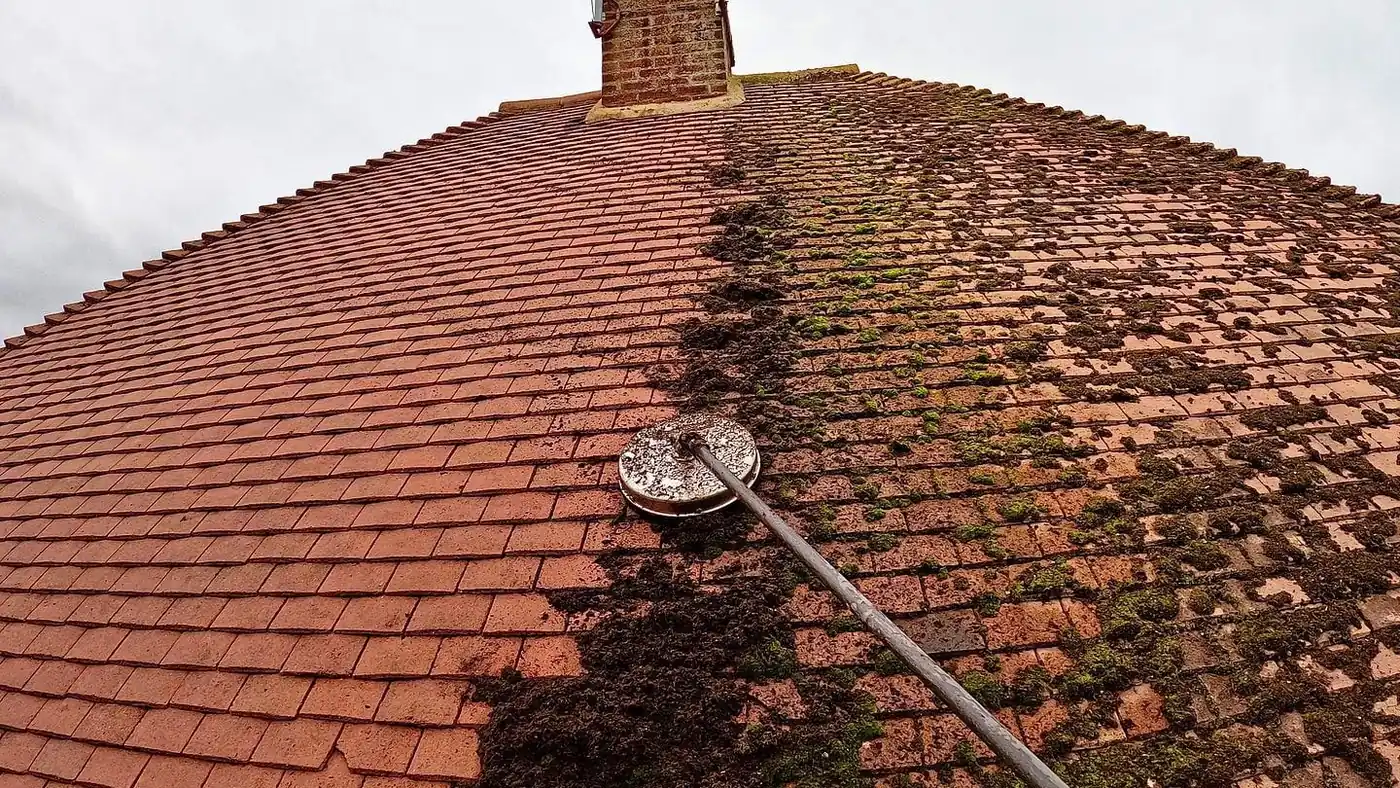
A biocide treatment is what keeps a cleaned roof clearer for longer. The treatment reaches the spores and traces of growth that hand removal leaves behind and holds back new growth. It is not permanent, typically lasting around one to a few years, depending on shade and aspect. The work covers algae and black streaks, shaded roof slopes and lichen patches, and the jobs we see most are a north-facing slope that greens up fast and keeping a freshly cleaned roof clearer for longer.
Villages like West Hagbourne often include older cottages and barns with clay tiles or slate, alongside newer houses. Older clay and slate need a gentle touch: hand scraping and brushing, never a jet wash.
We’re fully insured, Checkatrade members and have 20 years’ experience, with a written 12-month workmanship guarantee on each job. It’s given in writing for your records.
- Place
- West Hagbourne (OX11)
- Region
- Oxfordshire
- Guarantee
- 12-month workmanship guarantee, in writing
- Quote
- Fixed price, set before we begin
- Experience
- Checkatrade member, fully insured
- Telephone
- 01342 344 936
- Page updated
- 30 October 2026
Looking after it afterwards
After the work, a few habits help it last:
- Keep pets in while it dries
- Judge the result after a few months, not a few days
- Look for regrowth on the shady slope once a year
- Never scrape lichen yourself
After a biocide treatment, nothing much seems to happen at first. Over the following weeks and months, the growth dies back and weathers away, so the full effect builds slowly. You’ll know what to look for.
Copper strips or sacrificial lead at drip points can inhibit growth, the SPAB notes. Rain carries a trace of the metal down the tiles, which can slow regrowth.
Common questions in West Hagbourne
What if my home in West Hagbourne is in a conservation area?
It mainly matters for changes, not cleaning: a coating or new tiles alter how the roof looks, so check those with South Oxfordshire council. For reference, the West Hagbourne conservation area lies some 0.1 miles south-east of the middle of West Hagbourne.
Who can tell me if my home in West Hagbourne is listed?
West Hagbourne comes under South Oxfordshire council. Their conservation or planning staff can confirm the status of your home and what needs consent. If your home is listed, listed building consent is needed for works that affect its special character, so check with the council before a coating or any change to how the roof looks.
Is there anything I need to do beforehand?
Let us know the important things when you book: a conservatory underneath, birds nesting or a drive you share. On the day, clear the drive and keep pets inside.
What about my neighbours?
It’s a good idea to let them know, especially if we’ll be near the boundary or parking nearby. We protect their side as carefully as yours.
Do nesting birds affect the work?
The Wildlife and Countryside Act 1981 protects active nests, so we look before working near eaves, gutters or roof spaces. Tell us if you’ve seen birds going in and out when you get in touch.
Can you work on an old or listed property?
Yes. We use the gentlest methods on historic roofs and walls, such as careful hand removal and low-pressure steam where it suits. A coating, or anything else that changes the look, needs a word with the council first, as listed building consent is needed for works that affect a listed building’s special character.
Should the moss be removed before treatment?
That comes down to the build-up. Thick moss stops the biocide reaching the tiles and falls away slowly once it’s dead, so it’s best removed first, while lighter growth can simply be treated.
Do you tell me about problems you spot?
We point it out and explain what it means, with pictures where it helps. Repairs are priced on their own and only goes ahead if you agree.
When something else is needed
We won’t book work that doesn’t solve the problem, so here are the limits:
- Keeping growth away permanently (it slows regrowth; it isn’t permanent)
- Fading and old staining in the tile
- Damaged tiles
If in doubt, send details through the quote form or phone us on 01342 344 936 and we will say what we think.
Surfaces we cover
- Shaded roof slopes
- Roofs cleaned by hand
- Tile and slate surfaces
- Lichen patches
- Ridge and hip tiles
- Algae and black streaks
Roof biocide treatment around West Hagbourne: what to know
There are about 7 conservation areas less than two miles from the centre of West Hagbourne, the nearest being the West Hagbourne conservation area, roughly 0.1 miles south-east of central West Hagbourne. For homes in a conservation area, we keep to gentle cleaning, and anything that alters the roof’s appearance, such as a coating, is one to check with South Oxfordshire council first. West Hagbourne is about 51 miles from central London, well inside the area where we carry out roof biocide treatment across London and the South East. Twenty years in the trade, full insurance and Checkatrade membership come with every visit. One of the historic houses in the area is Brightwell Manor, some 4.5 miles north-east of West Hagbourne. Roofs on buildings like that have lasted because they were looked after, not because they were left alone.
Around Mowbray Fields, roughly 0.9 miles north-east of West Hagbourne, gardens often border trees and hedges, and that brings shade. A roof that sits in shade for part of the day tends to grow moss sooner. Roads within walking distance of a station like Didcot Parkway station, 1.9 miles north-east of West Hagbourne, often fill with parked cars, so mention it when you get in touch.
West Hagbourne is about 2 miles south of Didcot, in Oxfordshire. From the centre of West Hagbourne to the outskirts, roof biocide treatment is available for all kinds of property, from bungalows to large family homes. West Hagbourne is one of 443 towns, villages and districts in Oxfordshire where we work for homeowners and landlords. We also work in Reading, about 16 miles from West Hagbourne.
Every address in OX11 is within our area for roof biocide treatment, from the main roads to the quietest streets. Whether your home is on Main Street, York Road and Moor Lane or a nearby road, we can take on the work. If your home is just outside West Hagbourne, we cover Coscote (1 mile north-east), Upton (1 mile south), East Hagbourne (1 mile north-east), Harwell (2 miles north-west) and Blewbury (2 miles south-east). Within a short drive, we also cover Oxford (11 miles north), Abingdon-on-Thames (6 miles north), Wantage (7 miles west), Grove (7 miles west), Faringdon (15 miles west) and Benson (7 miles east).
Around West Hagbourne
Around West Hagbourne, homes near UTC Oxfordshire, St Birinus School and The Horse and Harrow pub are all within our usual area. For rail, the closest station is Didcot Parkway station, about 1.9 miles north-east. Nearby you will also find Atlas Computer Laboratory (2.4 miles west) and Brightwell Castle (4.5 miles north-east). Not far away are Mowbray Fields and Churn Hill.
Why it’s worth doing now in West Hagbourne
Biocide alone isn’t the answer for heavy moss. Dead moss can take a long time to drop and tends to end up in the gutters so we hand-remove it before treating. Moss and algae hold water, and that is the start of most problems.
Where the work is at height, access can make a big difference. Anything beyond ladders, such as a tower, scaffold or powered access, is built into the quote, and we explain why it’s needed.
Why West Hagbourne homeowners choose us
- We have 20 years’ experience
- Biocides used as the law requires and as the label says
- The waste bagged and taken away
- Run-off controlled and drains protected
Take a look at what affects the cost or our methods by tile type.
From first look to clear-up
Where water is part of the job, we control where it goes. Moss sludge, dirty water and any biocide are kept out of surface water drains, because those drains discharge directly to the environment. On site, it takes a few hours on the day, while the treated growth weathers away over the following months. Bigger gardens and outbuildings mean it’s worth telling us what’s included and how we reach it.
- We check whether a treatment alone will do, or the roof needs a clean first.
- You get a fixed quote and a date planned around the weather.
- Gullies and drain outlets are protected so nothing reaches surface water drains.
- We hand-clear thick moss before treating at low pressure.
- We clear up and go through anything you need to know.
Preparing for the work
- Clear pots, furniture and washing lines from the area
- Mention a conservatory or flat roof underneath
- Make sure we can get to the side and back of the property
How to get a quote
The quickest way to a quote is often a few photos: the whole area, the worst patches and the way in. There’s no need to climb anything; the garden or an upstairs window is fine.
Read more
Do you need roof biocide treatment in West Hagbourne?
Spores land on roofs constantly. Wind brings them in, and when the roof stays damp, they grow. A biocide kills them and slows that cycle.
If you notice any of these, it’s worth a closer look:
- Black lines on the tiles
- Lichen best left to a treatment rather than a scraper
- Lichen on clay or slate
- Lichen crusts along the ridge
Period houses close to churches such as Church of St Mary tend to have clay or slate on top, and we only ever clean that kind of roof by hand.
What to look for in a quote
- What insurance they carry
- How they’ll clean without damaging the tiles or surface
- Who clears up afterwards
- Whether ladders, a tower or scaffold are allowed for in the price
What else we do in West Hagbourne
Let and managed properties
When you cannot be there yourself, we let you know when the work is done and flag anything that needs attention, such as a slipped tile or a downpipe that isn’t running. Any repair is quoted separately and only done with your agreement.
Outside maintenance is easy to forget on a rental. Tenants don’t often check the roof or gutters, so a planned visit helps spot build-up, blockages or loose tiles early.
Doing it yourself: an honest view
Scraping moss off sounds simple, but technique matters. Lichen grips tightly, so scraping it can damage the tile, so it’s better treated and allowed to weather off. Leave the roof to someone with the right access.
It’s tempting to hire a jet washer for the roof, but it isn’t a good idea. Tile manufacturer guidance warns against high-pressure jet washers on roofs, as it can damage the surface, strip colour from concrete tiles and drive water under the laps.