Greater London · Biocide roof treatment
West Drayton roof biocide treatment
Roof biocide treatment in West Drayton, done the careful way. Safe access planned for the job, the area protected and the waste taken away.
- Lichen that won’t scrape off
- Green algae on the roof
- An old treatment that has worn off
What roof biocide treatment cannot fix
In fairness, some problems need a different fix:
- Colour lost over the years
- Thick moss (it needs removing by hand first)
- Overnight change
If in doubt, phone 01342 344 936 or use the form on our contact page and we’ll say what we think before booking.
What we work on in West Drayton
- Lichen patches
- Ridge and hip tiles
- Tile and slate surfaces
- Roofs cleaned by hand
- Algae and black streaks
- Shaded roof slopes
How we handle roof biocide treatment in West Drayton
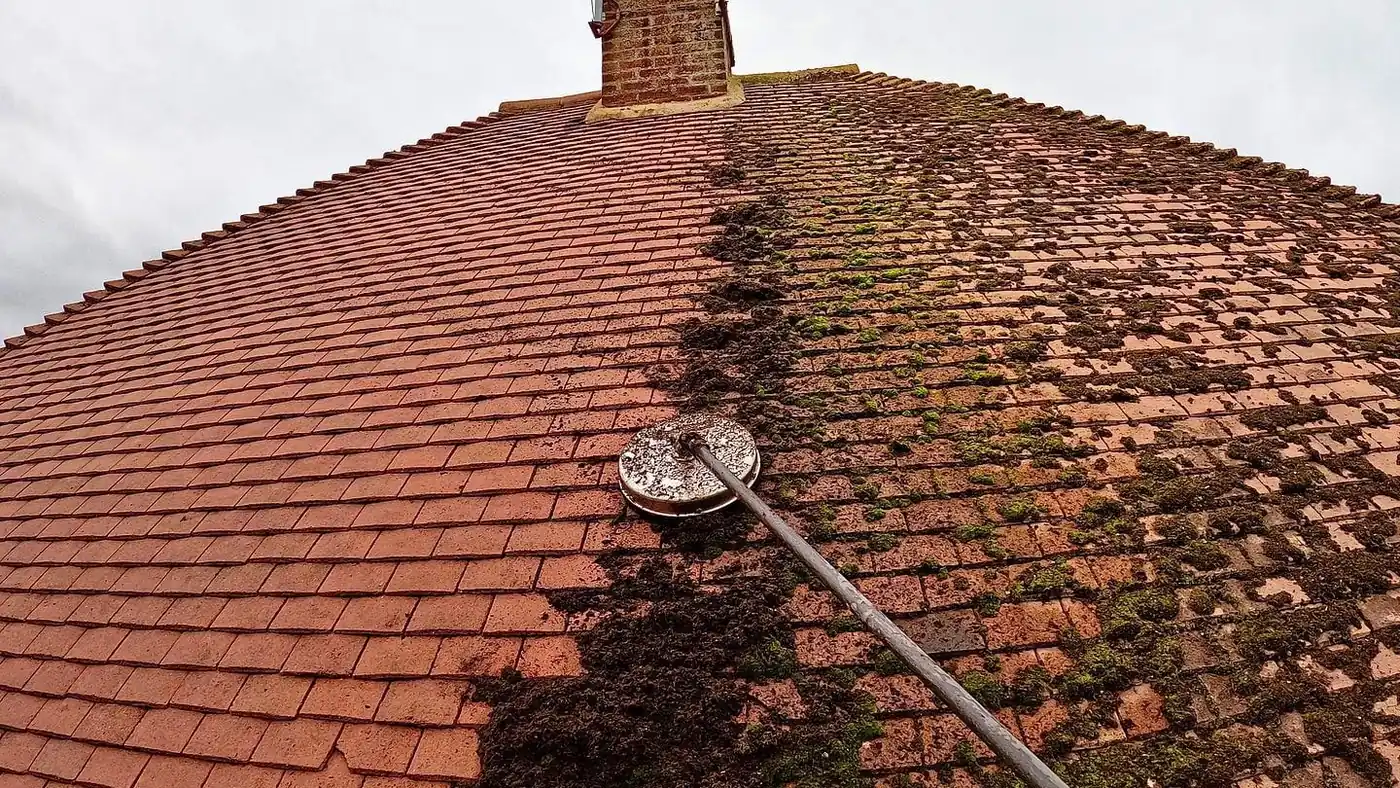
Lichen is the growth that most often needs a biocide. Scraping it off can damage the surface of the tiles, so we treat it instead and let the weather finish the job. Expect it to fade gradually. We’re often asked to deal with a north-facing slope that greens up fast and growth on delicate tiles that can’t be jet washed, across lichen patches, algae and black streaks and tile and slate surfaces.
Many London roofs are shared at the edges, with party walls, shared gutters and a neighbour’s slope running into yours. We bag the moss as we go and keep the slurry out of next door’s gutter and the drains in the street, so it’s worth letting the neighbours know the day we’re coming.
It’s worth knowing exactly what a guarantee covers. Ours is a written 12-month workmanship guarantee, covering the work itself. It is not a promise that moss, algae or dirt won’t return, because nobody can honestly promise that outdoors.
- Location
- West Drayton (UB7)
- Wider area
- Greater London
- Guarantee
- Workmanship guaranteed in writing for 12 months
- Quotes
- Fixed quote, agreed before any work
- Background
- 20 years’ experience; Checkatrade member
- Call
- 01342 344 936
- Updated
- 30 October 2026
Why deal with it now?
Biocide alone isn’t the answer for heavy moss. Killed moss falls away slowly, much of it into the gutters, so thick growth is removed by hand first. Shared walls and gutters mean a problem on one London home can affect the neighbours.
What you pay reflects the actual work. That’s why every job is looked at first, and the price agreed before we start.
Why us?
- A full clear-up before we leave
- Gentle methods first, pressure only where the surface can take it
- Covering London and the South East
- 20 years’ experience
Take a look at how roof cleaning is priced or our methods by tile type.
Roofs in West Drayton: local notes
Within a couple of miles of West Drayton there are about 9 conservation areas, and the West Drayton Green conservation area, about 0.3 miles west of the centre of West Drayton, is the closest. If your home is in a conservation area, cleaning is fine, but a coating or anything that changes the roof’s look should be checked with Hillingdon council first. Some London homes have slate on the main roof and a different tile on a later extension, and each is cleaned to suit. Historic buildings nearby include Ickenham Hall, roughly 4.2 miles north of West Drayton. Houses of that age are a reminder that clay and slate roofs can last a very long time with care.
Places like Lake Farm Country Park, about 1.7 miles east of West Drayton, can bring trees and birds close to the houses around them. Leaves on the tiles and in the gutters hold damp, and moss thrives on damp. If you live near West Drayton station, roughly 0.5 miles north-west of West Drayton, on-street parking may be busy in the day, so a word about parking when you book helps us plan.
West Drayton is about 2 miles west of Hayes, in Greater London. For roof biocide treatment in and around West Drayton, it’s easy to get a fixed quote: please call 01342 344 936 or fill in the quote form. We work across London and the South East, including West Drayton. Our Greater London coverage runs to 764 places, and West Drayton is one of them. Our London page covers homes nearby, about 16 miles away.
All of UB7 is covered for roof biocide treatment, from the main roads to the quietest streets. We cover properties on Church Road, Station Road and Constabulary Place and the roads around them. Neighbouring places we cover for roof biocide treatment include Yiewsley (1 mile north), Thorney (1 mile west), Cowley (2 miles north), Hayes (2 miles east) and Hillingdon (2 miles north). Further out, we also cover City of Westminster (14 miles east), Marylebone (14 miles east), Kensington (11 miles east), St Pancras (15 miles east), Hampstead (13 miles east) and Ruislip (6 miles north-east).
Near you in West Drayton
Properties near Park Academy West London, The Fox and Pheasant pub and Lake Farm Country Park are all within our usual area. West Drayton’s nearest station is West Drayton station, about 0.5 miles north-west of the centre. Other landmarks nearby include The Chimes (3 miles north) and British Airways Heritage Collection (2.5 miles north). Not far away are Uxbridge Moor and Staines Reservoirs.
More services for West Drayton
FAQs for West Drayton
What if my home in West Drayton is in a conservation area?
It mainly matters for changes, not cleaning: a coating or new tiles alter how the roof looks, so check those with Hillingdon council. The nearest to West Drayton is the West Drayton Green conservation area, about 0.3 miles west of the centre of West Drayton.
Does tree cover around West Drayton affect roof biocide treatment?
Often, yes. Green spaces such as Lake Farm Country Park, about 1.7 miles east of West Drayton, bring trees close to many homes. Shade keeps a roof damp, and moss grows best on damp, shaded slopes, so roofs under trees may need cleaning more frequently.
How often does a roof need treating?
It depends on shade and aspect, but typically around one to a few years. A yearly look at the roof tells you when to retreat, and treating early keeps the job small.
Do nesting birds affect the work?
We always check for active nests before any work starts, because the law protects them. If there’s an active nest where we’d be working, that part waits until the birds have gone, and we will talk you through the options.
Do I need a roof clean before a biocide treatment?
It varies with the roof. Thick moss stops the biocide reaching the tiles and falls away slowly once it’s dead, so it’s best removed first, while lighter growth can simply be treated.
What about my neighbours?
Next door gets the same care as your property. Splashes, debris and run-off are kept under control, and we only use their side with their permission.
What do you do with what you remove?
We collect it and take it with us. We gather debris as we go, so it doesn’t end up in gutters, drains or borders.
Which biocides do you use on roofs?
Every biocide we use is approved or authorised for this use in Great Britain, as the law requires. We follow the label every time on dose, timing and precautions.
What’s safe to do yourself
Hard paving at ground level is a reasonable DIY job, and that’s fine. Mind the run-off, though: surface water drains discharge directly to the environment, so keep dirty water and chemicals out of them.
Scraping moss off sounds simple, but technique matters. Lichen grips tightly, so scraping it can damage the tile, which is why it’s usually treated and left to weather away. Leave the roof to someone with the right access.
Common problems we fix in West Drayton
Older, weathered tiles hold moisture and spores more readily. That’s why older roofs often regrow faster after cleaning and why treatment matters on older roofs.
Keep an eye out for these signs:
- Dark algae stains
- Bright lichen patches on ridge and hip tiles
- A roof cleaned a few years ago that needs retreating
- Algae on the slope that gets the least sun
If your home is near West Drayton Academy or another school, the school run can fill the road twice a day. Tell us about it when you ask for a quote, and the start can be timed to suit.
Comparing quotes
- Whether they’ll use hand removal, soft wash, steam or pressure
- How they’ll keep drains, plants and paths protected
- Whether the figure could change on the day
- Whether any biocide used is authorised in Great Britain for the job
How the job changes from site to site
Fibre cement slates
A low-pressure biocide avoids aggressive scraping and pressure. That’s why it’s often what we’d suggest for these slates, after a careful look.
Natural slate
Lichen is common on slate. Slate can be scratched by scraping so a biocide is the gentle answer.
Rented properties in West Drayton
If you look after several properties, the work can go on one quote. Each property is priced on what it needs, so you can see what each one involves.
The tenancy agreement or lease normally says who is responsible for the outside. We’re happy to deal with either side, and we will keep whoever booked us informed.
How a job runs
Where cleaning is involved, we use the gentlest method that does the job, chosen to suit what we’re working on. Speed never comes before the condition of your property. The work itself takes a few hours on the day, while the treated growth weathers away over the following months, and the area is left tidy. In West Drayton, as across London, access to the rear often means a walk through the hall, so floors are protected.
- We check the growth and the tiles before deciding the approach.
- You get a fixed quote that says what’s being treated.
- We plan the day around the weather, since the biocide needs a dry spell to work.
- Gullies, plants and paths below are protected, then the biocide is applied at low pressure.
- You’re told how the treated growth will weather off over time.
Before we arrive
- Move cars off the drive and away from the work
- Let us know if birds are nesting under the eaves
- Tell us about any conservatory, glass roof or extension below the work
Get a fixed quote
If you need roof biocide treatment in West Drayton, call us on 01342 344 936 or send details through our quote form. Tell us the address and what you’d like done, and mention anything that could affect access, like a conservatory below or a narrow side passage. We will then give you a fixed quote.