West Sussex · Biocide roof treatment
West Dean roof biocide treatment
Roof biocide treatment for West Dean, from people with 20 years’ experience. Fully insured, Checkatrade members and a 12-month workmanship guarantee in writing.
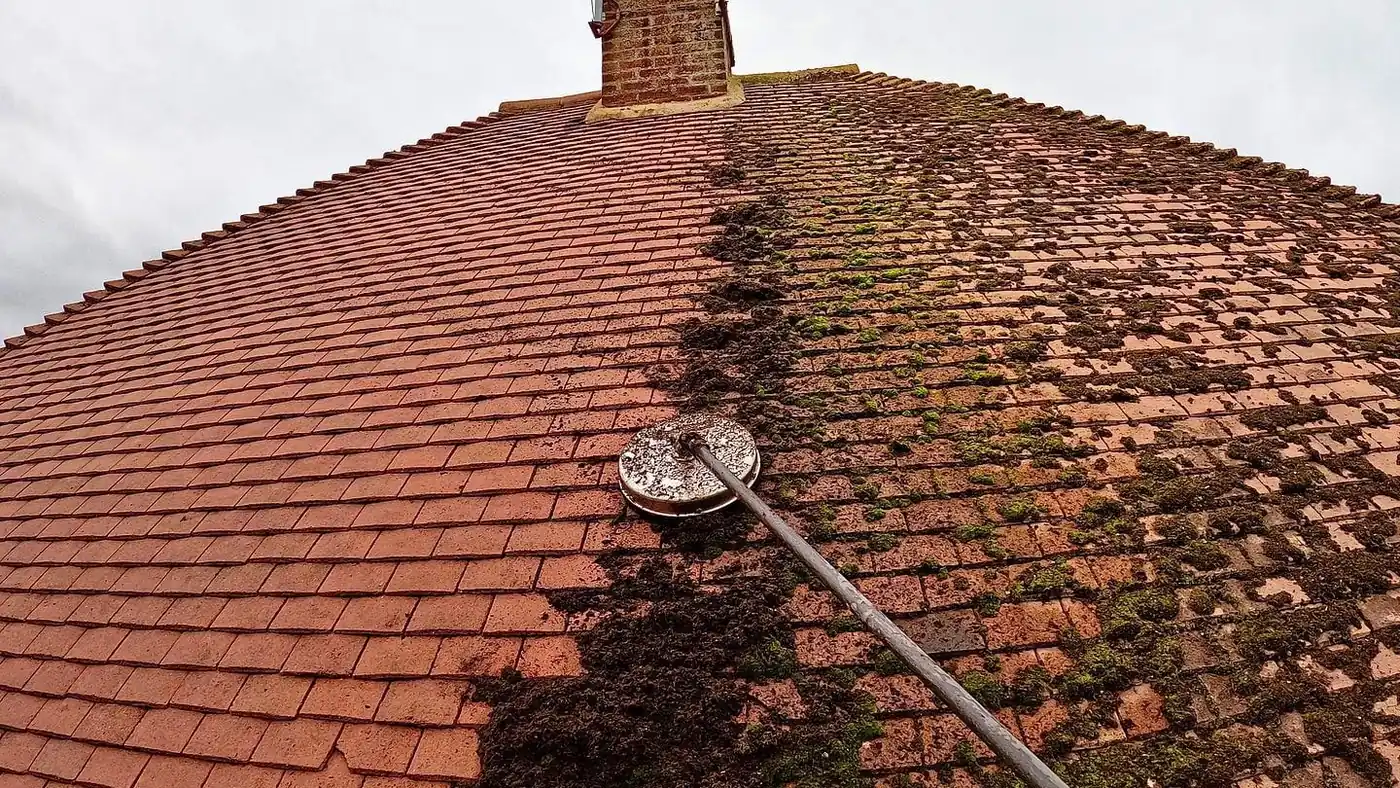
- Algae on an older roof
- Orange or yellow lichen on the ridge
- Growth coming back on a treated roof
Landlords, letting agents and property managers
The tenancy agreement or lease normally says who is responsible for the outside. We’re happy to deal with either side, and we will keep whoever booked us informed.
If you look after several properties, we can quote for them together. Every address is priced on its own job, so the figures are easy to follow.
Roof biocide treatment in West Dean
A biocide treatment is what keeps a cleaned roof clearer for longer. It kills remaining moss, algae and lichen, including spores too small to see, and slows regrowth. It is not permanent, typically lasting around one to a few years, depending on shade and aspect. If you have algae on an older roof and algae on the slope that gets the least sun, we can put it right.
Villages like West Dean often include older cottages and barns with clay tiles or slate, alongside newer houses. Old clay tiles in particular can flake when they stay damp, so they are cleaned by hand, gently, with no pressure washing.
We’re fully insured, Checkatrade members and have 20 years’ experience, and each job carries a 12-month written guarantee covering our workmanship. It’s given in writing, so it’s there if you ever need it.
- Where
- West Dean (PO18)
- Region
- West Sussex
- Cover
- 12-month workmanship guarantee, in writing
- Price
- One fixed price, quoted in advance
- Experience
- 20 years’ experience; Checkatrade member
- Telephone
- 01342 344 936
- Updated
- 30 October 2026
Other services in West Dean
How we price roof biocide treatment
There’s no set price list, because no two jobs are alike. The quote depends on:
- The area to be worked on
- Extras such as gutter clearing or a biocide treatment
- Repairs found during the job, quoted before they are done
- What’s below the work area
A few details change how long a job takes. A conservatory or extension below, a lot of moss, fragile tiles or no side access all mean extra care, so they are built into the quote. The price is still fixed before any work starts.
Helping us quote
Please do not climb a ladder to take photos: shots from the garden, the street or an upstairs window are fine. Useful things to send:
- Shots of the heaviest build-up
- Any listing you know about
- The postcode and the kind of building
- A wide photo of the whole roof or area, taken from the ground
Photos are enough for some jobs, while others need a visit. Where access is tricky or the area is hard to see in pictures, we normally come and look. Either way, the price is fixed before anything is booked.
What the work involves, part by part
Historic and listed roofs
Historic coverings need care. Access is planned to keep weight off the roof and flag any repairs worth doing.
Clay tiles
On clay, any thick moss is lifted by hand first. Then the treatment is applied gently with no jet washing at all.
Doing it yourself: an honest view
You can buy moss and algae treatments yourself, but only use one authorised for that job and follow the label to the letter. Applying it to a roof still means working at height, and run-off still has to be kept out of drains.
For a quick check from a ladder, set it on firm, level ground, have someone foot it and never lean out to the side. Never step off it onto the roof and never do it on your own.
Honest limits
Roof biocide treatment can’t fix everything, and we will tell you before any work starts. It doesn’t solve:
- Fading and old staining in the tile
- Broken ridge mortar
- Keeping growth away permanently (it slows regrowth; it isn’t permanent)
If you are not sure, just phone us on 01342 344 936 or send a few lines through the quote form and we’ll give you a straight answer before booking.
Surfaces we cover
- Roofs cleaned by hand
- Algae and black streaks
- Tile and slate surfaces
- Ridge and hip tiles
- Shaded roof slopes
- Lichen patches
Signs you need roof biocide treatment in West Dean
Lichen takes years to build up, but it’s stubborn once it does. Its crusts bond tightly to tiles and slates which is why a biocide is the usual answer.
If you notice any of these, it’s worth a closer look:
- A north-facing slope that greens up fast
- Clinging growth that would mark the tiles if scraped
- Crusty grey and yellow lichen
- Wanting to slow regrowth after a hand clean
Homes near open spaces like Levin Down, roughly 1.8 miles east of West Dean, often have more trees around them. A roof that sits in shade for part of the day tends to grow moss sooner.
What your quote should include
- Whether a biocide is included, and that it’s authorised for this use
- Whether the workmanship is guaranteed in writing
- Whether VAT is included
- How they’ll handle anything unexpected
The process
The weather plays a part in when we work. If frost, heavy rain or strong wind is forecast, we may suggest another day, as safety and the result come first. Once we’re under way, the job takes a few hours on the day, while the treated growth weathers away over the following months. Rural homes near West Dean can be hard to find, so a few directions help.
- We look at the roof and the growth on it.
- We fix the price and agree any hand removal first.
- A dry day is chosen and plants, paths and drains are protected.
- We apply the treatment evenly, following the label.
- We tidy up and explain how the growth will fade over time.
Getting ready for the day
- Shut nearby windows and roof lights
- Move garden furniture, pots and washing away from the work
- Tell us about any conservatory, glass roof or extension below the work
Pricing your job
A good quote tells you more than the price. Ours sets out what we’ll do, the method we’ll use and how we’ll reach the work, and the price is fixed. To get one, call us on 01342 344 936, or send photos through the quote form.
Related advice
Questions from West Dean
My house in West Dean is in a conservation area. What should I know?
A clean leaves the roof looking as it should, so it isn’t the issue; new tiles or a coating are what Chichester council may need to agree. There are about 3 conservation areas less than two miles from the centre of West Dean, the nearest being the West Dean conservation area, about 0.1 miles north-east of the centre of West Dean.
My home in West Dean is near trees: does that matter?
Trees can make a real difference. Ancient woodland such as Paddock Wood lies roughly 1 mile north of West Dean. Shade keeps a roof damp, and moss grows best on damp, shaded slopes, so roofs under trees may need cleaning more frequently.
Do you pressure wash?
It depends on the surface. On most hard paving, pressure washing is normal, while on roofs it’s kept for robust tiles, after a check. We never pressure wash clay, slate, old or fragile tiles, or solar panels.
Do nesting birds affect the work?
Nesting birds are protected by law, so we check first. An active nest means that part of the job waits until the nest is no longer in use, and we will talk you through the options.
Do I need a roof clean before a biocide treatment?
It varies with the roof. Thick moss stops the biocide reaching the tiles and falls away slowly once it’s dead, so it’s best removed first and light growth can be treated right away.
Are the products you use a risk to pets and plants?
Many jobs don’t involve chemicals at all; solar panels, for instance, get soft brushes and clean water. Where a biocide is part of the job, it’s one approved or authorised for this use in Great Britain, applied as the label says. We will let you know how long to keep pets off treated areas.
Will the work affect next door?
It’s a good idea to let them know, particularly where we’ll be near a shared boundary or drive. We protect their side as carefully as yours.
What do I need to do before you arrive?
Clear access matters most: cars off the drive, side gates open and pots or furniture out of the way. Close windows and roof lights near the work and keep pets in.
Roof biocide treatment around West Dean: what to know
From West Dean, the South Downs National Park is no more than about 6 miles away. Countryside such as the South Downs brings trees and damp air close to many homes, and roofs nearby can carry heavier moss as a result. Central London is about 51 miles away, and West Dean is firmly within our roof biocide treatment area. We’re a Checkatrade member with 20 years’ experience. Among the historic houses near West Dean is West Dean House, some 0.1 miles north-east of West Dean. Old roofs like those last because they’re maintained, and gentle cleaning is part of that.
Live on one of the older roads by The Parish Church of St Andrew? Clay tiles and slate are common on homes like yours, and both are treated gently. Traffic for West Dean CofE Primary School can make the road outside hard to use at certain times of day. If that’s your street, mention it, and the ladders can go up before the road fills.
West Dean is about 4 miles north of Chichester, in West Sussex. West Dean gets the same approach as each job we take on: a fixed price, careful work, controlled run-off and a 12-month written guarantee covering our workmanship. West Dean is one of 371 places in West Sussex where we work for roof biocide treatment. There’s also a page for Guildford, about 25 miles away.
We work across PO18 for roof biocide treatment and the streets around it. We also cover Singleton (1 mile east), Charlton (2 miles east), East Dean (3 miles east), Cocking (3 miles north) and Bepton (4 miles north). We also work in nearby towns such as Bognor Regis (9 miles south-east), Chichester (4 miles south), Selsey (12 miles south), Littlehampton (13 miles south-east), Emsworth (8 miles south-west) and Rustington (13 miles south-east).
Landmarks near West Dean
The closest station to West Dean is Fishbourne station, about 4.8 miles south of the centre. A little further out are Chichester Castle (4.5 miles south) and Museum of Gardening (under half a mile north-east). Not far away are Levin Down and Kingley Vale National Nature Reserve.