West Sussex · Biocide roof treatment
Biocide roof treatment in West Chiltington Common, West Sussex
Biocide roof treatment for properties in West Chiltington Common and across West Sussex. Checkatrade members with 20 years’ experience, fully insured.
- Lichen best left to a treatment rather than a scraper
- Green algae on the roof
- Moss returning after a clean
Roof biocide treatment for homes in West Chiltington Common
Lichen is the growth that most often needs a biocide. Trying to scrape it away risks marking the tiles, so we treat it instead and let the weather finish the job. It fades over the following months. The work covers roofs cleaned by hand, shaded roof slopes and algae and black streaks, and common reasons people get in touch are clinging growth that would mark the tiles if scraped and algae on an older roof.
Around a smaller place like West Chiltington Common, homes are often a mix of older cottages, inter-war houses and later bungalows and estates. Older roofs may be clay tiles or slate, which need gentle hand cleaning, while concrete tiles on newer homes can take a little more.
We have got 20 years’ experience, and we stand behind what we do: a written 12-month workmanship guarantee comes with every job. We’re also fully insured and a Checkatrade member.
- Place
- West Chiltington Common (RH20)
- Region
- West Sussex
- Guarantee
- 12 months on workmanship, in writing
- Quotes
- One fixed price, quoted in advance
- Track record
- 20 years’ experience; Checkatrade member
- Call
- 01342 344 936
- Reviewed
- 30 October 2026
What we do, step by step
The first job is protection: we cover or move anything that could be splashed or hit, and protect gullies and drains. After that, we get on with the roof biocide treatment. The job takes a few hours to apply on most roofs, with a full clear-up at the end. Bigger gardens in places like West Chiltington Common can mean a longer walk with equipment, so tell us how we reach the back.
- We look at the roof to see whether it needs a clean before treatment.
- You get a fixed quote that says what’s being treated.
- We plan the day around the weather, since the biocide needs a dry spell to work.
- After protecting what’s below, we apply an authorised biocide gently.
- We clear up and explain that the treatment works slowly, not overnight.
Helping the day go smoothly
- Make space on the drive by moving cars
- Tell us about any conservatory, glass roof or extension below the work
- Leave side gates unlocked so we can reach the back
Pricing your job
Some jobs can be priced from photos; others need us to see them. Big jobs, awkward access and anything that’s hard to see from the ground are normally looked at in person. Either way, the price is fixed before anything is booked.
Read more
Questions from West Chiltington Common
Do you cover smaller places like West Chiltington Common?
Yes. West Chiltington Common is within the area we cover across London and the South East. Let us know about access, parking and narrow lanes when you book.
Is West Chiltington Common close to the South Downs?
The South Downs National Park is within about 5 miles of West Chiltington Common. Trees and damp air near open countryside can mean thicker moss, and older roofs there need a gentle hand.
Do I need a roof clean before a biocide treatment?
It depends on the roof. Light algae and lichen can often be treated without a clean, but thick moss needs removing by hand first. We will tell you which applies.
How often does a roof need treating?
Typically around one to a few years, depending on shade and aspect. It slows regrowth; it is not permanent, and shaded slopes come back first.
Do you work on listed or historic buildings?
Yes. We use the gentlest methods on historic roofs and walls, such as careful hand removal and low-pressure steam where it suits. For anything that would change the appearance, such as a coating, check with the council first, as listed building consent is needed for works that affect a listed building’s special character.
Is a quote from photos possible?
Often, yes. With good pictures from the ground and a few details, we can price many jobs. If we can’t see enough, we arrange a visit.
What do I need to do before you arrive?
Clear access matters most: cars off the drive, side gates open and pots or furniture out of the way. Close windows and roof lights near the work and keep pets in.
How does a roof biocide work?
It treats the growth rather than removing it by force. It’s ideal for lichen, which is hard to remove safely by hand and helps keep a cleaned roof clearer.
When to call us in West Chiltington Common
Shaded, slow-drying slopes regrow fastest. North-facing slopes and areas under trees stay wet after rain and they need treating most often.
These are the things we see most often:
- Growth coming back on a treated roof
- Keeping a freshly cleaned roof clearer for longer
- Orange or yellow lichen on the ridge
- Clinging growth that would mark the tiles if scraped
Places like Amberley Wildbrooks RSPB Reserve, roughly 3.3 miles south-west of West Chiltington Common, can bring trees and birds close to the houses around them. A roof that sits in shade for part of the day tends to grow moss sooner.
What to look for in a quote
- Proof that they are insured
- The full scope of the work, in writing
- What happens if they find damage, and whether repairs are quoted first
- Who clears up afterwards
Roofs in West Chiltington Common: local notes
Within a couple of miles of West Chiltington Common there are about 8 conservation areas, and the West Chiltington Lanes conservation area, roughly 0.4 miles south of central West Chiltington Common, is the closest. If your home is in a conservation area, cleaning is fine, but a coating or anything that changes the roof’s look should be checked with Horsham council first. Historic buildings nearby include Parham House, some 2.4 miles south-west of West Chiltington Common. Roofs on buildings like that have lasted because they were looked after, not because they were left alone. West Chiltington Common lies roughly 41 miles from central London, comfortably inside the patch we cover. You get a fixed quote, a fully insured team and a 12-month workmanship guarantee in writing.
Roads near schools such as West Chiltington Community Primary School can be busy at drop-off and pick-up. If that’s your road, mention it when you book, and setting up can be planned around the busy times. Live on one of the older roads by St Mary's Church? Clay tiles and slate are common on homes like yours, and both are treated gently.
West Chiltington Common is about 9 miles north of Worthing, in West Sussex. Whatever kind of property you have in West Chiltington Common, roof biocide treatment is something we can help with. One number covers every area we work in, so booking is simple. Our West Sussex coverage runs to 371 places, and West Chiltington Common is one of them. Our Brighton page covers homes nearby (16 miles or so).
We work across RH20 for roof biocide treatment and the streets around it. Local streets include Morris Way, Nightingales and Wells Place, and we cover them all for roof biocide treatment. Other places close to West Chiltington Common include West Chiltington (1 mile north-east), Nutbourne (1 mile north-west), Marehill (1 mile north-west), Abingworth (1 mile east) and Wiggonholt (1 mile west). Further out, we also cover Horsham (10 miles north-east), Worthing (9 miles south), Bognor Regis (15 miles south-west), Burgess Hill (14 miles east), Littlehampton (10 miles south) and Shoreham-by-Sea (11 miles south-east).
What’s near West Chiltington Common
In West Chiltington Common, the houses around Rydon Community College fall within our area as well. West Chiltington Common’s nearest station is Pulborough station, about 2.7 miles west of the centre. A little further out are The Storrington And District Museum (1.9 miles south) and Amberley Castle (4.3 miles south-west). Open spaces near West Chiltington Common include Amberley Wildbrooks RSPB Reserve and Chanctonbury Hill.
Also near West Chiltington Common
More services for West Chiltington Common
Leave it or put it right?
Buying a moss killer and doing it yourself means working at height with a regulated product. You’d need safe access, the label followed and run-off controlled and that’s hard to do well from a ladder. Moss and algae hold water, and that is the start of most problems.
One house or several rental properties, the quote is built the same way: the work involved, the access and the time on site. The price is fixed before we start.
Why choose Superior Roof Cleaning in West Chiltington Common
- We’re fully insured
- Checkatrade member
- One phone number across our whole area
- The gentlest method that will do the job
How the job changes from site to site
Clay tiles
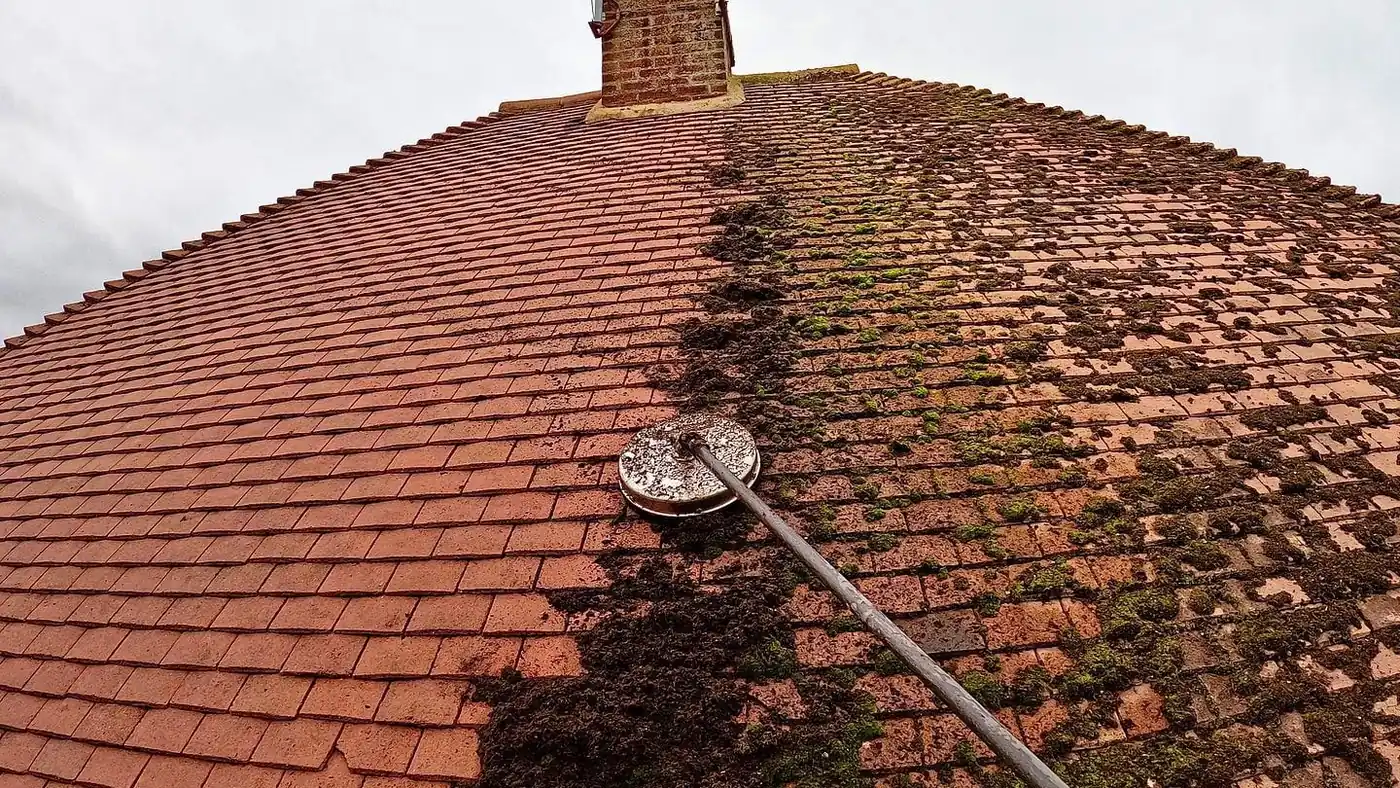
Moss on clay tiles comes off by hand before treatment. The biocide then goes on at low pressure, and no pressure washing is involved.
Fibre cement slates
A low-pressure biocide avoids aggressive scraping and pressure. That’s why it’s often what we’d suggest for these slates once we have checked them.
DIY or a professional?
Please don’t walk on the tiles. Tiles and slates can crack under your weight, sometimes with hairline cracks you can’t see, which frost can widen over time. Access should always be planned to suit the roof.
For a quick check from a ladder, set it on firm, level ground, have someone foot it and never lean out to the side. Don’t climb from the ladder onto the roof and never do it on your own.
Looking after it afterwards
Simple habits between visits make a real difference. We recommend:
- Leave lichen to weather off after treatment
- Leave the treated roof alone
- Keep off treated areas until they’ve dried
- Check the roof annually
The day after treatment, the roof may look much the same. Over the following weeks and months, the growth dies back and weathers away, so the full effect builds slowly. You will know what to look for.
Copper strips or sacrificial lead at drip points can inhibit growth, the SPAB notes. Rain carries a trace of the metal down the tiles, which can slow regrowth.
Honest limits
Even careful work has limits, and it’s fair to set them out:
- Fading and old staining in the tile
- Damaged tiles
- Stopping new spores landing
If in doubt, pick up the phone and call 01342 344 936 or fill in the quote form and we’ll say what we think.
What the work covers
- Tile and slate surfaces
- Algae and black streaks
- Ridge and hip tiles
- Roofs cleaned by hand
- Shaded roof slopes
- Lichen patches