Greater London · Biocide roof treatment
Biocide roof treatment in Walthamstow Village, Greater London
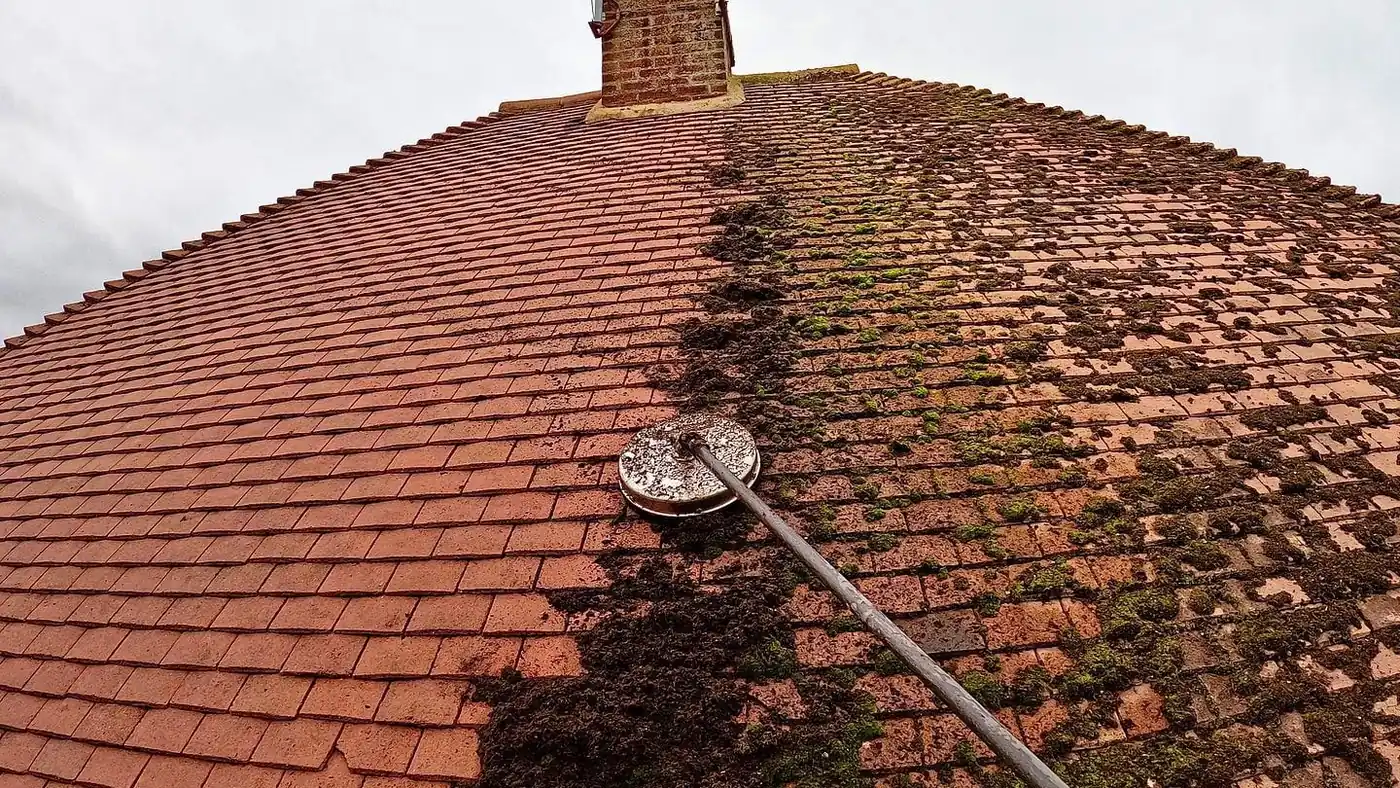
Biocide roof treatment to kill remaining moss, algae and lichen spores and slow regrowth in Walthamstow Village, done the careful way. Safe access planned for the job, the area protected and the waste taken away.
- A shaded slope that turns green quickly
- Light moss starting to show
- An old treatment that has worn off
Roof biocide treatment for homes in Walthamstow Village
In Walthamstow Village, as everywhere, a biocide needs the right weather. Rain too soon can wash it off before it works so the forecast decides the date. Frost and high wind put it on hold too. The work covers ridge and hip tiles, tile and slate surfaces and algae and black streaks, and common reasons people get in touch are green algae on the roof and new moss on a cleaned roof.
In a London neighbourhood like Walthamstow Village, access shapes the whole job: ladders from the street, a tower in the garden or a way through the house to the back. If a scaffold or tower has to stand on the pavement, it may need a licence from the council, and a parking permit or bay suspension may be needed for the van. We talk this through when we quote.
The guarantee isn’t a handshake. You get a written 12-month workmanship guarantee with each job, covering the work we carried out. File it with your other house papers in case you need it.
- Place
- Walthamstow Village (E17, E10, E11)
- Region
- Greater London
- Our guarantee
- 12-month workmanship guarantee, in writing
- Quotes
- Fixed price, set before we begin
- Background
- 20 years’ experience; Checkatrade member
- Telephone
- 01342 344 936
- Last updated
- 30 October 2026
Aftercare tips
Growth and dirt come back in time, but good habits slow them down. Our tips:
- Cut back overhanging trees
- Book a repeat treatment early
- Clear leaves from the gutters each autumn
- Give the treatment time to work
After a biocide treatment, nothing much seems to happen at first. Over the following weeks and months, the growth dies back and weathers away and the roof keeps improving. We’ll tell you what to expect.
Trimming branches over the roof helps a treatment last longer. A roof that dries quickly regrows slowly, and fewer leaves gather in the gutters.
Roof biocide treatment in Walthamstow Village: the local picture
Walthamstow Village has about 6 areas of ancient woodland within two miles, the closest being Epping-Walthamstow Forest, roughly 1.4 miles north-east of Walthamstow Village. If your roof is shaded by trees, it will stay damp for longer and moss will usually come back sooner than on an open roof. The area’s older buildings include Bruce Castle, about 2.9 miles west of Walthamstow Village. Buildings like that show how long clay and slate roofs can last when they’re looked after. London roofs often have hidden valleys and parapet gutters at the back, where moss collects out of sight, so the whole roof is looked at, not just the front.
Around Walthamstow Central station, less than half a mile from the centre of Walthamstow Village, terraces and commuter homes can be short of parking, and our van needs to be fairly close to the house, so let us know the options. If your home is near Walthamstow School for Girls or another school, the school run can fill the road twice a day. Tell us about it when you ask for a quote, and the start can be timed to suit.
Walthamstow Village is about 1 mile south-east of Walthamstow, in Greater London. Anywhere in E17, we can take on roof biocide treatment. Walthamstow Village is one of 764 towns, villages and districts in Greater London we cover for roof biocide treatment. London is in our area too, about 7 miles from Walthamstow Village.
Every address in E17, E10 and E11 is covered for roof biocide treatment, from the main roads to the quietest streets. Local streets include Elm Road, Eden Road and Lorne Road, and we cover them all for roof biocide treatment. We also cover Walthamstow (1 mile north-west), Bakers Arms (1 mile south), Upper Walthamstow (1 mile east), Warner Estate (1 mile north-west) and Snaresbrook (1 mile east). Further out, we also cover London (7 miles south-west), City of Westminster (8 miles south-west), Marylebone (7 miles south-west), Kensington (10 miles south-west), St Pancras (6 miles south-west) and Shoreditch (5 miles south-west).
Local landmarks in Walthamstow Village
In Walthamstow Village, the houses around Lloyd Park, The Nags Head pub and Emmanuel Community School are all within our usual area. There’s a railway station in Walthamstow Village itself: Walthamstow Central station. Well-known places in the area include 17 & Central (0.5 miles west) and Walthamstow Pump House Museum (1.1 miles south-west). Open spaces near Walthamstow Village include Hollow Pond and Ainslie Wood.
Landlords, letting agents and property managers
Who looks after the roof and gutters is normally set out in the tenancy agreement or lease. We’re happy to deal with either side, and we will keep whoever booked us informed.
From a single let house to a portfolio, you get the same service: a fixed price up front, the gentlest method that does the job, a proper clear-up and a 12-month written guarantee covering our workmanship.
Also near Walthamstow Village
What else we do in Walthamstow Village
What happens if it’s left?
Biocide alone isn’t the answer for heavy moss. Dead moss can take a long time to drop and tends to end up in the gutters, so thick growth is removed by hand first. On a shared terrace, keeping your part in order helps the whole row.
Leaving it longer rarely makes the job smaller. Growth, debris and minor damage tend to build over time, and that can mean a bigger job later. If you are unsure, reach us by phone on 01342 344 936, or by the quote form for honest advice and a fixed quote.
Why us?
- We’re fully insured
- 20 years’ experience in roof and exterior cleaning
- We take the waste with us
- One number for London and the South East
Take a look at what affects the cost or how we choose the method.
When to call us in Walthamstow Village
Green or black staining on a roof is typically algae. It grows quickly in damp weather and prepares the way for moss.
Keep an eye out for these signs:
- Growth coming back on a treated roof
- Bright lichen patches on ridge and hip tiles
- Slowing moss coming back after cleaning
- Regrowth since the roof was last cleaned
Around Lloyd Park, about 0.7 miles north-west of Walthamstow Village, gardens often border trees and hedges, and that brings shade. Where a slope gets little sun, moss typically comes back quicker after a clean.
What to look for in a quote
- How they’ll protect your property and control run-off
- What happens to the moss and debris
- How they’ll clean without damaging the tiles or surface
- If the quote is a fixed price or an estimate
Part by part
Clay tiles
Lichen is common on older clay roofs. Treating it avoids scraping the tile face and lets it weather off.
Concrete tiles
Older concrete tiles regrow quickly. Treating them slows regrowth, typically for around one to a few years, depending on shade and aspect.
Doing it yourself: an honest view
You can buy moss and algae treatments yourself, but only use one authorised for that job and follow the label to the letter. Applying it to a roof still means working at height, and run-off still has to be kept out of drains.
A pressure washer from a hire shop might look like a quick fix for the roof. Tile manufacturer guidance warns against high-pressure jet washers on roofs, as it can damage the surface, strip colour from concrete tiles and drive water under the laps.
FAQs for Walthamstow Village
Does a conservation area in Walthamstow Village change anything about roof biocide treatment?
A clean leaves the roof looking as it should, so it is not the issue; new tiles or a coating are what Waltham Forest council may need to agree. The nearest to Walthamstow Village is the St Mary's Church (Walthamstow Village) conservation area, some 0.1 miles north of the middle of Walthamstow Village.
Do I need a permit or licence for work at my home in Walthamstow Village?
It varies from street to street. Equipment on the pavement may need a licence from the council, and a parking permit or bay suspension may be needed for the van. This is covered when we quote, so there are no surprises.
How long will the treatment keep moss away?
It depends on shade and aspect, but typically around one to a few years. A yearly look at the roof tells you when to retreat and a light retreat is simpler than a full clean.
Where does the waste go?
We bag what we remove and take it away with us, from moss and leaves to silt and broken tiles. We don’t leave it behind.
What about my pets and plants?
Many jobs do not involve chemicals at all; solar panels, for instance, get soft brushes and clean water. Where we do use a biocide, we only use ones approved or authorised for this use in Great Britain, as the law requires. We will let you know how long to keep pets off treated areas.
Do you work on listed or historic buildings?
Yes, with care. We don’t use pressure on historic surfaces, and we won’t apply a coating without the council’s advice, and we’ll suggest the gentlest method that works. The council’s conservation officer can tell you if consent is needed.
What about plants and pets during treatment?
The area below is protected and the label’s precautions followed. Run-off is controlled and kept out of surface water drains, and we will tell you how long to keep pets and children off treated areas.
Should the moss be removed before treatment?
It varies with the roof. Thick moss stops the biocide reaching the tiles and falls away slowly once it’s dead so we remove it by hand before treating, while lighter growth can simply be treated.
What happens on the day
Where cleaning is involved, we use the gentlest method that does the job, matched to the surface in front of us. Speed never comes before the condition of your property. The work itself takes an hour or two for a small roof and longer for a large one, and we clear up at the end. For a job in Walthamstow Village, let us know where a van can stop and whether a visitor permit is needed.
- We start by checking what’s growing and where.
- The price is fixed and thick moss planned for removal before treatment.
- We book a dry day and protect plants, paths, gullies and drains.
- The treatment goes on at low pressure, evenly across the tiles.
- We clear up and explain how long the dead growth takes to go.
A few things to sort first
- Let us know where we can park
- Let neighbours know if we will be near a shared boundary or drive
- Mention any nests you know about
Your fixed quote
Some jobs can be priced from photos; others need us to see them. Where access is tricky or the area is hard to see in photos, we normally come and look. Either way, you get a fixed price before work begins.