Bracknell Forest · Biocide roof treatment
Biocide roof treatment in Tickleback Row, Bracknell Forest
Biocide roof treatment to kill remaining moss, algae and lichen spores and slow regrowth in Tickleback Row, with a fixed quote before we start. Fully insured, with a written 12-month guarantee on our workmanship.
- Algae on the slope that gets the least sun
- Growth on delicate tiles that can’t be jet washed
- Growth coming back on a treated roof
Roof biocide treatment for homes in Tickleback Row
Lichen is the growth that most often needs a biocide. Scraping it off can damage the surface of the tiles so the better route is to treat it and leave it to weather off. Expect it to fade gradually. If you are dealing with lichen best left to a treatment rather than a scraper and a roof greening up, we can put it right, from lichen patches, shaded roof slopes and ridge and hip tiles onwards.
In a rural spot like Tickleback Row, access may mean a long drive, a narrow lane or a gate to get through, and it helps to know about turning space and parking. Mature trees around a home in a village like Tickleback Row tend to mean heavier moss and fuller gutters.
We’re fully insured, Checkatrade members and have 20 years’ experience, and each job carries a 12-month written guarantee covering our workmanship. It’s given in writing for your records.
- Location
- Tickleback Row (RG42)
- Region
- Bracknell Forest
- Cover
- A written 12-month guarantee on our workmanship
- Price
- Fixed, not estimated
- Track record
- Checkatrade member, fully insured
- Phone
- 01342 344 936
- Reviewed
- 30 October 2026
Why act early in Tickleback Row
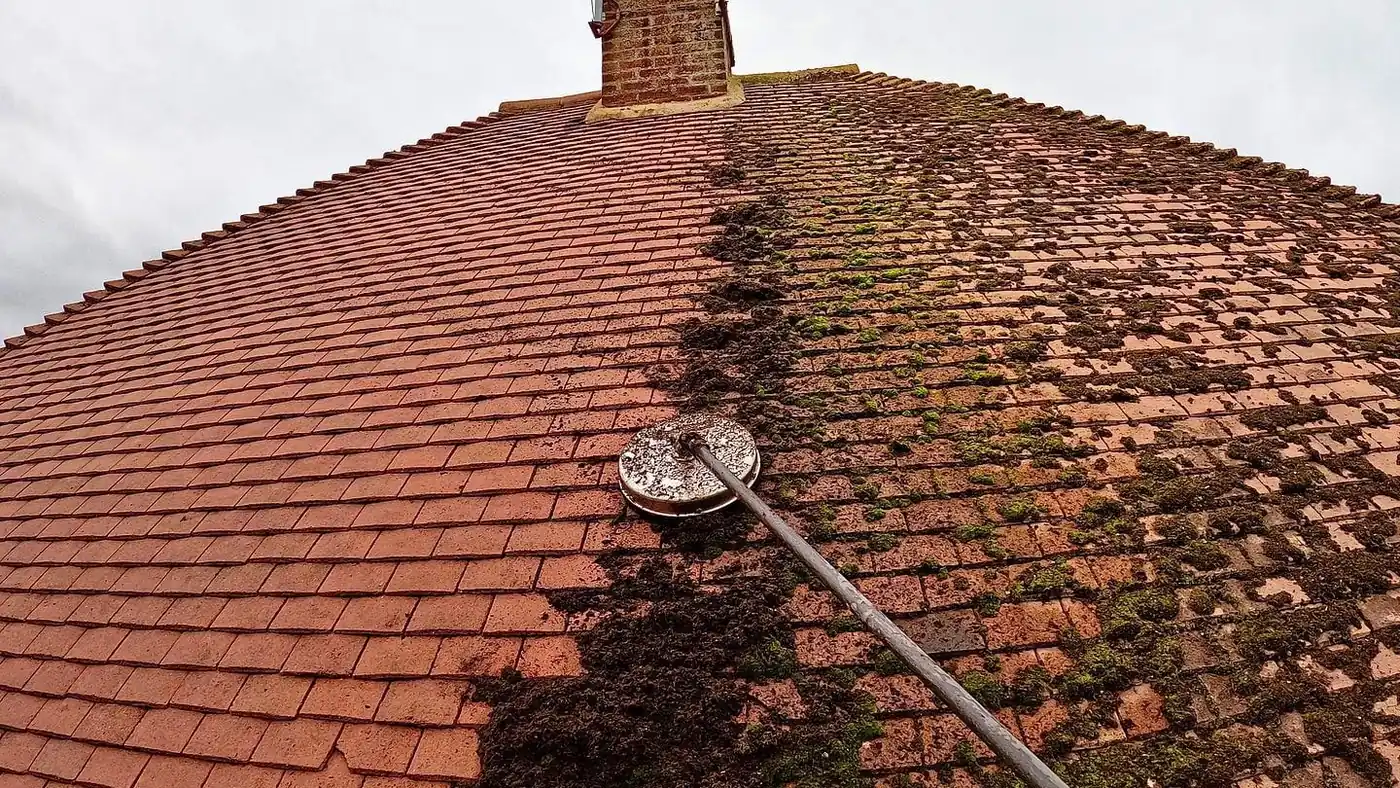
Leaving lichen and algae untreated lets them keep spreading. Algae keeps the surface damp and helps moss get started while lichen keeps spreading across the tiles. Treating now slows it down. Moss and algae hold water, and that is the start of most problems.
For work at height, access is a big part of the price. If a tower, scaffold or powered access is needed, it goes into the quote, and we tell you why.
Why Tickleback Row homeowners choose us
- One number for London and the South East
- A fixed quote before we start
- Every job backed by a written 12-month guarantee on our workmanship
- 20 years’ experience in roof and exterior cleaning
Tickleback Row: your questions answered
Does tree cover around Tickleback Row affect roof biocide treatment?
Trees can make a real difference. The nearest ancient woodland to Tickleback Row is (Epoch3: Lever's Piece)(Tithe: Marsh Coppice), about 0.5 miles south-west of Tickleback Row. Trees mean shade and leaf litter, so moss typically comes back sooner and gutters fill faster.
Is Tickleback Row within the area you cover?
Yes. Small places get the same service as large ones, and Tickleback Row is on our list. Just mention lanes, gates or anything else about getting there when you book.
Do nesting birds affect the work?
We work around active nests. Nesting birds are protected by law, so we check first and leave any active nest alone, and that area can be done once the nest is no longer in use.
How do you protect the garden during treatment?
Protecting the area below is part of the job. Planting is protected and drains covered, with nothing allowed into surface water drains. We’ll advise on pets and children on the day.
Where does the waste go?
It leaves with us when we go. Paths, patios and drives are swept clear before we go, so the property is left tidy.
Can you treat lichen on a roof?
A biocide kills lichen, which then weathers off over time. It takes time, but the tiles aren’t harmed as the dead crust loosens and goes.
Is there anything I need to do beforehand?
Clear access matters most: cars moved, gates unlocked and garden furniture or pots moved away from the work. Close windows and roof lights near the work and keep pets in.
Which method will you use?
It depends on the surface and its condition. Clay, slate and older tiles are cleaned by hand or at low pressure, robust concrete tiles may take controlled pressure after a check, and solar panels get soft brushes and clean water. You’ll know the method before you book.
Looking after it afterwards
Our aftercare advice, short and simple:
- Don’t rinse the roof after treatment
- Expect gradual change
- Let more sun reach the tiles
- Look for regrowth on the shady slope once a year
The treatment slows regrowth, typically for around one to a few years, depending on shade and aspect. A yearly look tells you how it’s doing and retreat when the first signs come back.
Trimming branches over the roof helps a treatment last longer. A roof that dries quickly regrows slowly, and fewer leaves gather in the gutters.
Roof biocide treatment around Tickleback Row: what to know
(Epoch3: Lever's Piece)(Tithe: Marsh Coppice), about 0.5 miles south-west of Tickleback Row, is the nearest of about 54 ancient woods within a couple of miles of Tickleback Row. Woods nearby can mean leaves on the tiles and shade for much of the day, and moss does well in both. At about 29 miles from central London, Tickleback Row sits well inside the area we cover for roof biocide treatment. Our 20 years’ experience and full insurance stand behind every job. Older buildings in the area include St Leonard's Hill, roughly 4.7 miles east of Tickleback Row. Houses of that age are a reminder that clay and slate roofs can last a very long time with care.
Roads near schools such as Garth Hill College can be busy at drop-off and pick-up. If that’s your road, mention it when you book, and setting up can be planned around the busy times. Homes near open spaces like Weycock Hill, roughly 4.2 miles north-west of Tickleback Row, often have more trees around them. A roof that sits in shade for part of the day tends to grow moss sooner.
Tickleback Row is about 3 miles north of Bracknell, in Bracknell Forest. We provide roof biocide treatment for houses, flats and rented homes in Tickleback Row and the rest of Bracknell Forest. Tickleback Row is one of 41 towns, villages and districts in Bracknell Forest we cover for homeowners and landlords. Reading is in our area too, around 10 miles away.
All of RG42 is covered for roof biocide treatment, from busy streets to back roads. Other places close to Tickleback Row include Moss End (1 mile east), Jealott's Hill (1 mile north), Warfield (1 mile east), Hawthorn Hill (1 mile north-east) and Newell Green (1 mile south). Within a short drive, we also cover Bracknell (3 miles south), Sandhurst (7 miles south), Great Hollands (3 miles south), Forest Park (3 miles south), The Warren (3 miles south-east) and Harmans Water (3 miles south).
Local landmarks in Tickleback Row
For rail, the closest station is Bracknell station, about 2.3 miles south. Nearby you will also find The Lexicon (2.1 miles south). The countryside around Tickleback Row includes Holt Copse & Joel Park and Weycock Hill.
Let and managed properties
Outside maintenance is easy to forget on a rental. Few tenants look up at the roof or into the gutters, so a planned visit helps spot build-up, blockages or loose tiles early.
Who looks after the roof and gutters is normally set out in the tenancy agreement or lease. We can quote either party, and we’ll keep whoever booked us informed.
Also near Tickleback Row
More services for Tickleback Row
From first look to clear-up
We bring everything the job needs, including covers, tools and whatever access the work calls for. All we need from you is a clear way in and somewhere to park. The job takes an hour or two for a small roof and longer for a large one. Mention ponds, greenhouses or anything fragile near the work.
- We check the roof and the growth on it.
- The price is fixed and thick moss planned for removal before treatment.
- We book a dry day and protect plants, paths, gullies and drains.
- We apply an authorised biocide at low pressure, as the label says.
- We clear up and explain how long the dead growth takes to go.
A few things to sort first
- Tell us about anything you already know, such as leaks or loose tiles
- Mention any permits or parking limits
- Park cars clear of the work area
Pricing your job
Photos are enough for some jobs, while others need a visit. Where access is tricky or the area is hard to see in photos, we normally come and look. Either way, you get a fixed price before any work starts.
Related advice
Common problems we fix in Tickleback Row
Even after a thorough clean, traces of growth remain. Fragments sit in the pits and pores of the tile surface, ready to grow again. That’s why a treatment after cleaning helps.
Signs it’s time to call us include:
- Black lines on the tiles
- Lichen spots across the tiles
- Lichen best left to a treatment rather than a scraper
- Light moss starting to show
Older homes, like many found near churches such as Church of St Michael and All Angels, often have clay tiles or slate that call for a gentle approach.
What to look for in a quote
- Whether the workmanship is guaranteed in writing
- Whether the waste is taken away
- How they’ll clean without damaging the tiles or surface
- Whether the price is fixed
Different parts, different methods
Concrete tiles
Rough, weathered concrete holds spores well. Treating them slows regrowth, typically for around one to a few years, depending on shade and aspect.
Historic and listed roofs
On a historic roof, a low-pressure treatment is one of the gentler options. We still check the roof closely first and avoid scraping old surfaces.
Doing it yourself: an honest view
You can buy moss and algae treatments yourself, but only use one authorised for that job and follow the label to the letter. Applying it to a roof still means working at height, and it must be kept away from drains and ponds.
Walking on a tiled roof does more harm than people think. Weight on a tile can leave hairline cracks that are not visible, and frost can open those cracks up over the following winters. Proper access, planned to suit the roof, avoids that.