Kent · Biocide roof treatment
The Moor roof biocide treatment
We cover The Moor for biocide roof treatment to kill remaining moss, algae and lichen spores and slow regrowth. The gentlest effective method, a fixed quote and a written 12-month workmanship guarantee with every job.
- Small tufts of moss on the tiles
- Keeping a freshly cleaned roof clearer for longer
- An old treatment that has worn off
How we handle roof biocide treatment in The Moor
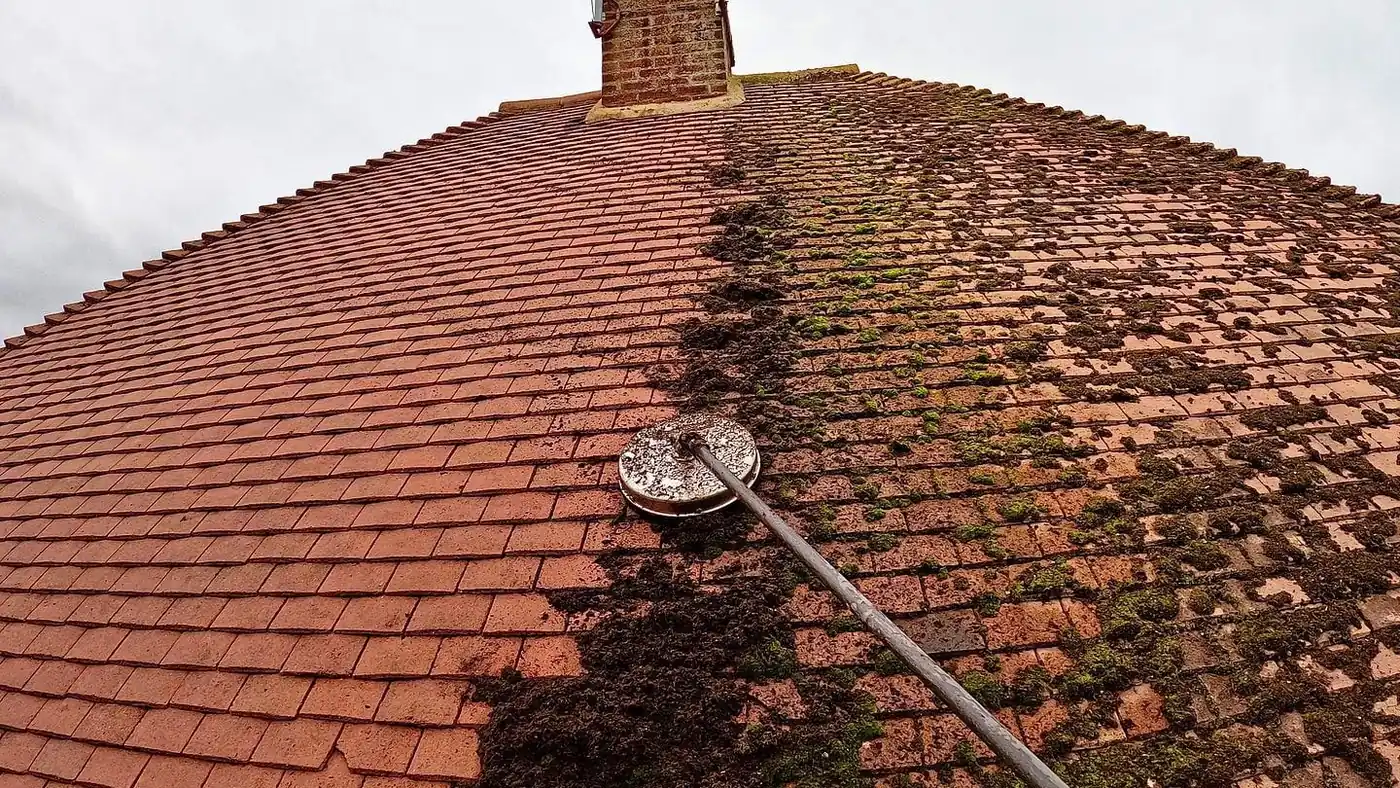
Lichen is the growth that most often needs a biocide. Scraping it off can damage the surface of the tiles, so we treat it instead and let the weather finish the job. Expect it to fade gradually. We are often asked to deal with slowing moss coming back after cleaning and lichen that won’t scrape off, on ridge and hip tiles, algae and black streaks and roofs cleaned by hand.
In a rural spot like The Moor, access may mean a long drive, a narrow lane or a gate to get through, and it helps to know about turning space and parking. Trees around rural homes often mean more shade, more moss and more leaves in the gutters.
We bring Checkatrade membership, full insurance and 20 years’ experience to each job. On top of that, each job comes with a written 12-month guarantee on our workmanship, so there’s something in writing if you need it.
- Location
- The Moor (TN18)
- Region
- Kent
- Our guarantee
- Workmanship guaranteed in writing for 12 months
- Quotes
- Fixed price, set before we begin
- Experience
- Two decades in the trade, fully insured
- Telephone
- 01342 344 936
- Updated
- 30 October 2026
Roof biocide treatment in The Moor: the local picture
The Moor lies within about 5 miles of the High Weald National Landscape. If your home sits on a wooded or north-facing slope near the High Weald, moss can build up faster, so a biocide treatment after cleaning may be worth considering. About 41 miles out from central London, The Moor is part of the South East area where we carry out roof biocide treatment. We have 20 years’ experience and are fully insured. One of the historic houses in the area is Great Dixter, about 4.8 miles south-east of The Moor. Buildings like that show how long clay and slate roofs can last when they’re looked after.
Traffic for Marlborough House School can make the road outside hard to use at certain times of day. If that’s your road, mention it when you book, and setting up can be planned around the busy times. Around a church like Church of St Laurence, the houses are often some of the oldest in the area, and clay or slate on a roof like that gets scrapers and brushes, never a jet.
The Moor is about 12 miles north of Hastings, in Kent. The Moor gets the same approach as each job we take on: a look at the job first, a fixed quote, the gentlest method that will do the job and a 12-month workmanship guarantee in writing. Our area takes in 922 places across Kent, from busy towns to small villages. You can also see our page for Royal Tunbridge Wells, about 12 miles away.
All of TN18 is covered for roof biocide treatment, from the main roads to the quietest streets. If you need roof biocide treatment at a property on The Moor, Pipers Lane and The Chestnuts or a nearby road, we can help. Close by, we work in Hawkhurst (1 mile north-east), Little Conghurst (1 mile east), Pipsden (1 mile north-east), Four Throws (1 mile east) and Beal's Green (1 mile north). Within a short drive, we also cover Royal Tunbridge Wells (12 miles north-west), Tonbridge (15 miles north-west), Paddock Wood (11 miles north-west), Tenterden (8 miles east), Southborough (13 miles north-west) and Park Wood (14 miles north).
What’s near The Moor
Properties near Collingwood Nature Reserve, The Eight Bells Hotel and Hawkhurst Church of England Primary School fall within our area as well. For rail, the closest station is Etchingham station, roughly 3.3 miles south-west.
Places near The Moor
More services for The Moor
Common questions in The Moor
Is The Moor close to the High Weald?
The Moor is within about 5 miles of the High Weald National Landscape. Homes near protected countryside can include many older properties with clay tiles or slate, which need gentle hand cleaning.
Who do I check with about listed building consent in The Moor?
The council to speak to is Tunbridge Wells council. Their conservation or planning staff can confirm the status of your home and what needs consent. If your home is listed, listed building consent is needed for works that affect its special character, so check with the council before a coating or any change to how the roof looks.
Can letting agents book you?
Yes. We can quote for several properties together, with each priced on its own work. Send the addresses and how access works.
Can neglect affect a home insurance claim?
Many home insurance policies exclude gradual damage and wear and tear, so regular maintenance matters. The wording of your own policy is what counts.
Could the price change on the day?
The quote is a fixed price for the work we have described. Anything new we find, like hidden damage, is quoted separately, and it only goes ahead if you agree.
Where does the waste go?
Everything we clear is bagged and leaves with us, whether it’s moss, leaves, silt or debris. None of it is left on site.
How do you decide on the method?
We choose after looking at the job. It’s never about doing it fastest: the aim is a good result with the least wear on the surface, and we will explain why.
Are you a Checkatrade member?
Yes. We are a Checkatrade member, and we are fully insured.
How we price roof biocide treatment
Each job gets its own quote. These are the things that affect it:
- The type and condition of the tiles or surface
- Which method we use
- Whether anything else is added, like clearing the gutters
- The area to be worked on
Houses, bungalows and flats are all priced the same way: how much there is, how we reach it, what state it’s in and how we’ll tackle it. Call for a fixed quote and we will go through it with you.
Asking for a quote
There’s no need for technical detail. It helps if you can send:
- Shots of the heaviest build-up
- How we’d get to the work, such as a side passage or back garden
- Whether the building is listed
- Photos showing the whole area to be worked on
Photos are enough for some jobs, while others need a visit. Big jobs, awkward access and anything that’s hard to see from the ground are normally looked at in person. Either way, you get a fixed price before work begins.
Leave it or put it right?
Scraping lichen and treating it give very different results. Because it bonds to the tile, scraping can damage it, while a biocide kills it and lets it weather off over time. The longer growth is left, the longer surfaces stay wet.
Where the work is at height, access can make a big difference. If a tower, scaffold or powered access is needed, it goes into the quote, and we tell you why.
What you get with us
- Gentle methods first, pressure only where the surface can take it
- Biocides approved or authorised for this use in Great Britain, as the law requires
- We take the waste with us
- A written 12-month workmanship guarantee
Take a look at what affects the cost and our methods by tile type.
How a job runs
Weather matters for most outdoor work. Frost, heavy rain and high wind can mean moving the date, because working safely and getting a good result come first. On a suitable day, it takes an hour or two for a small roof and longer for a large one. In a village like The Moor, a long drive, a narrow lane or a gate can affect access, so directions help.
- We check the roof and the growth on it.
- We agree the treatment and any hand removal first, at a fixed price.
- We book a dry day and protect plants, paths, gullies and drains.
- We apply an authorised biocide at low pressure, as the label says.
- We clear up and explain how long the dead growth takes to go.
Before we arrive
- Shut nearby windows and roof lights
- Let us know about anything fragile below, like a glass roof
- Make space on the drive by moving cars
Pricing your job
To help us price the job: the address and roughly what needs doing, some pictures, taken safely from the ground and any past work you know about, like a previous clean or a repair. Then reach us by phone on 01342 344 936, or by the quote form.
Advice
Do you need roof biocide treatment in The Moor?
Shaded, slow-drying slopes regrow fastest. North-facing slopes and areas under trees stay wet after rain, so they are where a treatment wears off first.
These are the things we see most often:
- Orange or yellow lichen on the ridge
- A north-facing slope that greens up fast
- Small tufts of moss on the tiles
- Regrowth since the roof was last cleaned
Places like Collingwood Nature Reserve, under half a mile from the middle of The Moor, can bring trees and birds close to the houses around them. Leaves on the tiles and in the gutters hold damp, and moss thrives on damp.
What to look for in a quote
- How they’ll keep drains, plants and paths protected
- If the quote is a fixed price or an estimate
- Whether any biocide used is authorised in Great Britain for the job
- How they’ll clean without damaging the tiles or surface
When something else is needed
Even careful work has limits, and we’d like you to know them:
- Stopping new spores landing
- An instant result (dead growth weathers off over time)
- Deep moss in the interlocks
If in doubt, pick up the phone and call 01342 344 936, or use the quote form and we will say what we think before you book.
What we work on in The Moor
- Ridge and hip tiles
- Lichen patches
- Tile and slate surfaces
- Shaded roof slopes
- Algae and black streaks
- Roofs cleaned by hand
What the work involves, part by part
Concrete tiles
A biocide avoids the colour loss that high pressure can cause on concrete. It goes on gently and works over the following weeks.
Fibre cement slates
We look at fibre cement slates first. Older fibre cement slates may contain asbestos and need a careful, low-impact approach, and we’ll advise on what’s suitable.
What’s safe to do yourself
Some jobs are fine to do yourself, from the ground: look the roof over once a year, watch for overflowing gutters and sweep up moss that falls onto paths. Anything higher than that is best left to us.
Scraping moss off sounds simple, but technique matters. Lichen in particular clings hard, and forcing it off can mark the tile surface, which is why it’s normally treated and left to weather away. Leave the roof to someone with the right access.