Kent · Biocide roof treatment
Biocide roof treatment in Temple Ewell, Kent
Need roof biocide treatment in Temple Ewell? We see the job first, fix the price and choose the gentlest method that does the job, then clear up and take the waste away.
- Bright lichen patches on ridge and hip tiles
- Growth coming back on a treated roof
- Growth on delicate tiles that cannot be jet washed
How we handle roof biocide treatment in Temple Ewell
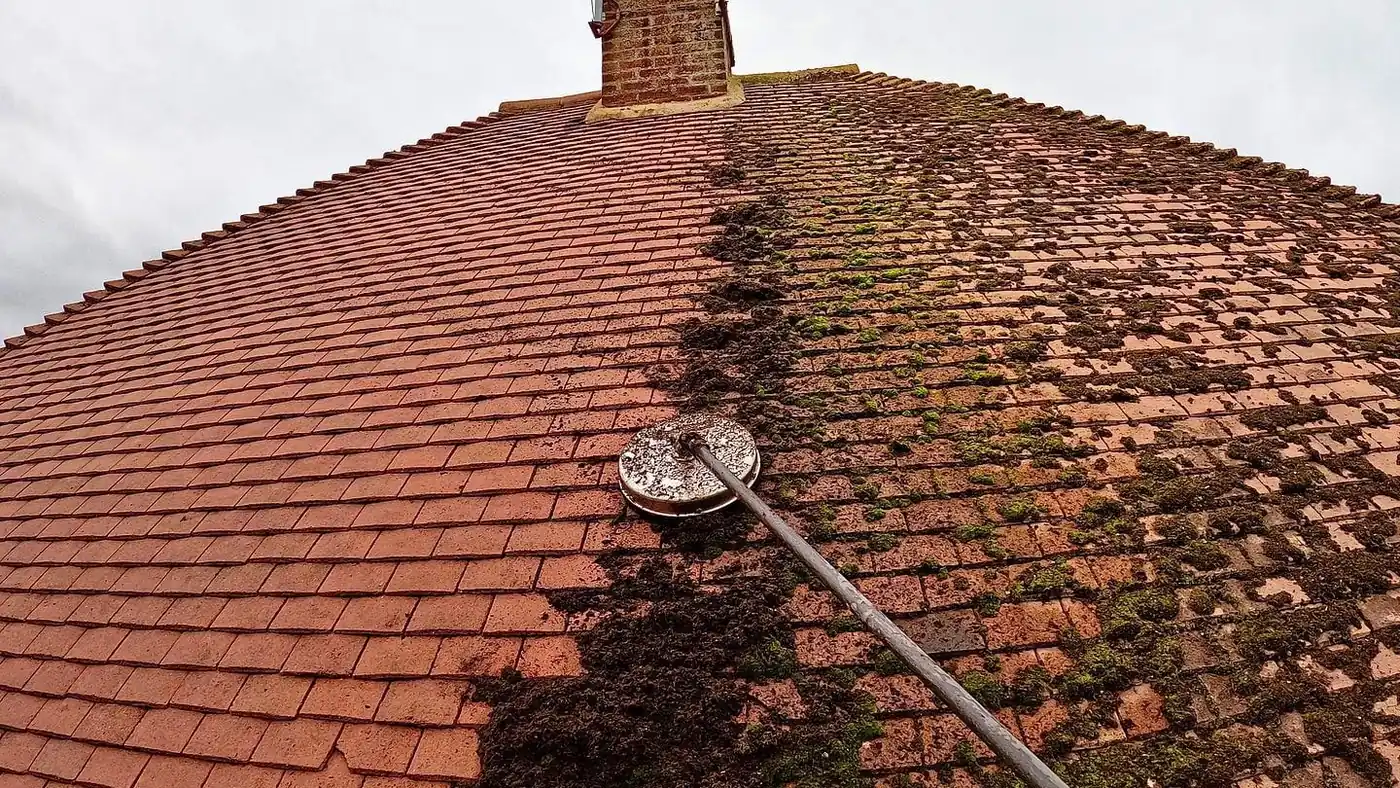
Those crusty grey, yellow and orange patches are lichen, and it clings hard. Trying to scrape it away risks marking the tiles so the better route is to treat it and leave it to weather off. It fades over the following months. The work covers ridge and hip tiles, lichen patches and roofs cleaned by hand, and people most often call us about regrowth since the roof was last cleaned and black streaks down the slopes.
Some homes in villages like Temple Ewell are listed or in a conservation area, and if yours is one of them, gentle methods matter even more. Cleaning doesn’t change how a roof looks, but a coating or a change of tiles can, so check with the council before anything like that.
Superior Roof Cleaning is fully insured, a Checkatrade member and has 20 years’ experience, with a written 12-month workmanship guarantee on each job. It’s given in writing, so it’s there if you ever need it.
- Where
- Temple Ewell (CT16, CT17)
- Region
- Kent
- Cover
- 12-month workmanship guarantee, in writing
- Price
- A fixed price before work begins
- Track record
- Checkatrade member, fully insured
- Call
- 01342 344 936
- Last updated
- 30 October 2026
Let and managed properties
Who looks after the roof and gutters is normally set out in the tenancy agreement or lease. We’re happy to deal with either side, and we’ll keep whoever booked us informed.
On a let property, the outside is easy to overlook. Few tenants look up at the roof or into the gutters, so planned work helps catch moss, blockages or slipped tiles before they grow into a bigger job.
What else we do in Temple Ewell
How it works
The first job is protection: we cover or move anything that could be splashed or hit, and protect gullies and drains. Then the work starts. It takes a few hours to apply on most roofs, and we clear up before we go. Access to the back garden decides where ladders or a tower go.
- First we decide whether treatment alone will do or a clean comes first.
- We fix the price and agree which slopes are treated.
- We plan the day around the weather, since the biocide needs a dry spell to work.
- After protecting what’s below, we apply an authorised biocide gently.
- We explain that the growth fades over time rather than all at once.
How to prepare
- Tell us about parking restrictions near the property
- Tell us about any conservatory, glass roof or extension below the work
- Let us know about any pets, and keep them inside on the day
Ask for a quote
To help us price the job: the address and roughly what needs doing, a few photos from the ground and any past work you know about, like a previous clean or a repair. Once you have those, pick up the phone and call 01342 344 936 or fill in the quote form.
Read more
Doing it yourself: an honest view
Hard paving at ground level is a reasonable DIY job, and there’s nothing wrong with that. Mind the run-off, though: surface water drains discharge directly to the environment, so dirty water and cleaning products shouldn’t go down them.
You can buy moss and algae treatments yourself, but only use one authorised for that job and follow the label to the letter. On a roof, applying it carries the same height risks as any roof work, and it must be kept away from drains and ponds.
Why deal with it now?
Untreated growth slowly gets worse. Algae holds moisture and paves the way for moss, and lichen keeps building its crust. Treating now slows it down. Cleaning what you have is almost always simpler than replacing it.
Where the work is at height, access can make a big difference. Anything beyond ladders, such as a tower, scaffold or powered access, is built into the quote, and we tell you why.
Why Temple Ewell homeowners choose us
- Every job backed by a written 12-month workmanship guarantee
- Checkatrade member
- One phone number across our whole area
- Access planned to suit the property
Read how roof cleaning is priced or which method suits your roof.
When something else is needed
In fairness, there are a few things this work won’t fix:
- Fading and old staining in the tile
- Heavy moss cushions
- Lichen vanishing on the day
If in doubt, ring 01342 344 936 or use the quote form and we’ll say what we think before you book.
What we work on in Temple Ewell
- Tile and slate surfaces
- Ridge and hip tiles
- Roofs cleaned by hand
- Algae and black streaks
- Lichen patches
- Shaded roof slopes
Questions from Temple Ewell
How near is Temple Ewell to the Kent Downs?
Temple Ewell lies within about 7 miles of the Kent Downs National Landscape. Homes near protected countryside can include many older properties with clay tiles or slate, which need gentle hand cleaning.
What if my home in Temple Ewell is in a conservation area?
For a clean, very little beyond our usual gentle approach; anything that changes the roof’s appearance is a question for Dover council. There are about 5 conservation areas less than two miles from the centre of Temple Ewell, the nearest being the Temple Ewell conservation area, about 0.1 miles west of the centre of Temple Ewell.
What about my pets and plants?
Many jobs don’t involve chemicals at all; solar panels, for instance, get soft brushes and clean water. Where a biocide is part of the job, it’s one approved or authorised for this use in Great Britain, applied as the label says. We will tell you about keeping pets and children away.
Do you pressure wash?
Not as a default. We use the gentlest effective method: hand scraping, soft wash or steam for most roofs, with pressure kept for surfaces that can take it. High pressure can damage tile finishes, strip colour from concrete tiles and force water under the laps.
Are you a Checkatrade member?
Yes. We’re a member of Checkatrade. We are also fully insured.
Will a biocide get rid of lichen?
By treating it, not scraping it. Lichen bonds tightly to tiles and slates and scraping can leave marks. Once treated, it fades over the following months.
What if birds are nesting nearby?
We work around active nests. Any active nest is left alone, as the law requires, coming back to that section later if needed.
Do you need scaffolding?
For some jobs, yes. Many jobs can be done safely from ladders and roof ladders, while high, steep or fragile roofs may need a tower, scaffold or powered access. Either way, it’s planned and priced before we start.
What the work involves, part by part
Clay tiles
Lichen is common on older clay roofs. Treating it avoids scraping the tile face and lets it weather off.
Natural slate
Where moss is thick on slate, it’s brushed off by hand before treating. Treatment follows to hold it back.
Aftercare tips
So the work lasts as long as it can:
- Let the biocide stay on the tiles
- Expect gradual change
- Clear leaves from the gutters each autumn
- Do not wait for thick moss to return
After a biocide treatment, nothing much seems to happen at first. Over the following weeks and months, the growth dies back and weathers away, so the full effect builds slowly. We’ll tell you what to expect.
Clear drainage helps the treated roof. Blocked gutters keep the lowest tiles wet and that’s where growth restarts first.
Roof biocide treatment around Temple Ewell: what to know
The coast is only about 3 miles from Temple Ewell. Sea air and wind-driven damp can mean lichen and algae as well as moss, so the clean is planned around all three. Temple Ewell has about 11 areas of ancient woodland within two miles, the closest being Frandham Wood, about 0.7 miles south of Temple Ewell. If your roof is shaded by trees, it will stay damp for longer and moss will normally come back sooner than on an open roof.
Streets near a church such as Church of St Peter and St Paul often include older homes, and older clay or slate roofs need hand cleaning rather than pressure. Commuters often leave their cars on the roads around Kearsney station, a short walk from the centre of Temple Ewell, so it helps to know about your drive or the nearest space. Around Old Park Hill, roughly 0.6 miles south-east of Temple Ewell, gardens often border trees and hedges, and that brings shade. Leaves on the tiles and in the gutters hold damp, and moss thrives on damp.
Temple Ewell is about 2 miles north-west of Dover, in Kent. Homes in Temple Ewell get the same service as everywhere we cover: a look at the job first, a fixed quote, the gentlest method that does the job and a 12-month workmanship guarantee in writing. Our Kent coverage runs to 922 places, Temple Ewell among them. Our Maidstone page covers homes nearby, about 33 miles away.
Here we cover the CT16 and CT17 postcode area for roof biocide treatment. If you need roof biocide treatment at a property on Park Road, Lower Road and Green Lane or anywhere close by, we can help. Close by, we work in Kearsney (1 mile south), River (1 mile south-east), Whitfield (1 mile north-east), Lydden (1 mile north-west) and Wolverton (2 miles south-west). Larger places within reach include Canterbury (12 miles north-west), Folkestone (6 miles south-west), Ramsgate (14 miles north-east), Deal (7 miles north-east), Hythe (10 miles south-west) and Walmer (7 miles north-east).
Local landmarks in Temple Ewell
Locally, the streets close to Dover Christ Church Academy, Royal Oak Cottage The Royal Oak Public House and Old Park Hill are on our patch, like the rest of Temple Ewell. Temple Ewell has its own railway station: Kearsney station. Other landmarks nearby include Dover Castle (2.9 miles south-east) and Dover Transport Museum (0.9 miles east). Green spaces nearby include Dover Western Heights.