Hampshire · Biocide roof treatment
Biocide roof treatment in Stubbington, Hampshire
Need roof biocide treatment in Stubbington? We see the job first, fix the price and choose the gentlest method that does the job, finishing with a full clear-up.
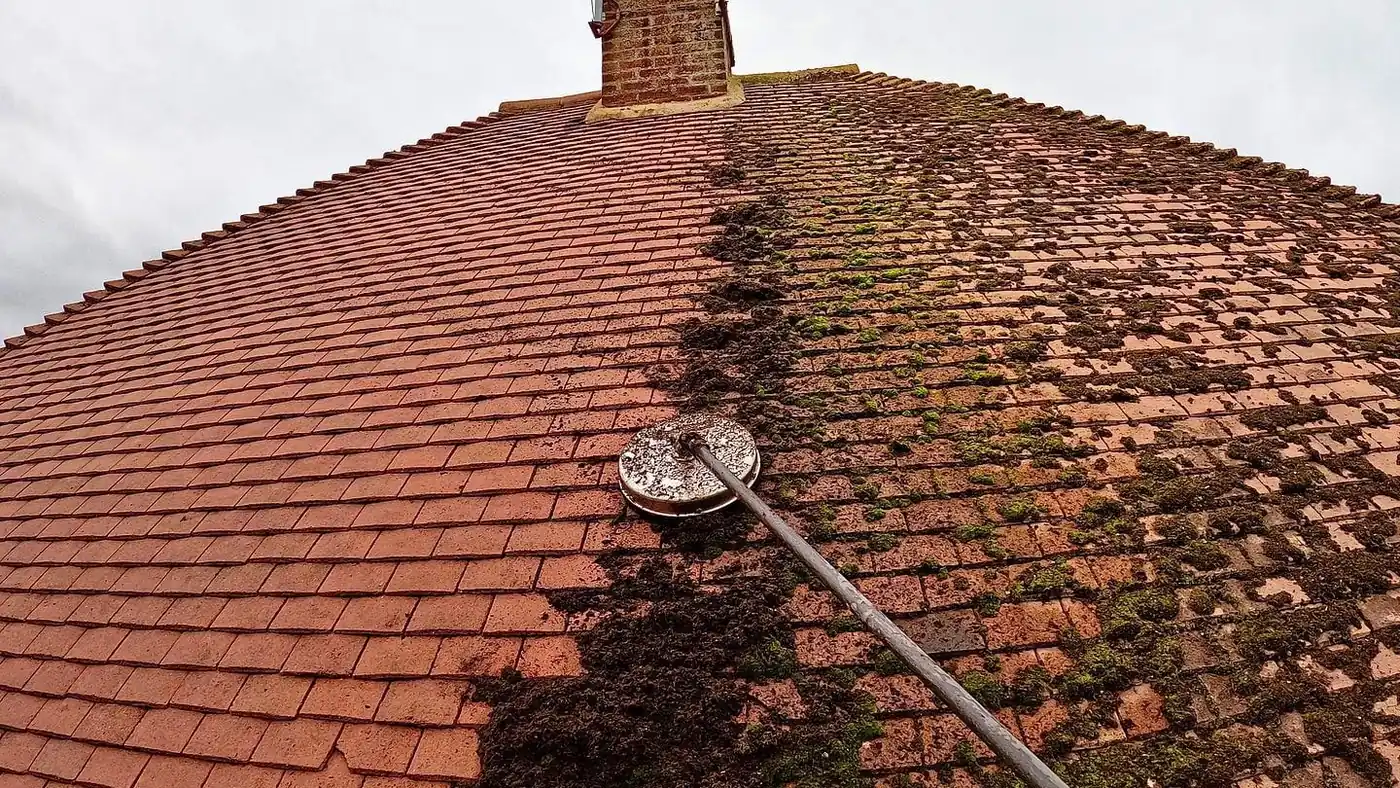
- Green algae on the roof
- Orange or yellow lichen on the ridge
- Light moss starting to show
Roof biocide treatment in Stubbington, done properly
With 20 years’ experience, we are straightforward about what a biocide can do. It slows regrowth; it is not permanent and dead growth takes time to weather away. We are fully insured, a Checkatrade member and give a 12-month written guarantee covering our workmanship. The work covers roofs cleaned by hand, tile and slate surfaces and shaded roof slopes, and people most often call us about algae on the slope that gets the least sun and growth on delicate tiles that can’t be jet washed.
In a place like Stubbington, you will often find older cottages alongside post-war houses and bungalows. Older roofs may be clay tiles or slate, which need gentle hand cleaning, while concrete tiles on newer homes can take a little more.
It’s worth knowing exactly what a guarantee covers. Ours is a written 12-month workmanship guarantee, covering the work itself. Nobody can honestly promise that growth or dirt will not come back outdoors, so we don’t.
- Where
- Stubbington (PO14, PO13)
- Wider area
- Hampshire
- Our guarantee
- Written 12-month workmanship guarantee
- Price
- A fixed price before work begins
- Experience
- 20 years’ experience; Checkatrade member
- Call
- 01342 344 936
- Page updated
- 30 October 2026
When it’s something else
To be straight with you, some problems need a different fix:
- Keeping growth away permanently (it slows regrowth; it isn’t permanent)
- Weathering from age
- Damaged tiles
Not sure which it is? You can call us on 01342 344 936 or send a few lines through the quote form and we will tell you honestly.
What we clean
- Algae and black streaks
- Roofs cleaned by hand
- Ridge and hip tiles
- Lichen patches
- Tile and slate surfaces
- Shaded roof slopes
Nearby places to Stubbington
What else we do in Stubbington
Roofs in Stubbington: local notes
At about 1 mile from the coast, Stubbington is close enough for sea air to matter. Being near the sea doesn’t change the run-off rule: surface water drains lead straight to the environment, so moss and wash water are kept out of them. The nearest ancient woodland to Stubbington is Tips Copse, some 0.5 miles east of Stubbington. Tree cover means shade, and shade means moss, so a roof near woods may need cleaning more frequently.
If you live near Holy Rood Church, or on any of the older streets in Stubbington, your roof may be clay or slate, which is cleaned gently by hand. Traffic for Crofton Anne Dale Junior School can make the road outside hard to use at certain times of day. If that’s your road, mention it when you book, and setting up can be planned around the busy times.
Stubbington is about 2 miles south-west of Fareham, in Hampshire. Wherever you are in the PO14 postcode area, we can carry out roof biocide treatment at your property. Our area takes in 683 places across Hampshire, from busy towns to small villages. Guildford is in our area too, around 40 miles away.
All of PO14 and PO13 is covered for roof biocide treatment, from the main roads to the quietest streets. If you need roof biocide treatment at a property on Park Lane, Croftlands Avenue and Bells Lane or a nearby road, we can help. We also cover Hill Head (1 mile south-west), Little Posbrook (1 mile north-west), Titchfield (2 miles north-west), Catisfield (2 miles north) and Heathfield (2 miles north). Larger places within reach include Gosport (3 miles south-east), Havant (10 miles east), Eastleigh (11 miles north-west), Horndean (11 miles north-east), Totton (14 miles north-west) and Chandler's Ford (13 miles north-west).
Around Stubbington
Locally, the streets close to The Osborne View pub, Crofton School and Stubbington House School are all part of the area we cover. The closest station to Stubbington is Fareham station, roughly 2.3 miles north-east of the centre. Other landmarks nearby include Carron Row Farm Museum (2.5 miles north) and Calshot Castle (3.9 miles west). Open spaces near Stubbington include West of the River Alver.
Stubbington questions
Do trees near my home in Stubbington make a difference to roof biocide treatment?
Trees can make a real difference. Tips Copse, an ancient wood, is about 0.5 miles east of Stubbington. A shaded roof dries slowly, which suits moss, so a biocide treatment after cleaning can help slow regrowth.
Is roof biocide treatment any different near the coast in Stubbington?
It can make a difference, with the sea only about 1 mile from Stubbington. Near the sea, we look for lichen and algae as well as moss and treat them with biocide where agreed.
Do you have insurance?
Yes. We are fully insured, and we can share the details if you need them.
Will you jet wash it?
Not by default. The method is always the gentlest one that does the job: hand removal, soft washing or steam on most roofs, with pressure only where the surface can take it. High pressure can damage tile finishes, strip colour from concrete tiles and force water under the laps.
Do I need to tell my neighbours?
It’s a good idea to let them know, especially if we will be near the boundary or parking nearby. We protect their side as carefully as yours.
How long does a biocide treatment take?
Size and access decide it. As a guide, it takes an hour or two for a small roof and longer for a large one, and the growth keeps dying back afterwards.
Do nesting birds affect the work?
We plan the work around it. Any active nest is left alone, as the law requires, coming back to that section later if needed.
Can you work on an old or listed property?
Yes, carefully. Historic surfaces get hand methods or low-pressure steam, never a pressure washer, and we will pick the gentlest method that does the job. The council’s conservation officer can tell you if consent is needed.
Let and managed properties
It helps if tenants know we’re coming, so cars can be moved and pets kept in. We’ll agree the date with you or with them, whichever works best.
Who looks after the roof and gutters is normally set out in the tenancy agreement or lease. We can quote either party, and we will keep whoever booked us informed.
Looking after it afterwards
After the work, a few habits help it last:
- Retreat when regrowth first appears
- Clear leaves from the gutters each autumn
- Never scrape lichen yourself
- Follow our advice on keeping pets and children away until dry
We will tell you about any precautions while the treatment dries. We follow the label’s guidance, and we’ll go through it with you.
A light brush down each season, as the SPAB recommends, keeps growth from settling. It needs safe access, but it makes each treatment go further.
When to call us in Stubbington
Lichen grows where the air and roof suit it, often slowly over many years. It grips the surface firmly, so it’s best treated rather than scraped.
What we are most often asked to deal with:
- Lichen best left to a treatment rather than a scraper
- A roof greening up
- Black streaks down the slopes
- Moss returning after a clean
If your home backs onto green space such as West of the River Alver, 2.5 miles south-east of Stubbington, you are likely to see more shade, leaves and bird droppings. Where a slope gets little sun, moss normally comes back quicker after a clean.
What to look for in a quote
- Exactly what’s included, area by area
- How they’ll handle anything unexpected
- What insurance they carry
- Whether VAT is included
How the job changes from site to site
Natural slate
Where moss is thick on slate, it’s brushed off by hand before treating. Treatment follows and slows regrowth.
Concrete tiles
Algae and moss are common on concrete roofs. We scrape out the interlocks before treating, so the treatment reaches the tile.
How a job runs
You don’t need to do much on the day. Once cars are moved and we can get round the side and back, the rest is down to us. We clear up before we go and take the waste away with us. Plants, borders and anything below the work are protected before we start.
- First we check the tiles and what’s growing.
- We fix the price and agree any hand removal first.
- We pick a dry spell and protect the area below.
- We apply the treatment evenly, following the label.
- We tidy up and explain how the growth will fade over time.
Before we arrive
- Unlock any gates we will need to get through
- Move garden furniture, pots and washing away from the work
- Mention any permits or parking limits
Pricing your job
Need a price for roof biocide treatment? Please have a word with us on 01342 344 936 or fill in the quote form and tell us about the property. We’ll explain the method we’d use and give you a fixed quote before you commit to anything.
Advice
What’s safe to do yourself
For a quick check from a ladder, set it on firm, level ground, have someone foot it and never lean out to the side. Never step off it onto the roof and never do it on your own.
It’s easy to damage a surface while scraping moss. Lichen grips tightly, so scraping it can damage the tile, which is why it’s typically treated and left to weather away. Leave the roof to someone with the right access.