Hampshire · Biocide roof treatment
Biocide roof treatment in Stone, Hampshire
For biocide roof treatment in Stone, one call is all it takes: quote, work and clear-up. Checkatrade member and fully insured.
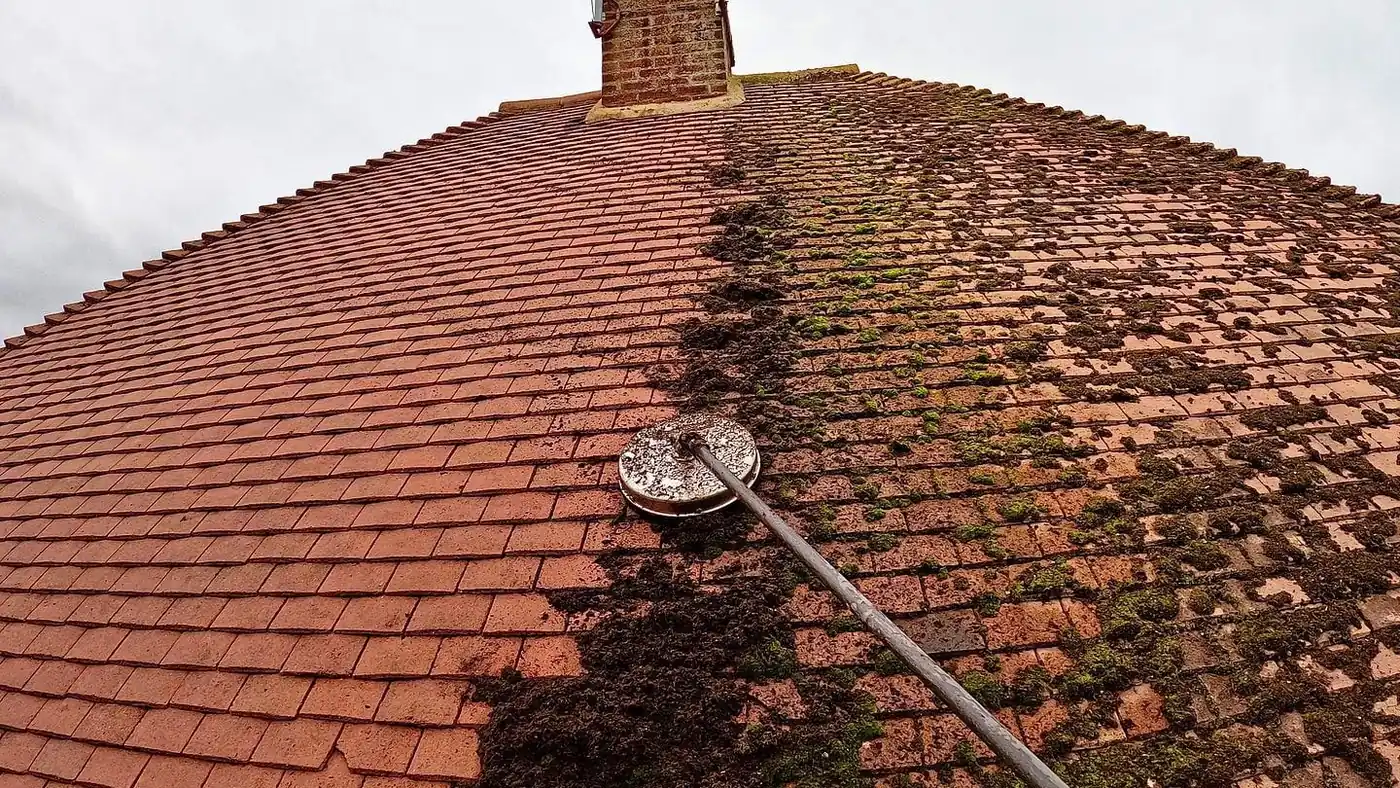
- The first patches of moss
- A roof cleaned a few years ago that needs retreating
- Moss returning after a clean
What roof biocide treatment cannot fix
A few issues sit outside what this work can do:
- Lichen vanishing on the day
- Thick moss (it needs removing by hand first)
- Damaged tiles
If you’re not sure, just have a word with us on 01342 344 936 or fill in the quote form and we will give you a straight answer before booking.
Surfaces we cover
- Algae and black streaks
- Ridge and hip tiles
- Lichen patches
- Tile and slate surfaces
- Shaded roof slopes
- Roofs cleaned by hand
Roof biocide treatment in Stone
Lichen is the growth that most often needs a biocide. Scraping it off can damage the surface of the tiles, so we treat it instead and let the weather finish the job. It fades over the following months. If you’re dealing with green algae on the roof and lichen best left to a treatment rather than a scraper, we can put it right, from ridge and hip tiles, algae and black streaks and tile and slate surfaces onwards.
Some homes in villages like Stone are listed or in a conservation area, and if yours is one of them, gentle methods matter even more. Cleaning doesn’t change how a roof looks, but a coating or a change of tiles can, so check with the council before anything like that.
Should you have a question about the work after we have left, just give us a call. The written 12-month workmanship guarantee covers our workmanship, and it spells out what it covers.
- Place
- Stone (SO45)
- Region
- Hampshire
- Guarantee
- A written 12-month guarantee on our workmanship
- Quotes
- One fixed price, quoted in advance
- Experience
- Fully insured, with 20 years’ experience
- Call
- 01342 344 936
- Checked
- 30 October 2026
Nearby places to Stone
What else we do in Stone
Questions from Stone
Is roof biocide treatment any different near the coast in Stone?
It can. Stone is within about 1 mile of the coast. Lichen and algae can be more of a feature near the sea, and lichen is treated with biocide rather than scraped off.
Do trees near my home in Stone make a difference to roof biocide treatment?
Trees can make a real difference. The nearest ancient woodland to Stone is Grassy Copse, some 0.3 miles west of Stone. A roof under trees is usually mossier than one in the open, and it tends to need attention sooner.
Can you quote from pictures?
Often, yes. With good pictures from the ground and a few details, we can price many jobs. Where the photos do not show enough, we come and look.
How should I prepare?
The main thing is clear access: cars off the drive, side gates open and pots or furniture out of the way. Close windows and roof lights near the work and keep pets in.
Do you pressure wash?
Only where it suits the surface. Driveways and patios normally take a pressure washer well, while on roofs it’s kept for robust tiles, after a check. Clay, slate, old or fragile tiles and solar panels are never pressure washed.
Is the price fixed?
Our quotes are fixed, not an estimate. That’s why we look at the job properly first, either in pictures or in person.
Are you a Checkatrade member?
Yes. We are a Checkatrade member, and we are fully insured.
Do you work on listed or historic buildings?
Yes. Mention that it’s listed when you ask for a quote, and we’ll plan the work around it. We start with the gentlest methods, and anything that would change the appearance is checked with the council beforehand.
Doing it yourself: an honest view
Patios and driveways are the one area many people clean themselves, and that’s fine. Just watch where the water goes: surface water drains discharge directly to the environment, so dirty water and cleaning products shouldn’t go down them.
Solar panels need particular care. Follow the panel maker’s care guidance, and pressure washers and strong chemicals are best avoided. Most panels sit on a roof, so the same height warnings apply.
Roofs in Stone: local notes
Stone lies within about 1 mile of the sea. Being near the sea doesn’t change the run-off rule: surface water drains lead straight to the environment, so moss and wash water are kept out of them. Planning matters in Stone go to New Forest council. For listed homes, the council’s conservation officer is the person to ask before anything beyond gentle cleaning. Among the historic houses near Stone is Beaulieu Palace House, about 4.4 miles north-west of Stone. They are proof that a roof treated gently can stay in good order for a very long time.
Around a church like St Francis, the houses are often some of the oldest in the area, and clay or slate on a roof like that gets scrapers and brushes, never a jet.
Stone is about 3 miles north-west of Cowes, in Hampshire. From the centre of Stone to the outskirts, roof biocide treatment is available for all kinds of property, from bungalows to large family homes. Across Hampshire, we cover 683 places, Stone among them. There’s also a page for Guildford, about 46 miles away.
We work across the SO45 postcode area for roof biocide treatment and the roads nearby. If your home is just outside Stone, we cover Gurnard (3 miles south-east), Cowes (3 miles south-east), Rew Street (4 miles south), Northwood (4 miles south-east) and Great Thorness (4 miles south). Larger places within reach include Gosport (9 miles east), Eastleigh (12 miles north), Fareham (8 miles north-east), Totton (11 miles north-west), Chandler's Ford (13 miles north) and Hedge End (9 miles north).
Landmarks near Stone
Other landmarks nearby include Calshot Castle (2.8 miles north-east) and Sir Max Aitken Museum (3.3 miles south-east). For a walk, there’s Mill Hill.
Different parts, different methods
Natural slate
Heavy moss on slate is hand-brushed first. Treatment follows and slows regrowth.
Clay tiles
Mature clay tiles often carry lichen. A biocide deals with it without scraping and the weather does the rest.
For landlords and letting agents
On a let property, the outside is easy to overlook. Tenants do not often check the roof or gutters, so planned work helps catch moss, blockages or slipped tiles before they grow into a bigger job.
It helps if tenants know we are coming, so cars can be moved and pets kept in. We’ll agree the date with you or with them, whichever is easier.
Between visits
After the work, a few habits help it last:
- Watch for new green patches
- Trim branches that shade the roof
- Keep pets in while it dries
- Expect gradual change
The treatment slows regrowth, typically for around one to a few years, depending on shade and aspect. Check the roof once a year and retreat when the first signs come back.
The SPAB suggests a seasonal brushing down to control the build-up. Only where it’s safe to reach the roof and helps treatments last.
How a job runs
We bring everything the job needs, including covers, tools and whatever access the work calls for. You just need to give us clear access and space to park nearby. On site, it takes part of a day for many homes, depending on the size of the roof and the access. Narrow lanes and long drives are part of rural work, so mention them when you book.
- We check the roof and the growth on it.
- You get a fixed quote, and loose moss is removed first if needed.
- Dry weather matters, so we pick the day and protect the ground below.
- The biocide is applied by soft wash, following the label.
- We tidy up and explain how the treated growth will weather away.
Before we arrive
- Tell us if you’ve seen birds nesting in the roof or gutters
- Make sure we can get to the side and back of the property
- Let us know about any pets, and keep them inside on the day
How to get a quote
Want a quote for roof biocide treatment? Please get in touch on 01342 344 936, or use the quote form and tell us about the property. We will talk you through how we’d do it and send a fixed quote before anything is booked.
Read more
Signs you need roof biocide treatment in Stone
Lichen grows where the air and roof suit it, often slowly over many years. Its crusts bond tightly to tiles and slates which is why a biocide is the usual answer.
Keep an eye out for these signs:
- The first patches of moss
- Slowing moss coming back after cleaning
- Black lines on the tiles
- New moss on a cleaned roof
Places like Mill Hill, 3.7 miles south-east of Stone, can bring trees and birds close to the houses around them. Moss grows fastest on shaded, damp slopes.
What your quote should include
- Which treatment they’ll apply, if any
- Whether VAT is included
- What insurance they carry
- What happens if they find damage, and whether repairs are quoted first