East Sussex · Biocide roof treatment
Steel Cross roof biocide treatment
Biocide roof treatment for properties in Steel Cross and across East Sussex. 20 years’ experience, fully insured and a Checkatrade member.
- Bright lichen patches on ridge and hip tiles
- Slowing moss coming back after cleaning
- Moss returning after a clean
Roof biocide treatment in Steel Cross, done properly
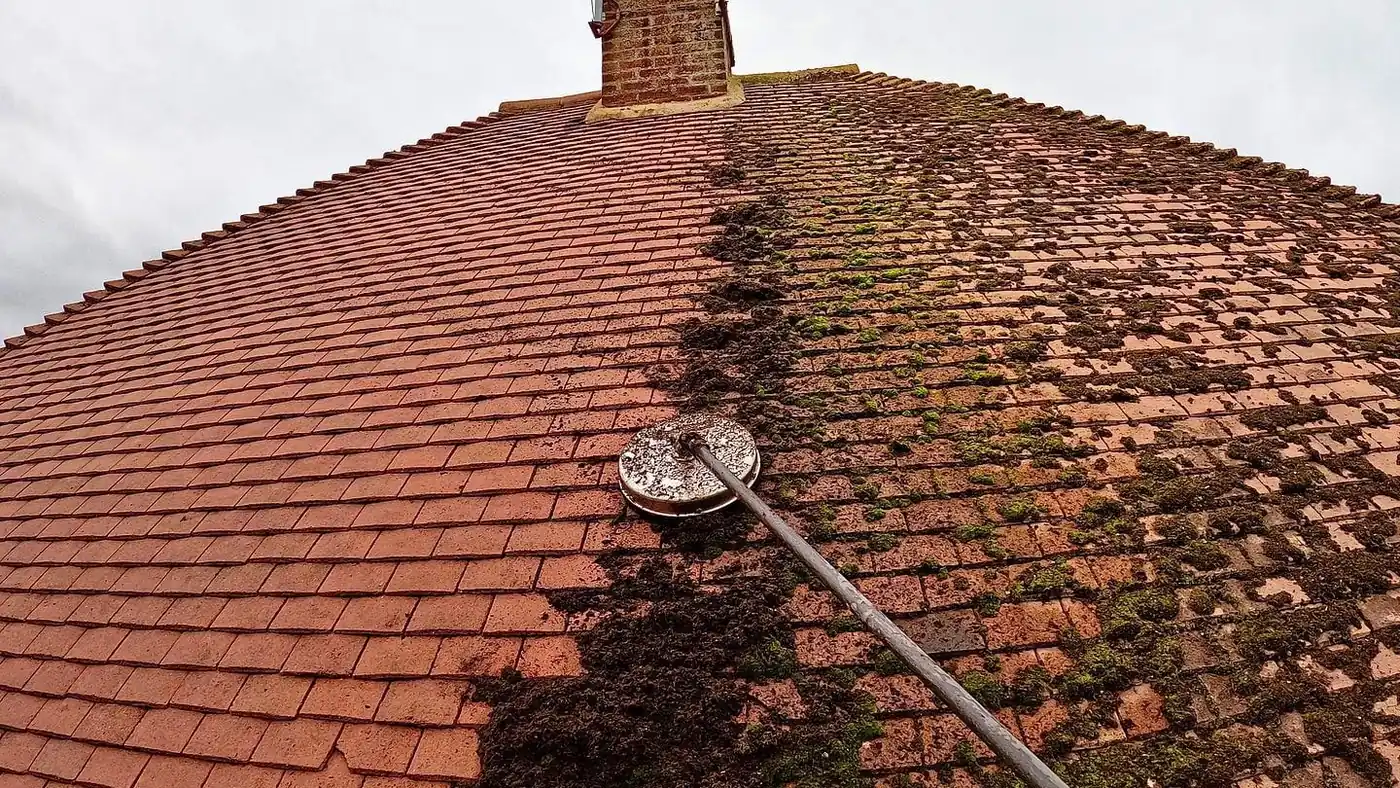
Biocides are regulated products, and the rules matter. Every product we use is approved or authorised for this use in Great Britain, as required by law and we follow its label to the letter. The label decides how much, when and how. The work covers ridge and hip tiles, tile and slate surfaces and shaded roof slopes, and the jobs we see most are bright lichen patches on ridge and hip tiles and wanting to slow regrowth after a hand clean.
Villages like Steel Cross often include older cottages and barns with clay tiles or slate, alongside newer houses. Old clay tiles in particular can flake when they stay damp, so they are cleaned by hand, gently, with no pressure washing.
We bring Checkatrade membership, full insurance and 20 years’ experience to every job. On top of that, each job comes with a written 12-month guarantee on our workmanship, so there’s something in writing if you need it.
- Location
- Steel Cross (TN6)
- Wider area
- East Sussex
- Our guarantee
- 12-month workmanship guarantee, in writing
- Price
- Fixed, not estimated
- Track record
- Fully insured, with 20 years’ experience
- Call
- 01342 344 936
- Checked
- 30 October 2026
Your questions about roof biocide treatment in Steel Cross
Is parking a problem for roof biocide treatment in Steel Cross?
Ideally, the van parks on the drive or right outside. Roads around Crowborough station, about 1.2 miles south of Steel Cross, can fill with commuters’ cars, so mention where we could park when you get in touch.
Does a conservation area in Steel Cross change anything about roof biocide treatment?
For cleaning, very little changes, though we keep to gentle methods; a coating or anything that alters the roof’s look is one to check with Wealden council. The Crowborough conservation area, about 0.9 miles west of the centre of Steel Cross, is the closest to Steel Cross.
Do you use a pressure washer?
Not by default. We use the gentlest method that will do the job: hand removal, soft washing or steam on most roofs, with pressure only where the surface can take it. Tile manufacturer guidance warns that high pressure can damage finishes and drive water into the laps.
What precautions do you take with the biocide?
Every treatment follows the label, which sets out the precautions. Plants and paving below are protected and drain outlets are protected and we will explain what to do while it dries.
What does roof biocide treatment cost?
The cost depends on the size of the job, the access, the condition of the surface and the method. Ask us for a fixed quote and we’ll explain what’s included.
Where does the waste go?
It leaves with us when we go. We sweep up and clear the area before leaving, leaving the place tidy.
Should the moss be removed before treatment?
It varies with the roof. Heavy moss blocks the treatment and ends up in the gutters as it dies so we remove it by hand before treating, while lighter growth can simply be treated.
What happens if there’s a nest?
We work around active nests. Nesting birds are protected by law, so we check first and leave any active nest alone, and that area can be done once the nest is no longer in use.
Towns and villages near Steel Cross
Also in Steel Cross
When to call us in Steel Cross
Regrowth is quickest where the roof stays damp. North-facing slopes and areas under trees stay wet after rain, so they’re where a treatment wears off first.
Things you may spot from the ground include:
- Lichen on clay or slate
- Moss returning after a clean
- A north-facing slope that greens up fast
- Lichen best left to a treatment rather than a scraper
Around a church like The Parish Church of All Saints, the houses are often some of the oldest in the area, and clay or slate on a roof like that gets scrapers and brushes, never a jet.
What to look for in a quote
- Whether they’ll use hand removal, soft wash, steam or pressure
- How they’ll protect your property and control run-off
- Which parts of the property the price covers
- Who clears up afterwards
Different parts, different methods
Concrete tiles
Older concrete tiles regrow quickly. Treating them slows regrowth though it isn’t permanent.
Clay tiles
Mature clay tiles often carry lichen. Treating it avoids scraping the tile face and the weather does the rest.
Steel Cross roofs and what affects them
The High Weald National Landscape is within about 5 miles of Steel Cross. Homes near protected countryside like the High Weald can include many older properties with clay or slate roofs, and trees and damp hillsides can mean heavier moss. Among the historic houses near Steel Cross is Groombridge Place, roughly 3.8 miles north of Steel Cross. Old roofs like those last because they are maintained, and gentle cleaning is part of that. With central London about 32 miles off, Steel Cross is one of the many South East places on our list for roof biocide treatment. You get a fixed quote, a fully insured team and a written 12-month workmanship guarantee.
Streets near stations such as Crowborough station, roughly 1.2 miles south of Steel Cross, can be busy with commuter parking, and our van needs to be fairly close to the house, so let us know the options. Homes near open spaces like Crowborough Country Park, roughly 1 mile south of Steel Cross, often have more trees around them. Shade slows how quickly a roof dries, and a roof that stays damp suits moss.
Steel Cross is about 1 mile north-east of Crowborough, in East Sussex. We carry out roof biocide treatment for houses, flats and rented homes in Steel Cross and the rest of East Sussex. We cover 289 places across East Sussex, from busy towns to small villages. We also work in Royal Tunbridge Wells, about 6 miles from Steel Cross.
We work across the TN6 postcode area for roof biocide treatment and the streets around it. Streets in the area include Hindleap Avenue, Payne Close and Vachery Street, and we cover them all for roof biocide treatment. Other places close to Steel Cross include Boarshead (1 mile north), Crowborough (1 mile south-west), Jarvis Brook (1 mile south), Marden's Hill (2 miles west) and Friar's Gate (2 miles west). Further out, we also cover Lewes (15 miles south-west), Hailsham (14 miles south), Uckfield (7 miles south-west), South Malling (15 miles south-west), Heathfield (7 miles south-east) and Southover (15 miles south-west).
Landmarks near Steel Cross
In Steel Cross, the houses around The Boars Head Inn and Sir Henry Fermor Church of England Primary School sit inside the area we work in. The closest station to Steel Cross is Crowborough station, roughly 1.2 miles south of the centre. Not far away are Crowborough Country Park.
Looking after it afterwards
Simple habits between visits make a real difference. Our advice:
- Watch for new green patches
- Don’t wait for thick moss to return
- Judge the result after a few months, not a few days
- Keep off treated areas until they’ve dried
After a biocide treatment, nothing much seems to happen at first. Over the following weeks and months, the growth dies back and weathers away, so the full effect builds slowly. You will know what to look for.
Clear drainage helps the treated roof. Water backing up keeps the eaves damp, which is where regrowth often starts.
Doing it yourself: an honest view
Some jobs are fine to do yourself, from the ground: look the roof over once a year, watch for overflowing gutters and sweep up moss that falls onto paths. Anything higher than that is best left to us.
Please don’t walk on the tiles. Tiles and slates can crack under your weight, sometimes with hairline cracks you cannot see, which frost can widen over time. Proper access, planned to suit the roof, avoids that.
Landlords, letting agents and property managers
If you manage properties from a distance, we let you know when the work is done and flag anything that needs attention, such as a slipped tile or a downpipe that is not running. Nothing extra is done without your say-so.
Where a building is shared, such as a block of flats, outside work is often arranged by the freeholder or managing agent. We can quote for the whole building and deal with whoever is in charge.
Why deal with it now?
Untreated growth slowly gets worse. Algae holds moisture and paves the way for moss while lichen keeps spreading across the tiles. Treating now slows it down. Cleaning what you have is almost always simpler than replacing it.
The price reflects the work, not guesswork. That’s why we look at the job first, from photos or in person, and why the quote is fixed before any work starts.
What you get with us
- One number for London and the South East
- Roofs treated as fragile until we know otherwise
- Gentle methods first, pressure only where the surface can take it
- A fixed quote before any work starts
See how roof cleaning is priced and our methods by tile type.
How the job works
If the work is close to a neighbour’s property, we take the same care on their side, and it helps to let them know beforehand. Windows, cars and paths close by are covered or kept clear of splashes. The job takes an hour or two for a small roof and longer for a large one. Rural homes near Steel Cross can be hard to find, so a few directions help.
- We see the roof first, from photos or on a visit.
- Heavy moss is booked for hand removal before the biocide goes on.
- We protect plants, paths and drain outlets.
- An authorised biocide is applied gently across the tiles.
- The site is tidied and the waste taken away.
A few things to sort first
- Have a word with next door if access is shared
- Mention any problems you’ve noticed
- Mention a conservatory or flat roof underneath
Getting a quote
Need a price for roof biocide treatment? Please get in touch on 01342 344 936, or by the quote form and tell us about the property. We will talk you through how we’d do it and send a fixed quote before you commit to anything.