Kent · Biocide roof treatment
Stanhope roof biocide treatment
Biocide roof treatment to kill remaining moss, algae and lichen spores and slow regrowth in Stanhope, with your property protected throughout. We plan the access, protect the area and take the waste with us.
- Moss returning after a clean
- Lichen on clay or slate
- Growth on tiles too fragile to scrape hard
How a job runs
We arrive at the time agreed with you and take a look around before anything else. Before work begins, we protect what’s around and below the work, such as plants, paving, windows and cars. On site, the job takes a few hours on the day, while the treated growth weathers away over the following months. Bigger gardens in places like Stanhope can mean a longer walk with equipment, so tell us how we reach the back.
- First we decide whether treatment alone will do or a clean comes first.
- You get a fixed quote that says what’s being treated.
- The date is set for dry weather, following the label.
- Gullies, plants and paths below are protected, then the biocide is applied at low pressure.
- We clear up and explain that the treatment works slowly, not overnight.
Before we arrive
- Let us know if birds are nesting under the eaves
- Leave side gates unlocked so we can reach the back
- Shut nearby windows and roof lights
Get a fixed quote
Need a price for roof biocide treatment? Please get in touch by phone on 01342 344 936, or through the quote form with a few details. We’ll talk you through how we’d do it and send a fixed quote before anything is booked.
Advice
Roof biocide treatment for homes in Stanhope
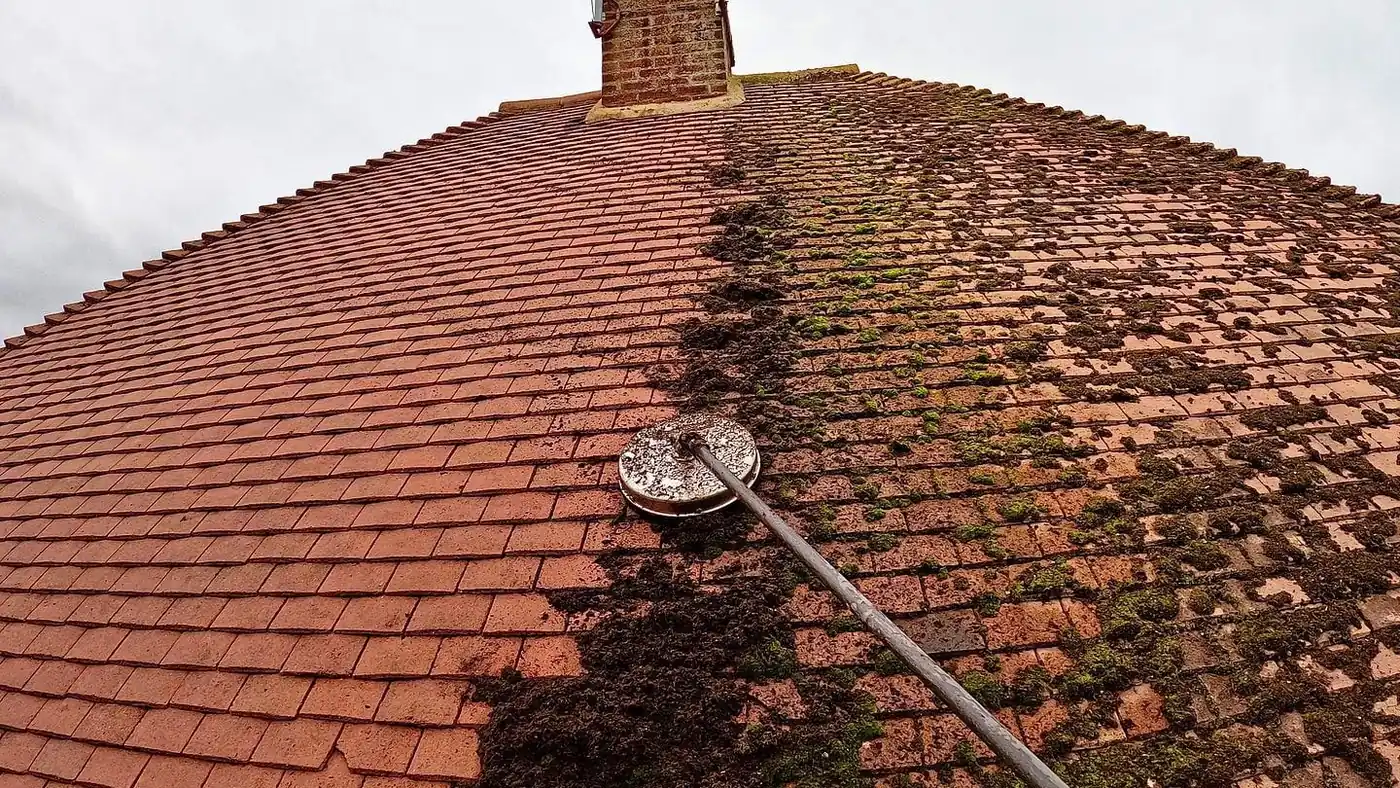
The treatment goes on at low pressure, evenly across the roof. Low pressure is safe for delicate tiles as well as robust ones, because nothing is forced under the tiles. Heavy moss comes off by hand beforehand, so the treatment can reach the surface. The work covers algae and black streaks, shaded roof slopes and ridge and hip tiles, and the jobs we see most are clinging growth that would mark the tiles if scraped and bright lichen patches on ridge and hip tiles.
Bungalows are common in many smaller places like Stanhope, and their low roofs are easier to reach, though the moss on them is just as stubborn. Access is planned after we’ve seen the roof, from the ground, from pictures or on a visit.
We’re fully insured, Checkatrade members and have 20 years’ experience, and each job carries a 12-month workmanship guarantee in writing. You’ll have it on paper, so it’s there if you ever need it.
- Place
- Stanhope (TN23)
- Wider area
- Kent
- Our guarantee
- A written 12-month guarantee on our workmanship
- Price
- Fixed quote, agreed before any work
- Background
- Two decades in the trade, fully insured
- Phone
- 01342 344 936
- Page updated
- 30 October 2026
Also near Stanhope
More services for Stanhope
Part by part
Fibre cement slates
Treatment is a low-impact option for fibre cement. That’s why it’s often what we’d suggest for these slates, after a careful look.
Concrete tiles
Concrete tiles often carry black algae streaks and moss in the interlocks. The interlocks are cleared by hand, then the biocide is applied so it gets to the surface.
Let and managed properties
For anyone managing more than one property, we can quote for them together. Each property is priced on what it needs, so you can see what each one involves.
Between tenancies is often a good time for outside work, when access is simple. Let us know the window you are working to and we will do our best to fit the work in.
Stanhope roofs and what affects them
Stanhope has about 4 conservation areas within two miles; the closest is the Kingsnorth conservation area, about 1.2 miles south-east of the centre of Stanhope. Cleaning does not change how a roof looks, but a coating can, so in a conservation area it’s worth checking with Ashford council before anything beyond a clean. Stanhope lies roughly 48 miles from central London, comfortably inside the patch we cover. You get a fixed quote, a fully insured team and a 12-month workmanship guarantee in writing. The area’s older buildings include Godinton House, roughly 2.1 miles north-west of Stanhope. Houses of that age are a reminder that clay and slate roofs can last a very long time with care.
If you live near St. Francis, or on any of the older streets in Stanhope, your roof may be clay or slate, which is cleaned gently by hand. Kerb space close to Ashford International station, roughly 1.2 miles north-east of Stanhope, can fill up early on a weekday, so a word about parking when you book helps us plan. Homes on school roads, near Beaver Green Primary School for instance, can face busy mornings and afternoons. If that’s your road, mention it when you book, and setting up can be planned around the busy times.
Stanhope is about 1 mile south-west of Ashford, in Kent. Wherever you are in the TN23 postcode area, we can take on roof biocide treatment. Across Kent, we cover 922 places, and Stanhope is one of them. For properties nearby, see our Maidstone page, about 17 miles away.
We take on work all over TN23 for roof biocide treatment and the roads nearby. Roof biocide treatment is available to homes on Green Lane, Cryol Road and Athol Road and nearby roads. Other places close to Stanhope include Ashford (1 mile north-east), Park Farm (1 mile south-east), Kingsnorth (1 mile south), Newtown (1 mile east) and Great Chart (1 mile north-west). Within a short drive, we also cover Canterbury (14 miles north-east), Folkestone (14 miles east), Faversham (13 miles north), Hythe (11 miles south-east), Davington (13 miles north) and Preston (12 miles north).
Around Stanhope
In Stanhope, the houses around The Beaver Inn, John Wallis Academy and Ashford Community Woodland are covered too, along with the rest of Stanhope. The nearest railway station is Ashford International station, about 1.2 miles north-east of the centre. Other landmarks nearby include Ashford Designer Outlet (1.1 miles east). Open spaces near Stanhope include Orlestone Forest.
DIY or a professional?
Roof work is dangerous, even for people who do it every day. HSE says almost one in five deaths in construction work involve roof work, and it advises treating all roofs as fragile until a competent person has confirmed they aren’t. If the job means climbing onto a roof, please leave it to a professional.
For a quick check from a ladder, set it on firm, level ground, have someone foot it and never lean out to the side. Never step off it onto the roof and never do it on your own.
What roof biocide treatment can’t fix
Roof biocide treatment can’t fix everything, and we will tell you before work begins. It won’t put right:
- Keeping growth away permanently (it slows regrowth; it isn’t permanent)
- Damaged tiles
- Weathering from age
Not sure which it is? You can pick up the phone and call 01342 344 936 or fill in the quote form and we’ll tell you honestly before booking.
Surfaces we cover
- Tile and slate surfaces
- Shaded roof slopes
- Algae and black streaks
- Roofs cleaned by hand
- Ridge and hip tiles
- Lichen patches
Aftercare tips
Growth and dirt come back in time, but good habits slow them down. Our tips:
- Clear leaves from the gutters each autumn
- Don’t wait for thick moss to return
- Look for regrowth on the shady slope once a year
- Keep off treated areas until they’ve dried
The day after treatment, the roof may look much the same. Dead growth fades gradually as the weather works on it, so the full effect builds slowly. You will know what to look for.
Clear drainage helps the treated roof. Water backing up keeps the eaves damp and that’s where growth restarts first.
How we price roof biocide treatment
A fixed price needs a few facts first. We check:
- The method, from hand removal to soft wash or steam
- Any repairs, which are always priced separately
- Tile or surface type, and its condition
- Any towers, scaffold or powered access
No two properties are the same, so we price each job on its own. Size, height, access, the condition of the surface and the method all play a part.
What to send for a quote
There’s no need to go up a ladder for pictures: shots from the garden, the street or an upstairs window are fine. The most helpful are:
- If the property is listed or historic
- A wide photo of the whole roof or area, taken from the ground
- Anything you’ve noticed, such as slipped tiles, overflowing gutters or damp patches
- The route round the side or back of the property
To help us price the job: where the property is and what you’d like done, a few pictures from the ground and any past work you know about, like a previous clean or a repair. Once you have those, send a message through our quote form, or ring us on 01342 344 936.
Common questions in Stanhope
I live in a conservation area in Stanhope: does that affect roof biocide treatment?
For a clean, very little beyond our usual gentle approach; anything that changes the roof’s appearance is a question for Ashford council. The nearest to Stanhope is the Kingsnorth conservation area, about 1.2 miles south-east of the centre of Stanhope.
Who can tell me if my home in Stanhope is listed?
That’s Ashford council. The council’s conservation officer can say whether your home is listed and what needs consent. For listed homes, the council’s conservation officer is the person to ask before anything beyond gentle cleaning.
Are your biocides legal to use?
Biocides used on roofs have to be approved or authorised for that use in Great Britain, and ours are. The label is followed to the letter.
Can you price the job without visiting?
Yes, where the pictures show enough. If not, we come and look first, and the fixed quote follows.
Can letting agents book you?
Yes. We work for landlords, letting agents and property managers alongside homeowners. Access can be arranged with you or the tenant.
Do you use a pressure washer?
Not by default. The method is always the gentlest one that does the job: hand scraping, soft wash or steam for most roofs, with pressure kept for surfaces that can take it. Tile manufacturer guidance warns that high pressure can damage finishes and drive water into the laps.
What is a biocide treatment for roofs?
It kills moss, algae and lichen, including spores left after cleaning and holds back new growth. How long it lasts depends on shade and aspect, typically around one to a few years.
What happens to the waste?
Everything we clear is bagged and leaves with us, whether it’s moss, leaves, silt or debris. We don’t leave it behind.