Greater London · Biocide roof treatment
St Paul's Cray roof biocide treatment
Roof biocide treatment for homeowners, landlords and letting agents in St Paul's Cray. Checkatrade members with 20 years’ experience, fully insured.
- A roof cleaned a few years ago that needs retreating
- Keeping a freshly cleaned roof clearer for longer
- Orange or yellow lichen on the ridge
Roof biocide treatment in St Paul's Cray
Lichen is the growth that most often needs a biocide. Scraping it off can damage the surface of the tiles so the better route is to treat it and leave it to weather off. Expect it to fade gradually. If you are dealing with algae on an older roof and growth coming back on a treated roof, we can put it right, from lichen patches, tile and slate surfaces and roofs cleaned by hand onwards.
Many London roofs are shared at the edges, with party walls, shared gutters and a neighbour’s slope running into yours. The moss we remove is bagged and taken away, and run-off is kept out of shared gutters and street drains.
You may see promises that outside surfaces will stay clean for years. We prefer to be honest: in damp, shady spots, growth returns sooner. What we do give you is a written 12-month workmanship guarantee covering our work.
- Location
- St Paul's Cray (BR5, BR7)
- Region
- Greater London
- Cover
- A written 12-month guarantee on our workmanship
- Price
- Fixed, not estimated
- Background
- Fully insured, with 20 years’ experience
- Telephone
- 01342 344 936
- Checked
- 30 October 2026
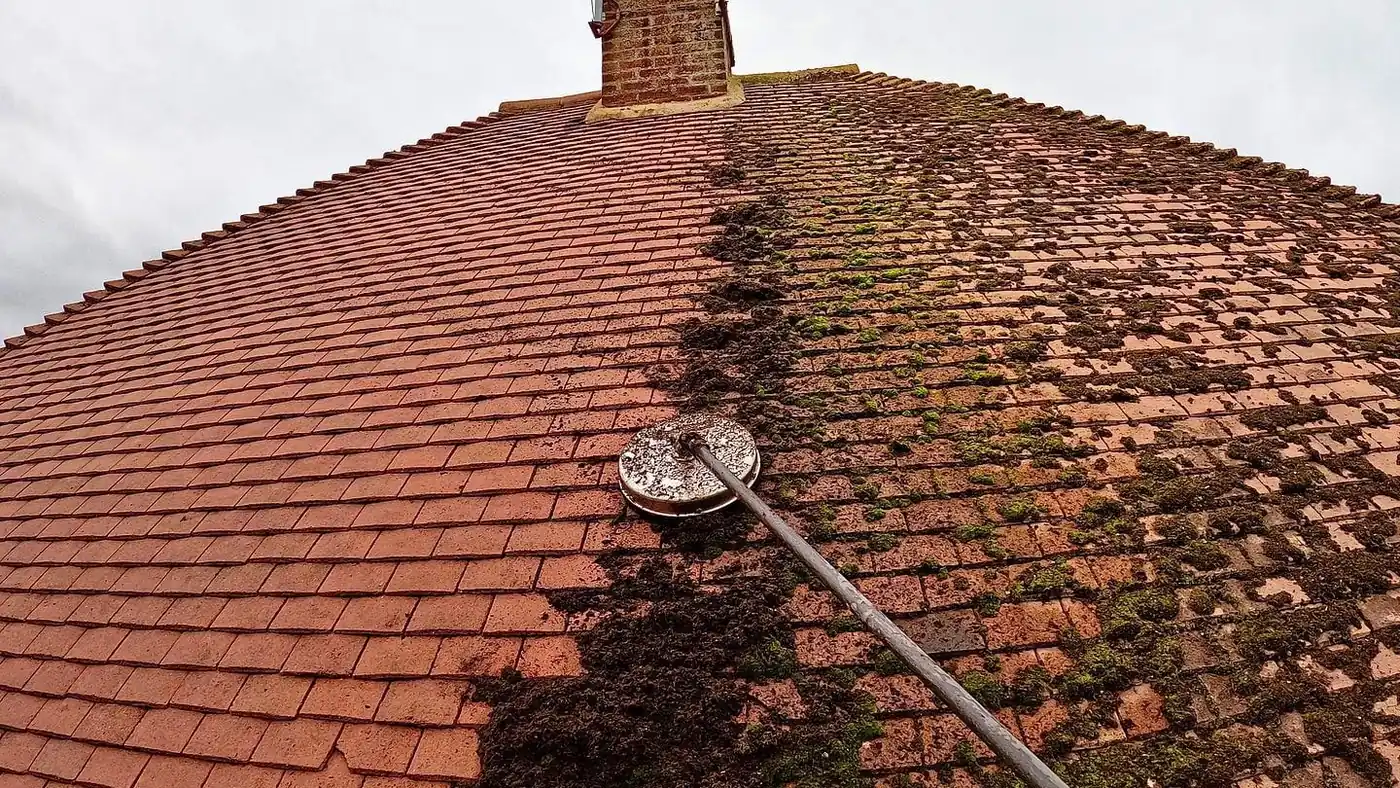
Signs you need roof biocide treatment in St Paul's Cray
Regrowth is quickest where the roof stays damp. North-facing slopes and areas under trees stay wet after rain, so they are where a treatment wears off first.
It’s time to think about roof biocide treatment if you see:
- Lichen that won’t scrape off
- Wanting to slow regrowth after a hand clean
- A north-facing slope that greens up fast
- Regrowth since the roof was last cleaned
Commuters often leave their cars on the roads around St Mary Cray station, less than half a mile from the centre of St Paul's Cray, and ladders have to be carried from the van, so the closer the space the better.
Questions to ask before you book
- Exactly what’s included, area by area
- Whether a biocide is included, and that it’s authorised for this use
- What insurance they carry
- How they’ll clean without damaging the tiles or surface
How we price roof biocide treatment
The quote reflects the property in front of us. We take into account:
- How much moss, algae or dirt there is
- Whether several jobs are done in one visit
- Repair work, if it’s needed, on its own quote
- The access the job needs, from ladders to scaffold
Every property is different, so each one gets its own fixed quote. The size of the job, how we reach it, the state of the surface and the method we use all make a difference.
Helping us quote
Before you ask for a quote, gather:
- How we’d get to the work, such as a side passage or back garden
- Any past cleaning, coating or repairs you know about
- Whether the building is listed
- Problems you’ve spotted, like loose tiles or water spilling from gutters
Need a price for roof biocide treatment? Please get in touch by phone on 01342 344 936, or use the quote form with a few details. We will talk you through how we’d do it and send a fixed quote before anything is booked.
What happens if it’s left?
Buying a moss killer and doing it yourself means working at height with a regulated product. You’d need safe access, the label followed and run-off controlled, which is a lot to manage. On a terrace, problems spread: water from a blocked gutter or a slipped slate can reach next door too.
A single home or a handful of properties, we price it on the same basis: what needs doing, how we reach it and how long it takes. You will have a fixed price before we start.
Why us?
- Covering London and the South East
- Run-off controlled and drains protected
- A fixed quote before we start
- Fully insured
Between visits
Our aftercare advice, in brief:
- Expect gradual change
- Look for regrowth on the shady slope once a year
- Book a repeat treatment early
- Follow our advice on keeping pets and children away until dry
The day after treatment, the roof may look much the same. Over the following weeks and months, the growth dies back and weathers away, so the full effect builds slowly. You will know what to look for.
Trimming branches over the roof helps a treatment last longer. A roof that dries quickly regrows slowly, and fewer leaves gather in the gutters.
What the work involves, part by part
Historic and listed roofs
Historic roofs need gentle handling, and a biocide is applied without force. We look at the tiles, fixings and mortar beforehand, and treat lichen rather than scraping it.
Fibre cement slates
From the ground, artificial slates can look just like natural slate. We confirm the material before starting, since older fibre cement may contain asbestos.
Questions from St Paul's Cray
Do I need a permit or licence for work at my home in St Paul's Cray?
It depends on how the work is reached. The council may need to agree anything placed on the pavement, and the van may need a permit or a suspended bay. Your quote will say what’s needed.
Which council covers St Paul's Cray for listed buildings and conservation areas?
That’s Bromley council. The council’s conservation officer can say whether your home is listed and what needs consent. If your home is listed, listed building consent is needed for works that affect its special character, so check with the council before a coating or any change to how the roof looks.
Are you insured?
Yes, we’re fully insured. We are Checkatrade members too, with 20 years’ experience.
How long will the treatment take to apply?
That depends on the size of the roof and the access. Typically it takes part of a day for many homes, depending on the size of the roof and the access, and the growth keeps dying back afterwards.
Do you control the run-off?
Run-off is planned before any water is used. Debris is caught and bagged, drains are protected and gutters are kept running to the right outlets, and we don’t wash sludge into the street.
Do you pressure wash?
Not as a default. We use the gentlest effective method: hand scraping, soft wash or steam for most roofs, with pressure kept for surfaces that can take it. Tile manufacturer guidance warns that high pressure can damage finishes and drive water into the laps.
Can I do it myself?
Some things, yes, if they can be done from the ground. A yearly check from the ground and clearing up fallen moss is sensible DIY, but walking on tiles or jet washing a roof can do real damage.
Is the biocide you use approved?
Biocides used on roofs have to be approved or authorised for that use in Great Britain, and ours are. The label is followed to the letter.
Also near St Paul's Cray
Also in St Paul's Cray
How the job works
Before we leave, you are welcome to walk round with us. We point out anything we spotted along the way, like a cracked tile or a gutter that isn’t running. On site, the work takes a few hours to apply on most roofs. Let us know how we reach the back of the house in St Paul's Cray: a side gate, a back lane or through the house.
- First we decide whether treatment alone will do or a clean comes first.
- You get a fixed quote that says what’s being treated.
- We plan the day around the weather, since the biocide needs a dry spell to work.
- Gullies, plants and paths below are protected, then the biocide is applied at low pressure.
- We explain that the growth fades over time rather than all at once.
Before we arrive
- Mention any permits or parking limits
- Let us know about anything fragile below, like a glass roof
- Let us know if birds are nesting under the eaves
Pricing your job
The price is only part of a proper quote. Ours sets out what we’ll do, the method we will use and how we will reach the work, and the price is fixed. For yours, ring 01342 344 936, or send photos through the quote form.
Read more
Roofs in St Paul's Cray: local notes
There are about 14 conservation areas within two miles of St Paul's Cray, the nearest being the St. Paul's Cray conservation area, roughly 0.6 miles north-east of central St Paul's Cray. Cleaning doesn’t change how a roof looks, but a coating can, so in a conservation area it’s worth checking with Bromley council before anything beyond a clean. The back slope of a London terrace is often where the worst moss hides, well away from the view from the street. One of the historic houses in the area is Bromley Palace, roughly 3.7 miles west of St Paul's Cray. Old roofs like those last because they’re maintained, and gentle cleaning is part of that.
If your home backs onto green space such as Chislehurst Common, roughly 1.9 miles west of St Paul's Cray, you are likely to see more shade, leaves and bird droppings. Moss grows fastest on shaded, damp slopes. Around a church like St Barnabas, the houses are often some of the oldest in the area, and clay or slate on a roof like that gets scrapers and brushes, never a jet.
St Paul's Cray is about 1 mile north of Orpington, in Greater London. We treat roof biocide treatment in St Paul's Cray the same as anywhere in Greater London: carefully, with a fixed price and a written guarantee on our workmanship for 12 months. Our Greater London coverage runs to 764 places, and St Paul's Cray is one of them. Our Sevenoaks page covers homes nearby, about 9 miles away.
Every address in BR5 and BR7 is within our area for roof biocide treatment, from busy streets to back roads. Streets in the area include Main Road, Murray Road and Rushet Road, all of which we cover for roof biocide treatment. We also cover St Mary Cray (1 mile south), Poverest (1 mile south), Derry Downs (1 mile south), Orpington (1 mile south) and Kevington (2 miles south-east). Further out, we also cover London (11 miles north-west), City of Westminster (14 miles north-west), Marylebone (14 miles north-west), Kensington (15 miles north-west), St Pancras (13 miles north-west) and Shoreditch (12 miles north-west).
Around St Paul's Cray
Around St Paul's Cray, homes near Kemnal Technology College, The Blue Anchor Public House and Walsingham School are covered too, along with the rest of St Paul's Cray. St Paul's Cray has its own railway station: St Mary Cray station. Other landmarks nearby include Lullingstone Castle (4.8 miles south-east) and The Mall (3.9 miles west). The countryside around St Paul's Cray includes The Warren and Summer Hill.
Doing it yourself: an honest view
Shop-bought moss treatments are an option for some surfaces, but only use one authorised for that job and follow the label to the letter. On a roof, applying it carries the same height risks as any roof work, and it must be kept away from drains and ponds.
Solar panels need particular care. The manufacturer’s care guidance comes first, and pressure washers and strong chemicals are best avoided. Most panels sit on a roof, so the same height warnings apply.