Kent · Biocide roof treatment
St Mary in the Marsh roof biocide treatment
Biocide roof treatment for properties in St Mary in the Marsh and across Kent. 20 years’ experience, fully insured and a Checkatrade member.
- Slowing moss coming back after cleaning
- New moss on a cleaned roof
- A north-facing slope that greens up fast
Roof biocide treatment in St Mary in the Marsh
A treatment can be booked with a roof clean or on its own. On a roof with light algae or lichen, a treatment alone may be enough but heavy moss always comes off by hand first. We will be honest about which your roof needs. If you’re dealing with algae on an older roof and clinging growth that would mark the tiles if scraped, we can help.
Older villages often have listed buildings and conservation areas, and if yours is one of them, gentle methods matter even more. For anything beyond cleaning, such as a coating, the council’s conservation officer is the person to ask first.
We’ve got 20 years’ experience, and we stand behind what we do: a written 12-month workmanship guarantee comes with every job. We are also fully insured and a Checkatrade member.
- Where
- St Mary in the Marsh (TN29)
- Region
- Kent
- Cover
- 12 months on workmanship, in writing
- Price
- A fixed price before work begins
- Experience
- 20 years’ experience; Checkatrade member
- Call
- 01342 344 936
- Updated
- 30 October 2026
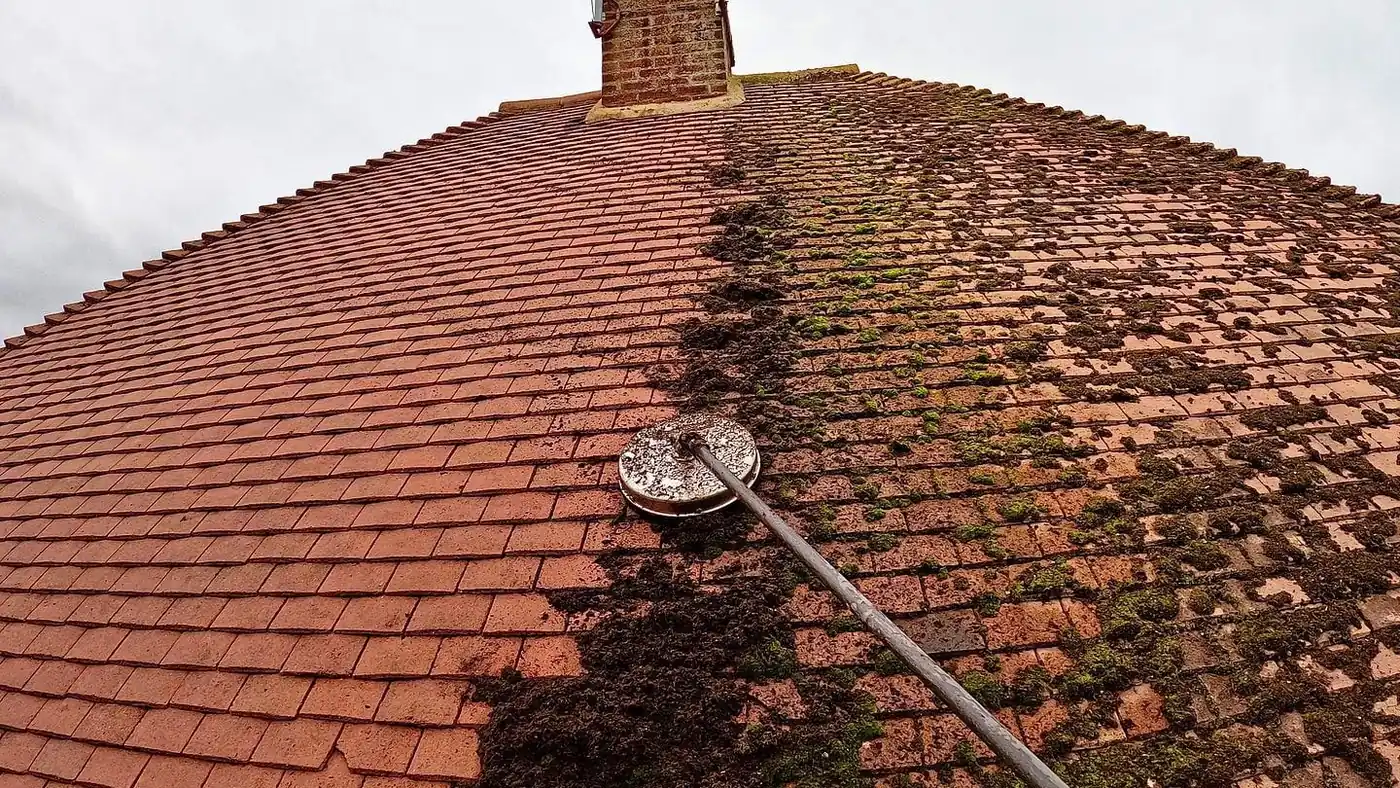
Roof biocide treatment in St Mary in the Marsh: the local picture
At about 2 miles from the coast, St Mary in the Marsh is close enough for sea air to matter. Sea air and wind-driven damp can mean lichen and algae as well as moss, so the clean is planned around all three. St Mary in the Marsh is looked after by Folkestone and Hythe council. Cleaning doesn’t change how a roof looks, but a coating can, so if your home is listed or in a conservation area, check with the council first. St Mary in the Marsh is about 56 miles from central London, well inside the area where we carry out roof biocide treatment across London and the South East. We’re fully insured, and our work comes with a written 12-month guarantee on our workmanship.
If you live near Church of St Mary the Virgin, or on any of the older streets in St Mary in the Marsh, your roof may be clay or slate, which is cleaned gently by hand. Homes near open spaces like Romney Warren Country Park, 1.4 miles south-east of St Mary in the Marsh, often have more trees around them. Moss grows fastest on shaded, damp slopes.
St Mary in the Marsh is about 7 miles south-west of Hythe, in Kent. We provide roof biocide treatment for houses, flats and rented homes in St Mary in the Marsh and the rest of Kent. St Mary in the Marsh is one of 922 places in Kent we cover for homeowners and landlords. Our Maidstone page covers homes nearby, about 25 miles away.
Postcode districts we cover here for roof biocide treatment: TN29. Streets in the area include Wades Close, Rectory Road and Pickneybush Lane, all of which we cover for roof biocide treatment. Close by, we work in St Mary's Bay (1 mile east), Newchurch (2 miles north), Burmarsh (3 miles north-east), Postling Green (5 miles north) and Bonnington (5 miles north). Larger places within reach include Ashford (9 miles north), Folkestone (11 miles north-east), Hythe (7 miles north-east), Hawkinge (12 miles north-east), Tenterden (12 miles west) and Cheriton (10 miles north-east).
Landmarks near St Mary in the Marsh
Properties near Romney Warren Country Park and The Star Inn are covered too, along with the rest of St Mary in the Marsh. Other landmarks nearby include Romney 'castle' (2.5 miles south-west) and Brenzett Aeronautical Museum (3.5 miles west).
What happens if it’s left?
Scraping lichen and treating it give very different results. Scraping risks damaging the tile surface because lichen grips so tightly, while a biocide kills it and lets it weather off over time. Growth that is left holds moisture against the surface beneath it.
No two properties are the same, so we price each job on its own. The size of the job, how we reach it, the state of the surface and the method we use all make a difference.
What you get with us
- One phone number across our whole area
- We choose the gentlest method that does the job
- Members of Checkatrade
- Roofs treated as fragile until we know otherwise
How the job works
Where water is part of the job, we control where it goes. Moss sludge, dirty water and any biocide are kept out of surface water drains, as surface water drains lead straight to the environment. The work takes an hour or two for a small roof and longer for a large one. Rural homes near St Mary in the Marsh can be hard to find, so a few directions help.
- We look at the roof and the growth on it.
- We fix the price and agree any hand removal first.
- A dry day is chosen and plants, paths and drains are protected.
- We apply the treatment evenly, following the label.
- We tidy up and explain how the growth will fade over time.
A few things to sort first
- Make sure we can get to the side and back of the property
- Let us know where we can park
- Tell us about anything you already know, such as leaks or loose tiles
Getting a quote
Photos are enough for some jobs, while others need a visit. Where access is tricky or the area is hard to see in pictures, we normally come and look. Either way, the price is fixed before anything is booked.
Read more
Signs you need roof biocide treatment in St Mary in the Marsh
Lichen grows where the air and roof suit it, often slowly over many years. Its crusts bond tightly to tiles and slates which is why a biocide is the usual answer.
What we are most often asked to deal with:
- Bright lichen patches on ridge and hip tiles
- Green algae on the roof
- Lichen that will not scrape off
- Growth coming back on a treated roof
If your home is near The Marsh Academy or another school, the school run can fill the road twice a day. It’s worth a mention when you book, as the van and ladders need space outside.
Before you book anyone
- Proof that they’re insured
- Who clears up afterwards
- Whether the price is fixed
- The full scope of the work, in writing
Your questions about roof biocide treatment in St Mary in the Marsh
Does living near the coast affect roof biocide treatment in St Mary in the Marsh?
It can. At about 2 miles from the coast, St Mary in the Marsh gets damp, salty sea air. Lichen and algae can be more of a feature near the sea, and lichen is treated with biocide rather than scraped off.
Which council covers St Mary in the Marsh for listed buildings and conservation areas?
That’s Folkestone and Hythe council. The council’s conservation officer can say whether your home is listed and what needs consent. For listed homes, the council’s conservation officer is the person to ask before anything beyond gentle cleaning.
What do you do with what you remove?
We bag what we remove and take it away with us, whether it’s moss, leaves, silt or debris. None of it is left on site.
My home is listed. Can you help?
Yes. Tell us the building is listed when you get in touch, and we will plan the work around it. We start with the gentlest methods, and anything that would change the appearance is checked with the council beforehand.
Do you need scaffolding?
Not for each job. Every roof is treated as fragile until it’s confirmed otherwise, so access is planned before we start, as the Work at Height Regulations 2005 require.
What about my pets and plants?
Many jobs don’t involve chemicals at all: solar panels, for example, are cleaned with soft brushes and clean water. Where a biocide is part of the job, it’s one approved or authorised for this use in Great Britain, applied as the label says. We’ll tell you about keeping pets and children away.
Will you jet wash it?
Only where it suits the surface. Driveways and patios typically take a pressure washer well, but on roofs we use controlled pressure only on robust tiles after checking them. We never pressure wash clay, slate, old or fragile tiles, or solar panels.
Is there anything I need to do beforehand?
Let us know the important things when you book: a conservatory underneath, birds nesting or a drive you share. On the day, clear the drive and keep pets inside.
Let and managed properties
It helps if tenants know we are coming, so cars can be moved and pets kept in. The date can be agreed with you or with the tenant, whichever is easier.
Outside maintenance is easy to forget on a rental. Few tenants look up at the roof or into the gutters, so a planned visit helps spot build-up, blockages or loose tiles early.
Between visits
To keep things in good shape between visits:
- Keep off treated areas until they’ve dried
- Do not wait for thick moss to return
- Trim branches that shade the roof
- Check gutters after heavy rain
The treatment slows regrowth, typically for around one to a few years, depending on shade and aspect. A yearly look tells you how it’s doing, and book a repeat treatment when new growth appears.
A light brush down each season, as the SPAB recommends, keeps growth from settling. Only where it’s safe to reach the roof and helps treatments last.
How the job changes from site to site
Concrete tiles
Algae and moss are common on concrete roofs. The interlocks are cleared by hand, then the biocide is applied so it gets to the surface.
Fibre cement slates
We look at fibre cement slates first. Older fibre cement slates may contain asbestos and need a careful, low-impact approach, and we will advise on what’s suitable.
How we price roof biocide treatment
There’s no set price list, because no two jobs are alike. The quote depends on:
- Extras such as gutter clearing or a biocide treatment
- Which method we use
- Access from the road to the work
- Whether a tower, scaffold or powered access is needed
Doing several jobs in one visit, such as the roof and the gutters together, often makes better use of the time. Tell us everything you’d like done, and you’ll get one fixed quote.
Asking for a quote
You do not need to know the technical terms. Just send:
- Any listing you know about
- The address and the type of property
- Close-ups of the worst patches of moss, algae or dirt
- Details of any previous treatment
Quotes are simple. Send a few details and photos, and we’ll come back to you with a fixed price. If we need to see it first, we will arrange a visit.