Kent · Biocide roof treatment
Roof Biocide Treatment in St Margaret's at Cliffe
Roof biocide treatment for St Margaret's at Cliffe, from people with 20 years’ experience. Fully insured, with a written guarantee on our workmanship for 12 months.
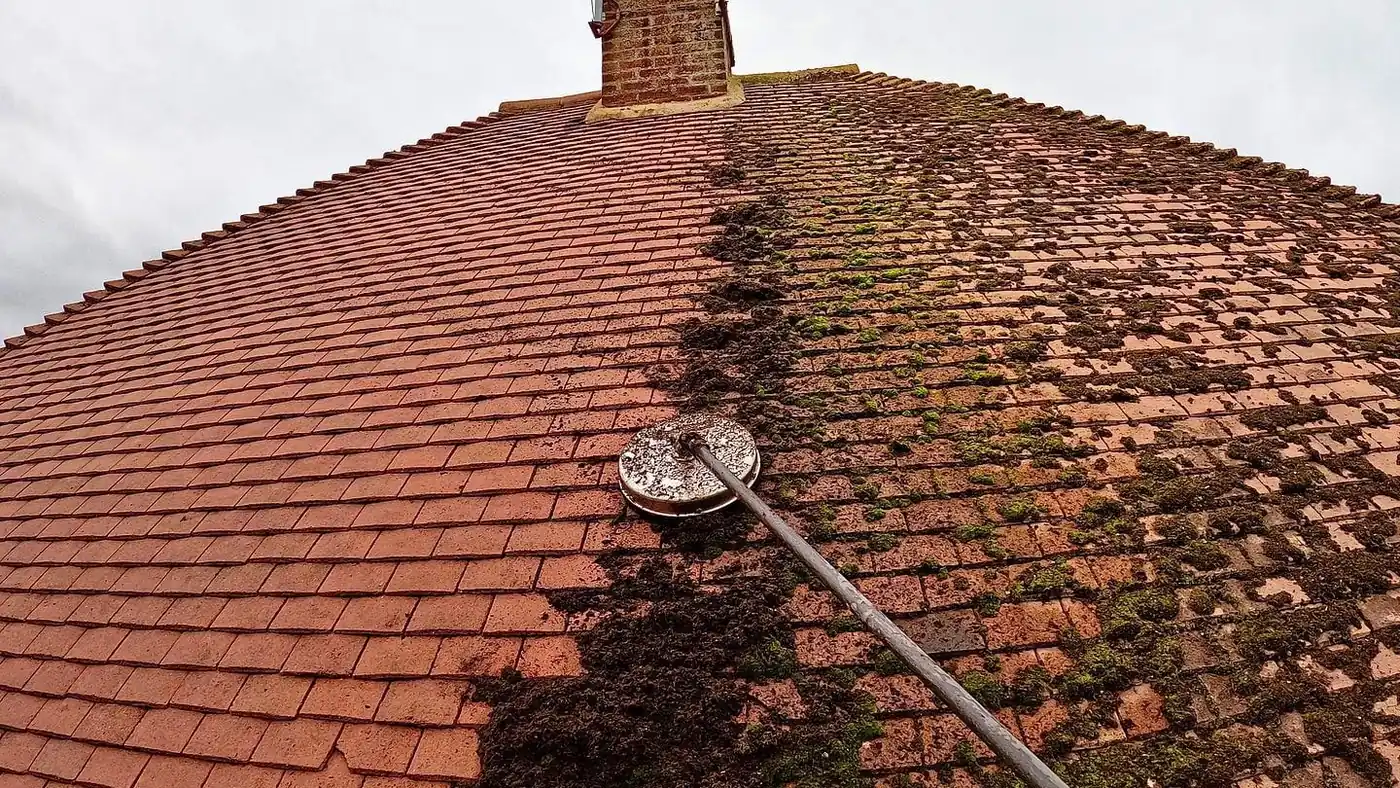
- Lichen spots across the tiles
- The first patches of moss
- A north-facing slope that greens up fast
Roof biocide treatment for homes in St Margaret's at Cliffe
Cleaning takes growth off a roof; a biocide treatment helps keep it off. It kills remaining moss, algae and lichen, including spores too small to see, and slows regrowth. It is not permanent, typically lasting around one to a few years, depending on shade and aspect. Common call-outs are for black lines on the tiles and a roof cleaned a few years ago that needs retreating, on ridge and hip tiles, shaded roof slopes and algae and black streaks.
In a place like St Margaret's at Cliffe, low roofs on bungalows and extensions can often be reached from ladders, while taller houses may need a tower. We decide on access once we have looked at the roof, and protect paths, plants and anything below before starting.
We have 20 years’ experience in this work, and we stand behind what we do: a written 12-month workmanship guarantee comes with every job. We’re also fully insured and a Checkatrade member.
- Location
- St Margaret's at Cliffe (CT15)
- Wider area
- Kent
- Our guarantee
- 12-month workmanship guarantee, in writing
- Quotes
- A fixed price before any work starts
- Experience
- 20 years’ experience; Checkatrade member
- Phone
- 01342 344 936
- Page updated
- 30 October 2026
What happens if it’s left?
A biocide isn’t permanent, whatever anyone tells you. It typically works for around one to a few years, depending on shade and aspect as spores land on every roof. Treating again when regrowth appears is lighter work than starting from scratch. Shade keeps surfaces damp, so homes near trees benefit most from regular cleaning.
What you pay depends on how big the job is, the height and access and how much build-up there is. We give you a fixed price before any work starts, so you know where you stand.
What you get with us
- Fixed prices, agreed before any work
- Access planned to suit the property
- Members of Checkatrade
- A full clear-up before we leave
Landlords, letting agents and property managers
Between tenancies is often a good time for outside work because access is easy then. Tell us the dates you have and we will try to fit around it.
For anyone managing more than one property, the work can go on one quote. Every address is priced on its own job, so the figures are easy to follow.
Looking after it afterwards
A little care between visits keeps things looking better for longer. We recommend:
- Retreat when regrowth first appears
- Check gutters after heavy rain
- Do not pick at dead lichen
- Let more sun reach the tiles
The day after treatment, the roof may look much the same. Dead growth fades gradually as the weather works on it and the roof keeps improving. You’ll know what to look for.
Treat again when regrowth first shows. Small amounts are easy to treat, while letting it build up means a full clean.
When to call us in St Margaret's at Cliffe
Lichen grows where the air and roof suit it, often slowly over many years. It grips the surface firmly which is why a biocide is the usual answer.
Keep an eye out for any of the following:
- Bright lichen patches on ridge and hip tiles
- Crusty grey and yellow lichen
- Growth on delicate tiles that can’t be jet washed
- Green algae on the roof
Commuters often leave their cars on the roads around Martin Mill station, roughly 1.6 miles north-west of St Margaret's at Cliffe, which is worth mentioning when you ask for a quote.
What your quote should include
- The method they’ll use, and why it suits your surface
- How VAT is shown on the quote
- Which treatment they’ll apply, if any
- Whether ladders, a tower or scaffold are allowed for in the price
What roof biocide treatment looks like in St Margaret's at Cliffe
St Margaret's at Cliffe lies within about 1 mile of the sea. Damp, salty air can suit lichen and algae on roofs, and lichen clings hard, so it’s normally treated with biocide and left to weather off rather than scraped. Bere Wood, an area of ancient woodland, lies some 1.3 miles south-west of St Margaret's at Cliffe. A roof close to old woodland often dries slowly after rain, which gives moss the damp it needs. One of the historic houses in the area is Walmer Castle, about 3.5 miles north of St Margaret's at Cliffe. Buildings like that show how long clay and slate roofs can last when they are looked after.
Living close to St Margaret's-at-Cliffe Primary School can mean parked cars and crowds at the start and end of the school day. It’s worth a mention when you book, as the van and ladders need space outside. Live on one of the older roads by Church of St Margaret? Clay tiles and slate are common on homes like yours, and both are treated gently.
St Margaret's at Cliffe is about 3 miles east of Dover, in Kent. We provide roof biocide treatment for homeowners, landlords and letting agents in St Margaret's at Cliffe and the rest of Kent. St Margaret's at Cliffe is one of 922 places in Kent where we work for roof biocide treatment. Our Maidstone page covers homes nearby, about 37 miles away.
Every address in CT15 is covered for roof biocide treatment, from busy streets to back roads. Streets in the area include High Street, Station Road and Chapel Lane, all of which we cover for roof biocide treatment. Nearby, we also carry out roof biocide treatment in West Cliffe (1 mile west), Martin Mill (2 miles north-west), East Langdon (2 miles north-west), Martin (2 miles north-west) and Ringwould (2 miles north). Larger places within reach include Canterbury (15 miles north-west), Dover (3 miles west), Folkestone (10 miles south-west), Ramsgate (13 miles north), Broadstairs (15 miles north) and Deal (4 miles north).
Local landmarks in St Margaret's at Cliffe
In St Margaret's at Cliffe, the houses around Duke of York's Royal Military School and The White Cliffs pub fall within our area as well. For rail, the closest station is Martin Mill station, roughly 1.6 miles north-west of the centre. A little further out are Dover Castle (2.8 miles south-west) and St Margaret's Museum (0.6 miles south-east). Open spaces near St Margaret's at Cliffe include Dover Western Heights.
When it’s something else
In fairness, there are a few things this work won’t fix:
- A roof that stays clear forever
- Overnight change
- Colour lost over the years
Not sure which it is? You can get in touch by phone on 01342 344 936, or by the quote form and we’ll tell you honestly.
What we work on in St Margaret's at Cliffe
- Lichen patches
- Roofs cleaned by hand
- Ridge and hip tiles
- Algae and black streaks
- Shaded roof slopes
- Tile and slate surfaces
What affects the cost of roof biocide treatment
We do not publish a price list, because properties vary so much. The quote depends on:
- Any towers, scaffold or powered access
- A conservatory or extension below the work
- Whether anything else is added, like clearing the gutters
- The area to be worked on
You will not find a price list here, because the cost depends on the job in front of us. For a fixed quote, talk to us on 01342 344 936 or fill in the quote form, and we’ll explain what’s included.
What to send for a quote
When you get in touch, these details help:
- Anything below the work, such as a conservatory, porch or extension
- How we’d get to the work, such as a side passage or back garden
- Where the property is and whether it’s a house, bungalow or flat
- Details of any previous treatment
Photos are often the quickest route to a quote: a wide shot of the whole area, a closer one of the worst part and one showing how we’d get to it. There’s no need to climb anything; the garden or an upstairs window is fine.
How it works
Before we leave, you are welcome to walk round with us. We point out anything we spotted along the way, like a cracked tile or a gutter that is not running. On site, the work takes a few hours to apply on most roofs. Plants, borders and anything below the work are protected before we start.
- We check the roof and the growth on it.
- We agree the treatment and any hand removal first, at a fixed price.
- We book a dry day and protect plants, paths, gullies and drains.
- We apply an authorised biocide at low pressure, as the label says.
- We clear up and explain how long the dead growth takes to go.
How to prepare
- Mention a conservatory or flat roof underneath
- Tell us about parking restrictions near the property
- Check with neighbours if we need to use a shared drive
Getting a quote
Some jobs can be priced from photos; others need us to see them. Where access is tricky or the area is hard to see in pictures, we normally come and look. Either way, the price is fixed before anything is booked.
Related advice
Places near St Margaret's at Cliffe
More services for St Margaret's at Cliffe
Common questions in St Margaret's at Cliffe
Where will your van park in St Margaret's at Cliffe?
Ideally, the van parks on the drive or right outside. Roads around Martin Mill station, about 1.6 miles north-west of St Margaret's at Cliffe, can fill with commuters’ cars, so mention where we could park when you get in touch.
What if my home in St Margaret's at Cliffe is in a conservation area?
Cleaning is fine; it’s changes to how the roof looks, such as a coating, that should be checked with Dover council first. For reference, the St Margarets-at-Cliffe conservation area lies about 0.1 miles north-west of the centre of St Margaret's at Cliffe.
Do you work on listed or historic buildings?
Yes. We use the gentlest methods on historic roofs and walls, like hand brushing and low-pressure steam where suitable. A coating, or anything else that changes the look, needs a word with the council first, because listed building consent can be needed for works affecting its special character.
How do you protect the garden during treatment?
Protecting the area below is part of the job. Planting is protected and drains covered so no biocide reaches surface water drains. We will advise on pets and children on the day.
How does a roof biocide work?
A biocide kills remaining growth and spores on the roof and holds back new growth. How long it lasts depends on shade and aspect, typically around one to a few years.
Do nesting birds affect the work?
The Wildlife and Countryside Act 1981 protects active nests, so we look before working near eaves, gutters or roof spaces. Tell us if you’ve seen birds going in and out when you get in touch.
How long does a biocide treatment last?
That varies with shade and aspect, typically around one to a few years. Check the roof each year for regrowth, and treating early keeps the job small.
What do I need to do before you arrive?
Move cars off the drive, unlock side gates and keep pets indoors, and tell us about a conservatory, glass roof or nesting birds.