Isle of Wight · Biocide roof treatment
Biocide roof treatment in St Lawrence, Isle of Wight
Looking for roof biocide treatment in St Lawrence? We see the job first, fix the price and choose the gentlest method that does the job, finishing with a full clear-up.
- Light moss starting to show
- Lichen best left to a treatment rather than a scraper
- A roof greening up
Roof biocide treatment in St Lawrence
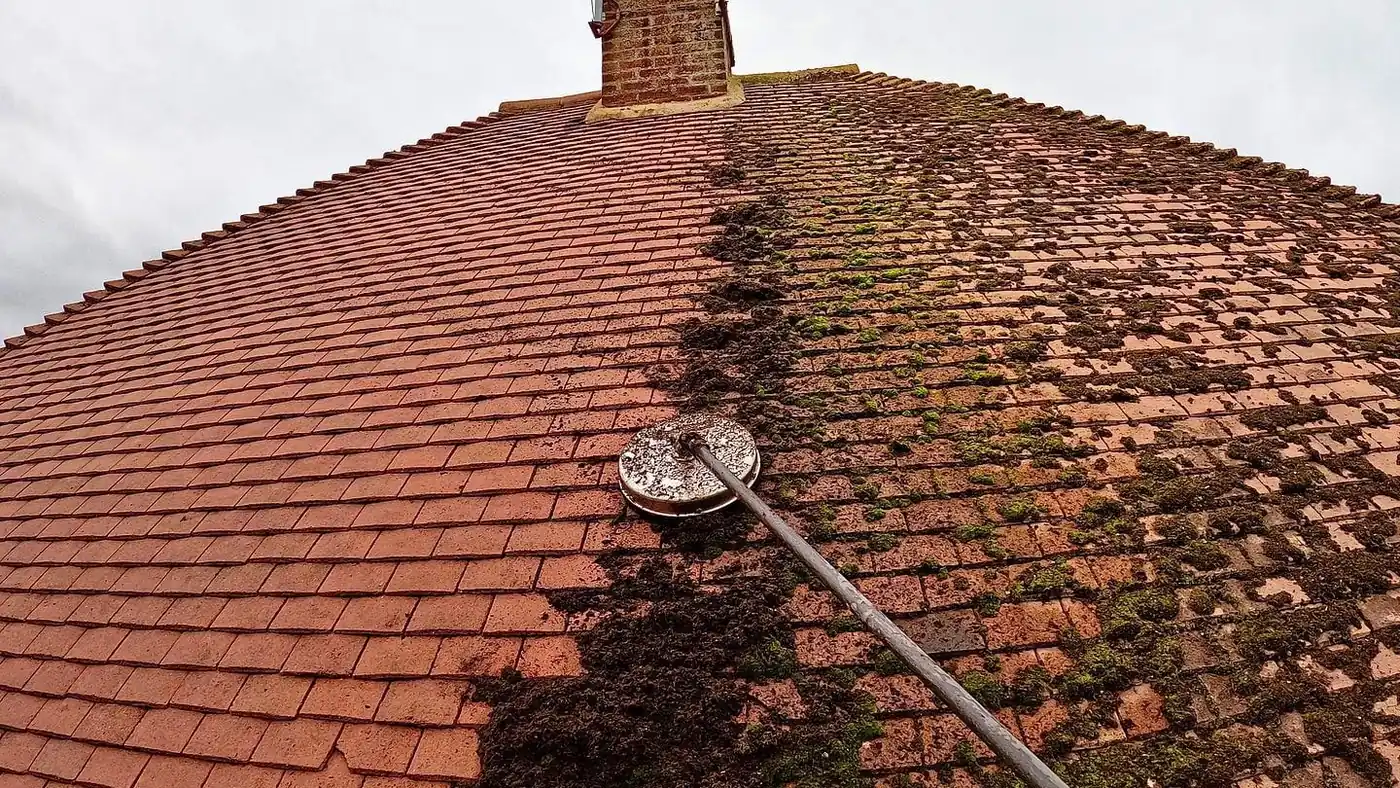
A treatment can be booked with a roof clean or on its own. Where growth is light, treating it may be all that’s needed, while thick moss needs removing first. We will be honest about which your roof needs. The work covers shaded roof slopes, algae and black streaks and ridge and hip tiles, and the jobs we see most are orange or yellow lichen on the ridge and a north-facing slope that greens up fast.
Long drives, lanes and big gardens are part of working in a village like St Lawrence, and it helps to know about turning space and parking. Mature trees around a home in a village like St Lawrence tend to mean heavier moss and fuller gutters.
Some firms suggest their work will keep things looking new for years. We prefer to be honest: in damp, shady spots, growth returns sooner. What you do get from us is a written 12-month workmanship guarantee on the work we carry out.
- Place
- St Lawrence (PO38)
- Wider area
- Isle of Wight
- Guarantee
- 12 months on workmanship, in writing
- Quotes
- A fixed quote up front
- Background
- 20 years’ experience; Checkatrade member
- Telephone
- 01342 344 936
- Updated
- 30 October 2026
From first look to clear-up
Before we leave, you are welcome to walk round with us. Anything we noticed, such as a slipped tile or a blocked downpipe, is pointed out there and then. On site, the work takes part of a day for many homes, depending on the size of the roof and the access. Tell us about the route to your home in St Lawrence, especially narrow lanes or gates.
- We look at the roof to see whether it needs a clean before treatment.
- We fix the price and agree which slopes are treated.
- We plan the day around the weather, since the biocide needs a dry spell to work.
- We protect the area below and apply the biocide by soft wash.
- We explain that the growth fades over time rather than all at once.
Getting ready for the day
- Mention any problems you’ve noticed
- Check with neighbours if we need to use a shared drive
- Shut nearby windows and roof lights
Getting a quote
Quotes are simple. Tell us about the job, add a few photos if you can, and we’ll give you a fixed price. Where we need a closer look, we arrange a time to come round.
Related advice
What else we do in St Lawrence
DIY or a professional?
Solar panels need particular care. The manufacturer’s care guidance comes first, and pressure washers and strong chemicals are best avoided. Since most panels are on a roof, the risk is the same as any roof work.
Walking on a tiled roof does more harm than people think. Tiles and slates can crack under your weight, sometimes with hairline cracks you cannot see, which frost can widen over time. Access should always be planned to suit the roof.
Aftercare tips
Looking after it afterwards is straightforward, and it makes the next visit easier:
- Never scrape lichen yourself
- Book a repeat treatment early
- Look for regrowth on the shady slope once a year
- Don’t rinse the roof after treatment
Your treatment comes with a 12-month written guarantee covering our workmanship. It’s about our workmanship rather than a regrowth guarantee, because spores keep landing.
The SPAB notes that copper strips or sacrificial lead at drip points can help hold growth back. Traces of metal wash down the slope with the rain and that can discourage moss and algae.
Roof biocide treatment around St Lawrence: what to know
St Lawrence lies within about 1 mile of the sea. Crusty lichen is a common sight on roofs near the sea, and because scraping it can mark the tiles, a biocide is the usual answer. St Lawrence has about 9 areas of ancient woodland within two miles, the closest being Rew Copse, about 0.9 miles north-east of St Lawrence. Tree cover means shade, and shade means moss, so a roof near woods may need cleaning more frequently. Among the historic houses near St Lawrence is Rylstone Manor, roughly 3.8 miles north-east of St Lawrence. They are proof that a roof treated gently can stay in good order for a very long time.
Streets near a church such as St Lawrence's Church often include older homes, and older clay or slate roofs need hand cleaning rather than pressure. Homes near open spaces like Stenbury Down, roughly 1.7 miles north of St Lawrence, often have more trees around them. Moss grows fastest on shaded, damp slopes.
St Lawrence is about 4 miles south-west of Shanklin, in the Isle of Wight. We provide roof biocide treatment for houses, flats and rented homes in St Lawrence and the rest of the Isle of Wight. St Lawrence is one of 125 towns, villages and districts in the Isle of Wight we cover for homeowners and landlords. There’s also a page for Brighton, about 51 miles away.
Every address in PO38 is covered for roof biocide treatment, from busy streets to back roads. You will find streets such as Twining Road, Whitwell Road and Woolverton Road, all of which we cover for roof biocide treatment. If your home is just outside St Lawrence, we cover Steephill (1 mile east), Nettlecombe (1 mile north-west), Whitwell (1 mile north-west), Ventnor (1 mile east) and Bierley (2 miles north-west). We also work in nearby towns such as Newport (8 miles north), Ryde (10 miles north), Cowes (12 miles north), Sandown (6 miles north-east), Shanklin (4 miles north-east) and East Cowes (12 miles north). Island and remote properties take a little more planning, so please mention your location when you speak to us on 01342 344 936, or use the quote form.
Near you in St Lawrence
Roofs on the roads around St Catherine's School are all within our usual area. St Lawrence’s nearest station is Shanklin station, about 4.1 miles north-east. Nearby you will also find Longshoremans Museum (1.3 miles east). For a walk, there’s Stenbury Down.
Honest limits
Some problems need a different service or another trade:
- Lichen vanishing on the day
- Fading and old staining in the tile
- Keeping growth away permanently (it slows regrowth; it is not permanent)
If you are not sure, just send details through the quote form or call us on 01342 344 936 and we will give you a straight answer before booking.
What we clean
- Algae and black streaks
- Lichen patches
- Tile and slate surfaces
- Roofs cleaned by hand
- Ridge and hip tiles
- Shaded roof slopes
Do you need roof biocide treatment in St Lawrence?
Every roof is exposed to spores, all the time. Wind brings them in, and when the roof stays damp, they grow. Treating the roof interrupts it for a while.
Homeowners normally contact us after spotting one of these:
- Bright lichen patches on ridge and hip tiles
- Keeping a freshly cleaned roof clearer for longer
- Moss returning after a clean
- A roof greening up
Homes on school roads, near St Francis Catholic and Church of England Primary Academy for example, can face busy mornings and afternoons. A quick note about it when you book helps us plan where to unload.
What your quote should include
- How they’ll handle anything unexpected
- How they’ll protect your property and control run-off
- Whether a biocide is included, and that it’s authorised for this use
- Whether the waste is taken away
How the job changes from site to site
Clay tiles
Lichen is common on older clay roofs. Treating it avoids scraping the tile face and the weather does the rest.
Natural slate
Heavy moss on slate is hand-brushed first. The biocide then deals with the rest and slows regrowth.
Your questions about roof biocide treatment in St Lawrence
Does tree cover around St Lawrence affect roof biocide treatment?
Normally, yes. Rew Copse, an ancient wood, is roughly 0.9 miles north-east of St Lawrence. Shade keeps a roof damp, and moss grows best on damp, shaded slopes, so roofs under trees may need cleaning more frequently.
Is roof biocide treatment any different near the coast in St Lawrence?
It can make a difference, with the sea only about 1 mile from St Lawrence. Near the sea, we look for lichen and algae as well as moss and treat them with biocide where agreed.
Where does the dirty water go?
We keep it out of the surface water drains. Surface water drains discharge directly to the environment, so only clean water should go into them.
Will a biocide get rid of lichen?
By treating it, not scraping it. It grips the surface hard and scraping can leave marks. Treated lichen weathers away gradually.
How should I prepare?
Please move cars, leave gates unlocked and keep pets inside, and tell us about a conservatory, glass roof or nesting birds.
Do you work on rented properties?
Yes. Several properties can go on one quote, with each priced on its own work. Tell us the addresses and the access arrangements.
How do you protect the garden during treatment?
Protecting the area below is part of the job. Planting is protected and drains covered so no biocide reaches surface water drains. You will get clear advice on keeping pets and children clear.
What does roof biocide treatment cost?
Every property is different, so each gets its own fixed quote. For a quote, speak to us on 01342 344 936 or send details through the form on our contact page and tell us roughly what needs doing.
Leave it or put it right?
A biocide isn’t permanent, whatever anyone tells you. How long depends on shade and aspect, typically around one to a few years, because new spores keep arriving. Treating again when regrowth appears is lighter work than starting from scratch. Growth that is left holds moisture against the surface beneath it.
A few details change how long a job takes. A conservatory or extension below, a lot of moss, fragile tiles or no side access all mean extra care, so they’re built into the quote. The price is still fixed before any work starts.
Why choose Superior Roof Cleaning in St Lawrence
- Every job backed by a 12-month workmanship guarantee in writing
- The waste bagged and taken away
- Full insurance on each job
- Biocides approved or authorised for this use in Great Britain, as the law requires
Read how roof cleaning is priced or our methods by tile type.