Buckinghamshire · Biocide roof treatment
Biocide roof treatment in Skittle Green, Buckinghamshire
Roof biocide treatment in Skittle Green, done the careful way. Safe access planned for the job, the area protected and the waste taken away.
- The first patches of moss
- Regrowth since the roof was last cleaned
- A roof cleaned a few years ago that needs retreating
Honest limits
We will always give you a straight answer, so here’s what roof biocide treatment will not do:
- An instant result (dead growth weathers off over time)
- Deep moss in the interlocks
- Broken ridge mortar
If you are not sure, just have a word with us on 01342 344 936 or send details through the form on our contact page and we will give you a straight answer.
What we clean
- Roofs cleaned by hand
- Ridge and hip tiles
- Tile and slate surfaces
- Shaded roof slopes
- Lichen patches
- Algae and black streaks
How we handle roof biocide treatment in Skittle Green
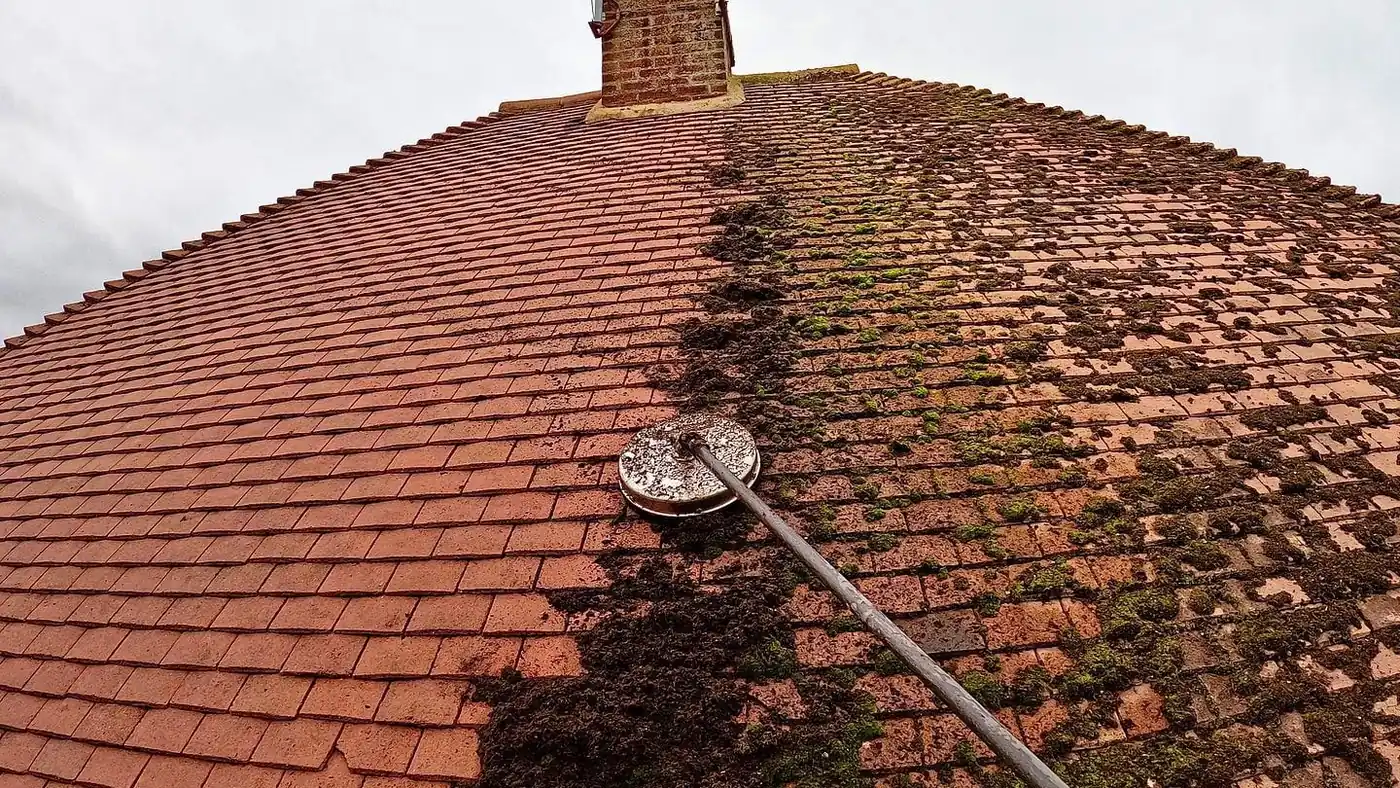
A treatment can be booked with a roof clean or on its own. Where growth is light, treating it may be all that’s needed but heavy moss always comes off by hand first. We’ll be honest about which your roof needs. If you have moss returning after a clean and clinging growth that would mark the tiles if scraped, we can put it right.
In a village like Skittle Green, many homes are older, and clay peg tiles, handmade plain tiles and slate are often found on cottages and farmhouses. Older clay and slate need a gentle touch: hand scraping and brushing, never a jet wash.
If something about the work concerns you after we’ve gone, get in touch with us. The written 12-month workmanship guarantee covers our workmanship, and it spells out what it covers.
- Place
- Skittle Green (HP27)
- Region
- Buckinghamshire
- Cover
- Written 12-month workmanship guarantee
- Quotes
- A fixed quote up front
- Track record
- Checkatrade member, fully insured
- Phone
- 01342 344 936
- Updated
- 30 October 2026
For landlords and letting agents
Between tenancies is often a good time for outside work because access is easy then. Tell us the dates you have and we’ll do our best to fit the work in.
Tenants need to know when we’re due, so cars can be moved and pets kept in. We will agree the date with you or with them, whichever is easier.
What affects the cost of roof biocide treatment
We look at the job before pricing it. We consider:
- The type and condition of the tiles or surface
- How high and steep the work is
- Which method we use
- The access the job needs, from ladders to scaffold
No two properties are the same, so we price each job on its own. The size of the job, how we reach it, the state of the surface and the method we use all make a difference.
Asking for a quote
To help us quote quickly, send us:
- Anything below the work, such as a conservatory, porch or extension
- Shots of the heaviest build-up
- The postcode and the kind of building
- Anything you’ve noticed, such as slipped tiles, overflowing gutters or damp patches
Want a quote for roof biocide treatment? Please reach us by phone on 01342 344 936, or through the quote form with a few details. We’ll talk you through how we’d do it and send a fixed quote before anything is booked.
Aftercare tips
Once we’ve finished, these simple steps help:
- Look for regrowth on the shady slope once a year
- Cut back overhanging trees
- Expect gradual change
- Follow our advice on keeping pets and children away until dry
We give a 12-month workmanship guarantee in writing. It covers how the treatment was carried out rather than a regrowth guarantee, because spores keep landing.
Keep gutters and downpipes clear. Blocked gutters keep the lowest tiles wet and that’s where growth restarts first.
Skittle Green roofs and what affects them
Skittle Green is within about 5 miles of the Chilterns National Landscape. Homes near protected countryside like the Chilterns can include many older properties with clay or slate roofs, and trees and damp hillsides can mean heavier moss. Skittle Green lies roughly 37 miles from central London, comfortably inside the patch we cover. Our 20 years’ experience and full insurance stand behind every job.
Around a church like Church of the Holy Trinity, the houses are often some of the oldest in the area, and clay or slate on a roof like that gets scrapers and brushes, never a jet. Commuters often leave their cars on the roads around Princes Risborough station, roughly 1.7 miles east of Skittle Green, which is worth mentioning when you ask for a quote. Living near Oakley Hill nature reserve, roughly 2.4 miles south-west of Skittle Green, can mean more trees, shade and leaf fall. Where a slope gets little sun, moss typically comes back quicker after a clean.
Skittle Green is about 2 miles west of Princes Risborough, in Buckinghamshire. Skittle Green gets the same approach as every job we take on: a fixed price, careful work, controlled run-off and a 12-month workmanship guarantee in writing. 263 places in Buckinghamshire are on our list, from busy towns to small villages. Reading is in our area too, about 19 miles from Skittle Green.
Here we cover the HP27 postcode area for roof biocide treatment. Roof biocide treatment is available to homes on Chinnor Road and Skittle Green and the roads around them. We also cover Pitch Green (1 mile north-east), Holly Green (1 mile north), Henton (1 mile west), Bledlow (1 mile south-east) and Forty Green (1 mile north-west). Further out, we also cover Aylesbury (7 miles north-east), High Wycombe (8 miles south-east), Chesham (12 miles east), Marlow (11 miles south-east), Amersham (12 miles east) and Beaconsfield (13 miles south-east).
Landmarks near Skittle Green
Around Skittle Green, homes near The Lions Of Bledlow pub fall within our area as well. The nearest railway station is Princes Risborough station, roughly 1.7 miles east. Other landmarks nearby include Great Kimble Dial Hill (3.8 miles north-east). Green spaces nearby include Oakley Hill nature reserve and Beacon Hill.
Questions from Skittle Green
My home in Skittle Green is near trees: does that matter?
Typically, yes. The nearest ancient woodland to Skittle Green is Thickthorne Wood, about 1.2 miles south of Skittle Green. A shaded roof dries slowly, which suits moss, so a biocide treatment after cleaning can help slow regrowth.
Which council covers Skittle Green for listed buildings and conservation areas?
It’s Buckinghamshire council, the local council for Skittle Green. They can confirm whether your home is listed or in a conservation area. For listed homes, the council’s conservation officer is the person to ask before anything beyond gentle cleaning.
How do you protect the garden during treatment?
Protecting the area below is part of the job. Planting is protected and drains covered, with nothing allowed into surface water drains. You’ll get clear advice on keeping pets and children clear.
What happens to the waste?
We bag what we remove and take it away with us, whether it’s moss, leaves, silt or debris. None of it is left on site.
What guarantee do you offer?
Our written 12-month workmanship guarantee covers our workmanship. You get it on paper, and we are fully insured too.
Which biocides do you use on roofs?
We only use biocides approved or authorised for this use in Great Britain, as the law requires. We follow the label every time, including dose, weather and precautions.
How much does roof biocide treatment cost in Skittle Green?
We don’t publish prices, because the cost depends on the job: how big it is, how we reach it, its condition and how we will tackle it. We fix the price before work begins.
Do you work on rented properties?
Yes. Landlords, letting agents and property managers book us alongside homeowners. Access can be arranged with you or the tenant.
What happens if it’s left?
Leaving lichen and algae untreated lets them keep spreading. Algae keeps the surface damp and helps moss get started, and lichen keeps building its crust. Treating now slows it down. On older homes, original tiles, render and paving can be hard to match, so caring for what’s there makes sense.
A few details change how long a job takes. Fragile surfaces, heavy build-up, a conservatory underneath or tricky access all take more time, and that’s reflected in the quote. Either way, you know the price before we start.
Why book with us
- We are fully insured
- 20 years’ experience
- We take the waste with us
- Biocides approved or authorised for this use in Great Britain, as the law requires
Read how our quotes work and how we choose the method.
How the job changes from site to site
Clay tiles
Clay roofs are well suited to a low-pressure treatment. Damp makes clay tiles in particular more prone to delamination, Wienerberger notes, so keeping growth down helps.
Natural slate
Slate roofs often carry lichen more than moss. Slate can be scratched by scraping so a biocide is the gentle answer.
From first look to clear-up
Where water is part of the job, we control where it goes. Moss sludge, dirty water and any biocide are kept out of surface water drains, as surface water drains lead straight to the environment. On site, it takes a few hours on the day, while the treated growth weathers away over the following months. Tell us if anything blocks access to the work, from a gate to a parked car.
- First we look at the tiles and the moss, algae or lichen on them.
- The price is fixed and thick moss planned for removal before treatment.
- We book a dry day and protect plants, paths, gullies and drains.
- We apply an authorised biocide at low pressure, as the label says.
- We tidy up and explain how the treated growth will weather away.
A few things to sort first
- Mention a conservatory or flat roof underneath
- Tell us about parking restrictions near the property
- Tell us about anything you already know, such as leaks or loose tiles
Your fixed quote
Quotes are simple. Tell us about the job, add a few photos if you can, and we’ll give you a fixed price. If we need to see it first, we’ll arrange a visit.