Hertfordshire · Biocide roof treatment
Shillington roof biocide treatment
Biocide roof treatment to kill remaining moss, algae and lichen spores and slow regrowth for homeowners, landlords and letting agents in Shillington. 20 years’ experience, fully insured and a Checkatrade member.
- A roof cleaned a few years ago that needs retreating
- The first patches of moss
- Black lines on the tiles
About our roof biocide treatment in Shillington
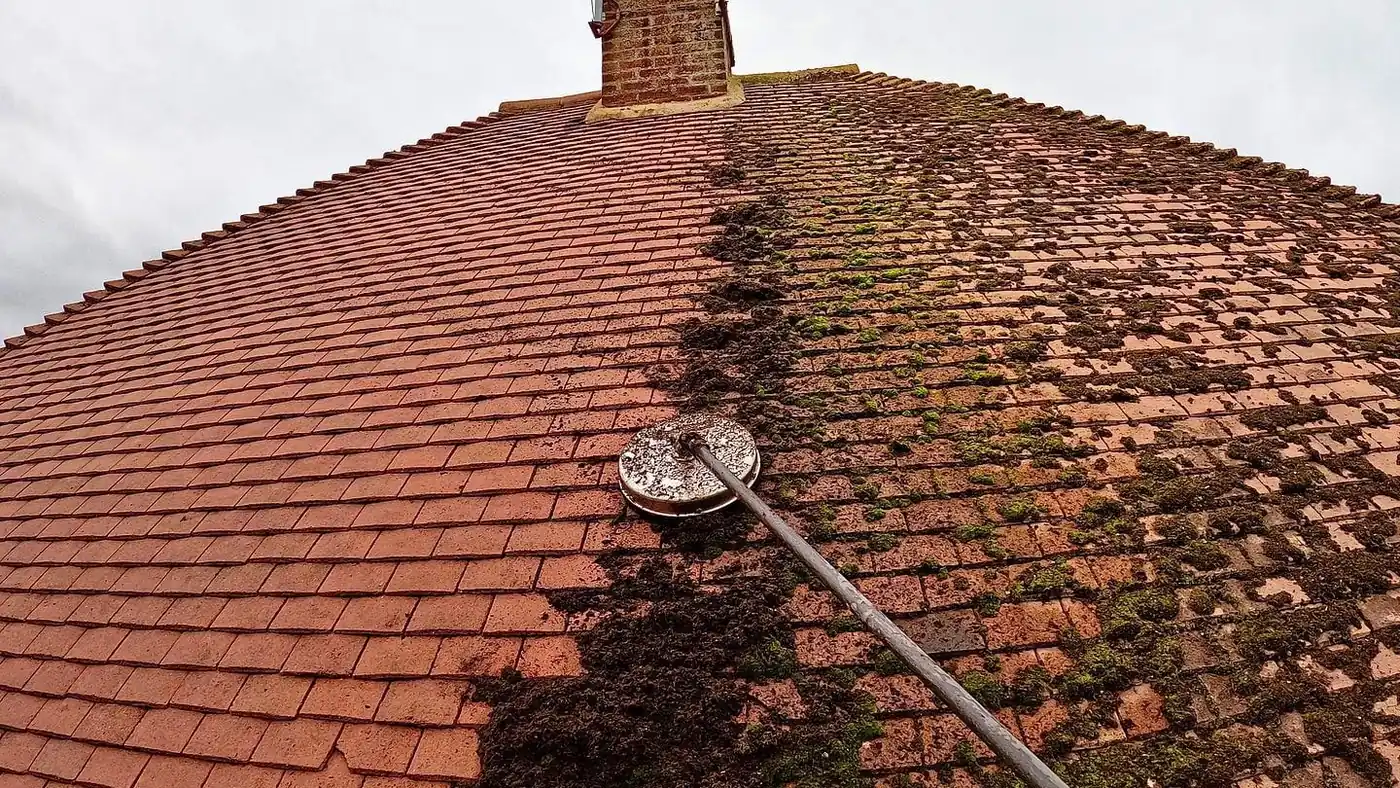
The treatment goes on at low pressure, evenly across the roof. That suits every kind of roof, from clay and slate to concrete since no water is driven into the laps. Thick moss is removed by hand first, so the biocide reaches the tile. The work covers algae and black streaks, ridge and hip tiles and tile and slate surfaces, and the jobs we see most are bright lichen patches on ridge and hip tiles and a shaded slope that turns green quickly.
Older villages often have listed buildings and conservation areas, and if yours is one of them, gentle methods matter even more. Cleaning doesn’t change how a roof looks, but a coating or a change of tiles can, so check with the council before anything like that.
Should you have a question about the work after we’ve left, get in touch with us. The written 12-month workmanship guarantee covers our workmanship, and it spells out what it covers.
- Where
- Shillington (SG5)
- Wider area
- Hertfordshire
- Guarantee
- 12 months on workmanship, in writing
- Price
- Fixed, not estimated
- Background
- 20 years’ experience, fully insured
- Telephone
- 01342 344 936
- Checked
- 30 October 2026
How the job changes from site to site
Historic and listed roofs
On a historic roof, a low-pressure treatment is one of the gentler options. We still check the roof closely first, and treat lichen rather than scraping it.
Natural slate
Slate roofs often carry lichen more than moss. Slate can be scratched by scraping so a biocide is the gentle answer.
Towns and villages near Shillington
Other services in Shillington
When to call us in Shillington
Even after a thorough clean, traces of growth remain. Tiny fragments of moss and algae stay in the texture of the tiles and they regrow when conditions suit. A biocide deals with what’s left.
The problems we’re asked about most include:
- Slowing moss coming back after cleaning
- Regrowth since the roof was last cleaned
- Algae on an older roof
- Green algae on the roof
Around a church like Church of All Saints, the houses are often some of the oldest in the area, and clay or slate on a roof like that gets scrapers and brushes, never a jet.
Comparing quotes
- Which treatment they’ll apply, if any
- What happens to the moss and debris
- How they’ll keep drains, plants and paths protected
- Whether the figure could change on the day
Between visits
A yearly look from the ground goes a long way. On top of that:
- Keep off treated areas until they’ve dried
- Do not pick at dead lichen
- Check gutters after heavy rain
- Let the biocide stay on the tiles
Your treatment comes with a 12-month written guarantee covering our workmanship. It covers how the treatment was carried out rather than a regrowth guarantee, because spores keep landing.
The SPAB notes that copper strips or sacrificial lead at drip points can help hold growth back. Rain carries a trace of the metal down the tiles and that can discourage moss and algae.
What a clean will not put right
To be straight with you, there are a few things this work will not fix:
- Heavy moss cushions
- Damaged tiles
- Weathering from age
Not sure which it is? You can pick up the phone and call 01342 344 936 or fill in the quote form and we will tell you honestly.
What the work covers
- Tile and slate surfaces
- Shaded roof slopes
- Roofs cleaned by hand
- Algae and black streaks
- Lichen patches
- Ridge and hip tiles
Why deal with it now?
Scraping lichen and treating it give very different results. Scraping risks damaging the tile surface because lichen grips so tightly whereas a treatment lets it fade without harm. Cleaning what you have is almost always simpler than replacing it.
Doing several jobs in one visit, for instance the roof and the gutters, often makes better use of the time. Tell us everything you’d like done, and you’ll get one fixed quote.
What you get with us
- Access planned to suit the property
- The gentlest effective method
- Run-off controlled and drains protected
- Covering London and the South East
Take a look at how roof cleaning is priced and how we choose the method.
Doing it yourself: an honest view
It’s tempting to hire a jet washer for the roof, but it is not a good idea. Tile manufacturer guidance warns against high-pressure jet washers on roofs, as it can damage the surface, strip colour from concrete tiles and drive water under the laps.
You can buy moss and algae treatments yourself, but check the product is authorised for that use and follow the label exactly. Applying it to a roof still means working at height, and it must be kept away from drains and ponds.
How a job runs
The day has three parts: getting ready, doing the work and clearing up. Getting ready means protecting the area and setting up access, and the clear-up means sweeping, bagging the waste and taking it with us. Most of the time goes on the work, which takes an hour or two for a small roof and longer for a large one. Access to the back garden decides where ladders or a tower go.
- We look at the roof to see whether it needs a clean before treatment.
- You get a fixed quote that says what’s being treated.
- The date is set for dry weather, following the label.
- Gullies, plants and paths below are protected, then the biocide is applied at low pressure.
- You’re told how the treated growth will weather off over time.
Getting ready for the day
- Mention any problems you’ve noticed
- Tell us about any conservatory, glass roof or extension below the work
- Move garden furniture, pots and washing away from the work
How to get a quote
Quotes are simple. Tell us about the job, add a few photos if you can, and we will give you a fixed price. If we need to see it first, we’ll arrange a visit.
Related advice
Shillington: your questions answered
Does tree cover around Shillington affect roof biocide treatment?
Often, yes. The nearest ancient woodland to Shillington is Apsleybury Wood, about 1.1 miles south-west of Shillington. Leaves on the tiles and shade over the roof both keep it damp, and damp is what moss needs.
Does a conservation area in Shillington change anything about roof biocide treatment?
It mainly matters for changes, not cleaning: a coating or new tiles alter how the roof looks, so check those with Central Bedfordshire council. There are about 4 conservation areas less than two miles from the centre of Shillington, the nearest being the Shillington conservation area, roughly 0.2 miles south of central Shillington.
Do you work in Shillington?
Yes. Our area takes in London and the counties of the South East, and that includes Shillington.
What happens to the waste?
We bag what we remove and take it away with us, whether it’s moss, leaves, silt or debris. None of it is left on site.
Do you pressure wash?
It depends on the surface. On most hard paving, pressure washing is normal, while on roofs it’s kept for robust tiles, after a check. Clay, slate, old or fragile tiles and solar panels are never pressure washed.
Are you on Checkatrade?
Yes. Checkatrade is the scheme we belong to. On top of that, we are fully insured.
What do I need to do before you arrive?
Please move cars, leave gates unlocked and keep pets inside, and let us know about any conservatory or nests.
What if birds are nesting nearby?
Nesting birds are protected by law, so we check first. If there’s an active nest where we’d be working, that part waits until the birds have gone, and we’ll agree a plan with you.
Roofs in Shillington: local notes
Shillington has about 4 conservation areas within two miles; the closest is the Shillington conservation area, about 0.2 miles south of the centre of Shillington. Being in a conservation area doesn’t stop a roof being cleaned, and Central Bedfordshire council is the one to ask about anything that would change its look. At about 36 miles from central London, Shillington sits well inside the area we cover for roof biocide treatment. We’re fully insured, and our work comes with a 12-month written guarantee covering our workmanship.
Around Cain Hill, 1.8 miles north-west of Shillington, gardens often border trees and hedges, and that brings shade. Moss grows fastest on shaded, damp slopes. Traffic for Shillington Lower School can make the road outside hard to use at certain times of day. It’s worth a mention when you book, as the van and ladders need space outside.
Shillington is about 5 miles north-west of Hitchin, in Hertfordshire. Shillington gets the same approach as each job we take on: a look at the job first, a fixed quote, the gentlest method that works and a 12-month written guarantee covering our workmanship. Our Hertfordshire coverage runs to 381 places, and Shillington is one of them. You can also see our page for London, roughly 36 miles from Shillington.
Postcode districts we cover here for roof biocide treatment: SG5. Roof biocide treatment is available to homes on Hillfoot Road, New Walk and Church View Avenue and the roads around them. We also cover the places around Shillington: Hanscombe End (1 mile west), Apsley End (1 mile south-west), Pirton (2 miles south-east), Hexton (3 miles south-west) and Pegsdon (3 miles south). We also work in nearby towns such as Stevenage (10 miles south-east), Welwyn Garden City (15 miles south-east), Harpenden (12 miles south), Hitchin (5 miles south-east), Letchworth (6 miles east) and Letchworth Garden City (6 miles east).
Local landmarks in Shillington
Roofs on the roads around The Five Bells Public House sit inside the area we work in. The nearest railway station is Arlesey station, roughly 4.6 miles north-east of the centre. Other landmarks nearby include Stondon Motor Museum (2.1 miles east) and Ravensburgh Castle (3.4 miles south-west). Open spaces near Shillington include Cain Hill and Pegsdon Hills.