Greater London · Biocide roof treatment
Roof Biocide Treatment in Seething Wells
Roof biocide treatment across Seething Wells and nearby, done carefully, with your property protected and a fixed price agreed first.
- A shaded slope that turns green quickly
- Algae on an older roof
- Black lines on the tiles
Roof biocide treatment for homes in Seething Wells
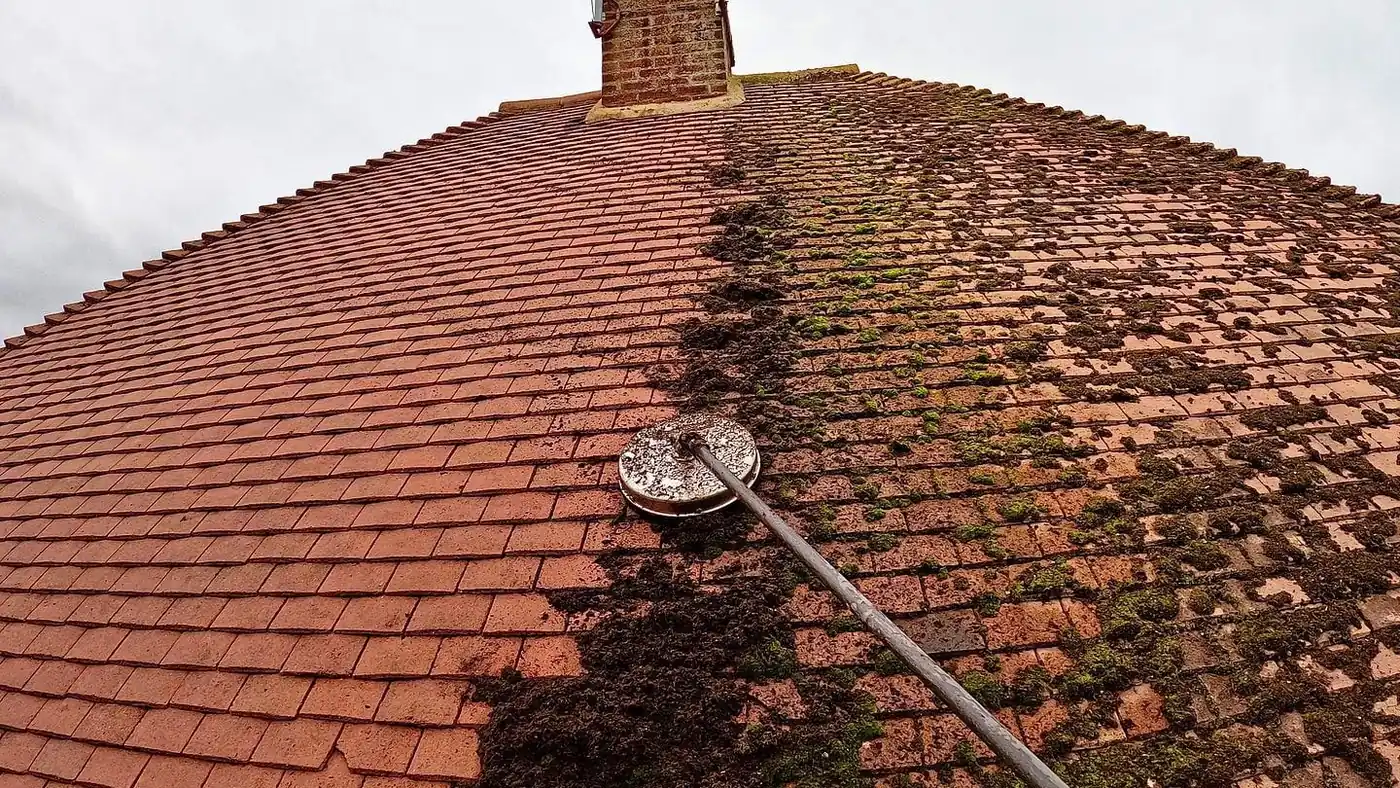
We take care of the ground, plants and drains below. Gullies and drain outlets are protected and we make sure no biocide runs into surface water drains. Plants and paths are protected as well. Common call-outs are for lichen spots across the tiles and an old treatment that has worn off, on lichen patches, ridge and hip tiles and shaded roof slopes.
Work on a London roof usually starts with access: ladders from the street, a tower in the garden or a way through the house to the back. Anything standing on the pavement, such as a tower or scaffold, may need the council’s permission, and the van may need a visitor permit or a suspended bay. We talk this through when we quote.
Insurance and a guarantee protect you in different ways. Our full insurance is in place while we work, and afterwards a written 12-month workmanship guarantee covers our workmanship.
- Where
- Seething Wells (KT6, KT1, KT7)
- Wider area
- Greater London
- Guarantee
- Written 12-month workmanship guarantee
- Quote
- A fixed price before work begins
- Experience
- 20 years’ experience; Checkatrade member
- Call
- 01342 344 936
- Updated
- 30 October 2026
Common questions in Seething Wells
Who can tell me if my home in Seething Wells is listed?
That’s Kingston-Upon-Thames council. The council’s conservation officer can say whether your home is listed and what needs consent. If your home is listed, listed building consent is needed for works that affect its special character, so check with the council before a coating or any change to how the roof looks.
My home in Seething Wells is near trees: does that matter?
Often, yes. Green spaces such as Hampton Court Park, roughly 0.9 miles north-west of Seething Wells, bring trees close to many homes. A shaded roof dries slowly, which suits moss, so a biocide treatment after cleaning can help slow regrowth.
Which biocides do you use on roofs?
Only biocides approved or authorised for this use in Great Britain, as the law requires. We apply them by soft wash, as the label says, with run-off kept out of surface water drains.
Should the moss be removed before treatment?
It depends on the roof. Light algae and lichen can often be treated without a clean, but thick moss needs removing by hand first. We will tell you which applies.
Where does the dirty water go?
Where water is part of the job, we plan where it goes before we start. We catch debris, protect drains and keep the sludge contained, and nothing is hosed into the road.
Do you use a pressure washer?
Not by default. We use the gentlest effective method: hand removal, soft washing or steam on most roofs, with pressure only where the surface can take it. Tile manufacturer guidance warns that high pressure can damage finishes and drive water into the laps.
Will my insurer care about maintenance?
Many home insurance policies exclude gradual damage and wear and tear, so regular maintenance matters. The wording of your own policy is what counts.
Will you tell me if you find any damage?
You are told right away. We never add work without asking, and any repair gets its own fixed quote. The price for the original job stays as agreed.
How the job works
Where water is part of the job, we control where it goes. Moss sludge, dirty water and any biocide are kept out of surface water drains, because those drains discharge directly to the environment. The work takes part of a day for many homes, depending on the size of the roof and the access. Anything placed on the pavement in London, such as a tower, may need the council’s permission.
- You send pictures or we visit to see what’s growing.
- Thick moss is planned for hand removal before treatment.
- We protect plants, paths and drain outlets.
- The biocide goes on evenly at low pressure, as the label says.
- Everything is cleared away before we leave.
How to prepare
- Let us know about earlier repairs or treatments
- Have a word with next door if access is shared
- Make sure we can get to the side and back of the property
Your fixed quote
Some jobs can be priced from pictures; others need us to see them. Big jobs, awkward access and anything that’s hard to see from the ground are normally looked at in person. Either way, you get a fixed price before any work starts.
Read more
Towns and villages near Seething Wells
Also in Seething Wells
Between visits
Aftercare is simple, and it makes the next visit easier:
- Check gutters after heavy rain
- Let the biocide stay on the tiles
- Check the roof annually
- Don’t wait for thick moss to return
The treatment slows regrowth, typically for around one to a few years, depending on shade and aspect. A yearly look tells you how it’s doing and retreat when the first signs come back.
Keep gutters and downpipes clear. Blocked gutters keep the lowest tiles wet, which is where regrowth often starts.
Roofs in Seething Wells: local notes
There are about 30 conservation areas within a couple of miles of Seething Wells, the nearest being the St.Andrews Square conservation area, roughly 0.2 miles east of central Seething Wells. Cleaning does not change how a roof looks, but a coating can, so in a conservation area it’s worth checking with Kingston-Upon-Thames council before anything beyond a clean. The area’s older buildings include Hampton Court Palace, some 1.3 miles north-west of Seething Wells. Old roofs like those last because they are maintained, and gentle cleaning is part of that. On a London terrace, the roof is often shared at the edges, so moss and run-off are kept out of next door’s gutter.
Older homes, like many found near churches such as St Andrew's Church, often have clay tiles or slate that call for a gentle approach. If your home backs onto green space such as Hampton Court Park, 0.9 miles north-west of Seething Wells, you are likely to see more shade, leaves and bird droppings. Where a slope gets little sun, moss normally comes back quicker after a clean.
Seething Wells is about 4 miles north-west of Ewell, in Greater London. We carry out roof biocide treatment for homeowners, landlords and letting agents in Seething Wells and the rest of Greater London. Seething Wells is one of 764 places in Greater London we cover for roof biocide treatment. Our London page covers homes nearby (12 miles or so).
Here we cover the KT6, KT1 and KT7 postcode area for roof biocide treatment. Local streets include Maple Road, Grove Road and North Road, and we cover them all for roof biocide treatment. We also cover Surbiton Park (1 mile north-east), Long Ditton (1 mile south), Thames Ditton (1 mile west), Ditton Hill (1 mile south) and Weston Green (1 mile west). Larger places within reach include London (12 miles north-east), City of Westminster (11 miles north-east), Marylebone (11 miles north-east), Kensington (9 miles north-east), St Pancras (12 miles north-east) and Shoreditch (14 miles north-east).
Around Seething Wells
Roofs on the roads around The Hollyfield School and Sixth Form Centre, The City Arms and Hampton Court Park are all part of the area we cover. Seething Wells has its own railway station: Surbiton station. A little further out are Chessington Castle Hill (2.6 miles south) and Metropolitan Police Mounted Branch Museum (1.6 miles west). For a walk, there’s The Wood and Kingston Hill Road area.
Why it’s worth doing now in Seething Wells
Lichen can be scraped or treated. Scraping risks damaging the tile surface because lichen grips so tightly whereas a treatment lets it fade without harm. In Seething Wells, as across London, a planned clean is far less disruptive than a bigger job later.
Houses, bungalows and flats are all priced the same way: the size of the job, the access, the condition and the method. Call for a fixed quote and we’ll go through it with you.
Why book with us
- We take the waste with us
- 20 years’ experience in roof and exterior cleaning
- One phone number across our whole area
- Fully insured
What a clean won’t put right
Even careful work has limits, and we’d like you to know them:
- Damaged tiles
- Weathering from age
- A roof that stays clear forever
If in doubt, pick up the phone and call 01342 344 936 or fill in the quote form and we’ll say what we think.
What we clean
- Lichen patches
- Ridge and hip tiles
- Tile and slate surfaces
- Algae and black streaks
- Roofs cleaned by hand
- Shaded roof slopes
What we are called out for in Seething Wells
Lichen takes years to build up, but it’s stubborn once it does. Its crusts bond tightly to tiles and slates which is why a biocide is the usual answer.
Signs it’s time to call us include:
- Green algae on the roof
- Slowing moss coming back after cleaning
- Dark algae stains
- Algae on the slope that gets the least sun
If you live near Surbiton station, close to the centre of Seething Wells, on-street parking may be busy in the day, which is worth mentioning when you ask for a quote.
Questions to ask before you book
- The method they’ll use, and why it suits your surface
- Proof that they’re insured
- Whether extra work needs your agreement
- Who clears up afterwards
For landlords and letting agents
Where a building is shared, such as a block of flats, outside work is often arranged by the freeholder or managing agent. We can quote for the whole building and work with whoever is responsible.
If you manage properties from a distance, we let you know when the work is done and flag anything that needs attention, like a cracked tile or a blocked downpipe. Nothing extra is done without your say-so.
How we price roof biocide treatment
Your quote is based on your property. We take into account:
- How high and steep the work is
- What’s below the work area
- Combining work, like the roof and the gutters
- Any towers, scaffold or powered access
What you pay reflects the actual work. That’s why each job is looked at first, and the price agreed before we start.
Photos for a quote
Many jobs can be priced from photos and a few basics. Send what you can of the following:
- Whether the building is listed
- Problems you’ve spotted, like loose tiles or water spilling from gutters
- Parking near the property
- A few general shots from the garden or street
For roof biocide treatment in Seething Wells, speak to us on 01342 344 936 or fill in the quote form. Let us know where the property is and what needs doing, plus anything that affects access, such as no side gate or a glass roof underneath. We will then send you a fixed quote.