West Sussex · Biocide roof treatment
Roof Biocide Treatment in Pyecombe
Roof biocide treatment in Pyecombe from a team with 20 years’ experience. Fully insured, with a written 12-month guarantee on our workmanship.
- Wanting to slow regrowth after a hand clean
- A roof cleaned a few years ago that needs retreating
- Lichen on clay or slate
Roof biocide treatment in Pyecombe, done properly
Biocides are regulated products, and the rules matter. We only use biocides approved or authorised for this use in Great Britain, as the law requires, and we apply them as the label says. The label decides how much, when and how. If you’re dealing with clinging growth that would mark the tiles if scraped and keeping a freshly cleaned roof clearer for longer, we can help.
Some homes in villages like Pyecombe are listed or in a conservation area, which makes gentle cleaning even more important. Cleaning doesn’t change how a roof looks, but a coating or a change of tiles can, so check with the council before anything like that.
Some firms suggest their work will keep things looking new for years. We prefer to be honest: growth comes back in time, faster in shade and damp. What you do get from us is a written 12-month workmanship guarantee on the work we carry out.
- Location
- Pyecombe (BN45)
- Region
- West Sussex
- Our guarantee
- 12 months on workmanship, in writing
- Quote
- One fixed price, quoted in advance
- Background
- Checkatrade member, fully insured
- Call
- 01342 344 936
- Page updated
- 30 October 2026
Roofs in Pyecombe: local notes
The Pyecombe conservation area, roughly 0.1 miles south of central Pyecombe, is the nearest of about 4 conservation areas less than two miles from the centre of Pyecombe. Homes in conservation areas are often older, so their roofs get our gentlest methods, and anything that alters the look is one for Mid Sussex council. Pyecombe is about 42 miles from central London, well inside the area where we carry out roof biocide treatment across London and the South East. We are fully insured, and our work comes with a 12-month workmanship guarantee in writing. One of the historic houses in the area is Preston Manor & Gardens, roughly 4 miles south of Pyecombe. Roofs on buildings like that have lasted because they were looked after, not because they were left alone.
Around Wolstonbury Hill, 1 mile north-west of Pyecombe, gardens often border trees and hedges, and that brings shade. Leaves on the tiles and in the gutters hold damp, and moss thrives on damp. Streets near a church such as Church of the Transfiguration often include older homes, and older clay or slate roofs need hand cleaning rather than pressure.
Pyecombe is about 4 miles south of Burgess Hill, in West Sussex. Whether you’re in the middle of Pyecombe or further out, roof biocide treatment is available for all kinds of property, from bungalows to large family homes. 371 places in West Sussex are on our list, from busy towns to small villages.
All of BN45 is covered for roof biocide treatment, from busy streets to back roads. Local streets include London Road, School Lane and Church Hill, all of which we cover for roof biocide treatment. We also cover the places around Pyecombe: Saddlescombe (1 mile south-west), Waterhall (2 miles south), Patcham (3 miles south), Westdene (3 miles south) and Hollingbury (3 miles south-east). Further out, we also cover Crawley (15 miles north), Horsham (13 miles north-west), Worthing (12 miles south-west), Haywards Heath (7 miles north-east), Burgess Hill (4 miles north) and Shoreham-by-Sea (6 miles south-west).
Near you in Pyecombe
Pyecombe’s nearest station is Hassocks station, about 1.9 miles north-east. Other landmarks nearby include Clayton Castle (1 mile north-east) and The Budding Foundation Museum of Gardening (1.7 miles north). Green spaces nearby include Wolstonbury Hill and Ladies Mile.
What happens on the day
We bring everything the job needs, from protective sheeting to tools and any access equipment. All we need from you is a clear way in and somewhere to park. The job takes part of a day for many homes, depending on the size of the roof and the access. Narrow lanes and long drives are part of rural work, so mention them when you book.
- We start by checking what’s growing and where.
- We agree the treatment and any hand removal first, at a fixed price.
- A dry spell is chosen and the area below is protected.
- The treatment goes on at low pressure, evenly across the tiles.
- We tidy up and explain how the treated growth will weather away.
Before we arrive
- Move cars off the drive and away from the work
- Have a word with next door if access is shared
- Mention a conservatory or flat roof underneath
How to get a quote
Photos are enough for some jobs, while others need a visit. Big jobs, awkward access and anything that’s hard to see from the ground are normally looked at in person. Either way, the price is fixed before anything is booked.
Related advice
Doing it yourself: an honest view
It’s tempting to hire a jet washer for the roof, but it isn’t a good idea. Roof tile makers’ guidance advises against high-pressure washing, because they can damage tile finishes, strip colour from concrete tiles and force water into the laps and interlocks.
Solar panels need particular care. The manufacturer’s care guidance comes first, and pressure washers and strong chemicals are best avoided. Since most panels are on a roof, the risk is the same as any roof work.
Let and managed properties
The tenancy agreement or lease normally says who is responsible for the outside. We can quote either party, and we’ll tell whoever books us what we found.
From a single let house to a portfolio, you get the same service: a look at the job first, a fixed quote, careful work and a written guarantee on our workmanship for 12 months.
What the work involves, part by part
Fibre cement slates
Treatment is a low-impact option for fibre cement. It’s often the most suitable approach once we have checked them.
Natural slate
Slate roofs often carry lichen more than moss. Scraping it risks marking the slate, so we treat it and leave it to weather off.
Your questions about roof biocide treatment in Pyecombe
Is parking a problem for roof biocide treatment in Pyecombe?
Ideally, the van parks on the drive or right outside. If you live near Hassocks station, roughly 1.9 miles north-east of Pyecombe, street parking can fill up in the day, so let us know the options.
How does a conservation area in Pyecombe affect roof biocide treatment?
For cleaning, very little changes, though we keep to gentle methods; a coating or anything that alters the roof’s look is one to check with Mid Sussex council. The nearest to Pyecombe is the Pyecombe conservation area, about 0.1 miles south of the centre of Pyecombe.
How long will the treatment keep moss away?
There’s no fixed answer. It depends on shade and aspect, typically around one to a few years, because spores keep arriving on every roof.
Are the products you use a risk to pets and plants?
Plants, ponds and borders below the work are protected and run-off is controlled. Any biocide is applied at low pressure, only as the label allows, using products approved or authorised for this use in Great Britain. Keep pets indoors until we have finished.
Are your biocides legal to use?
Every biocide we use is approved or authorised for this use in Great Britain, as the law requires. It’s applied as the label says on dose, timing and precautions.
How do you decide on the method?
We choose after looking at the job. Speed never decides it: the aim is a good result with the least wear on the surface, and we’ll talk you through it.
How much does roof biocide treatment cost in Pyecombe?
There’s no set price, as it depends on the job: how big it is, how we reach it, its condition and how we’ll tackle it. You get a fixed price before any work starts.
Will dirty water go down the drains?
Run-off is planned before any water is used. We catch debris, protect drains and keep the sludge contained, and nothing is hosed into the road.
What happens if it’s left?
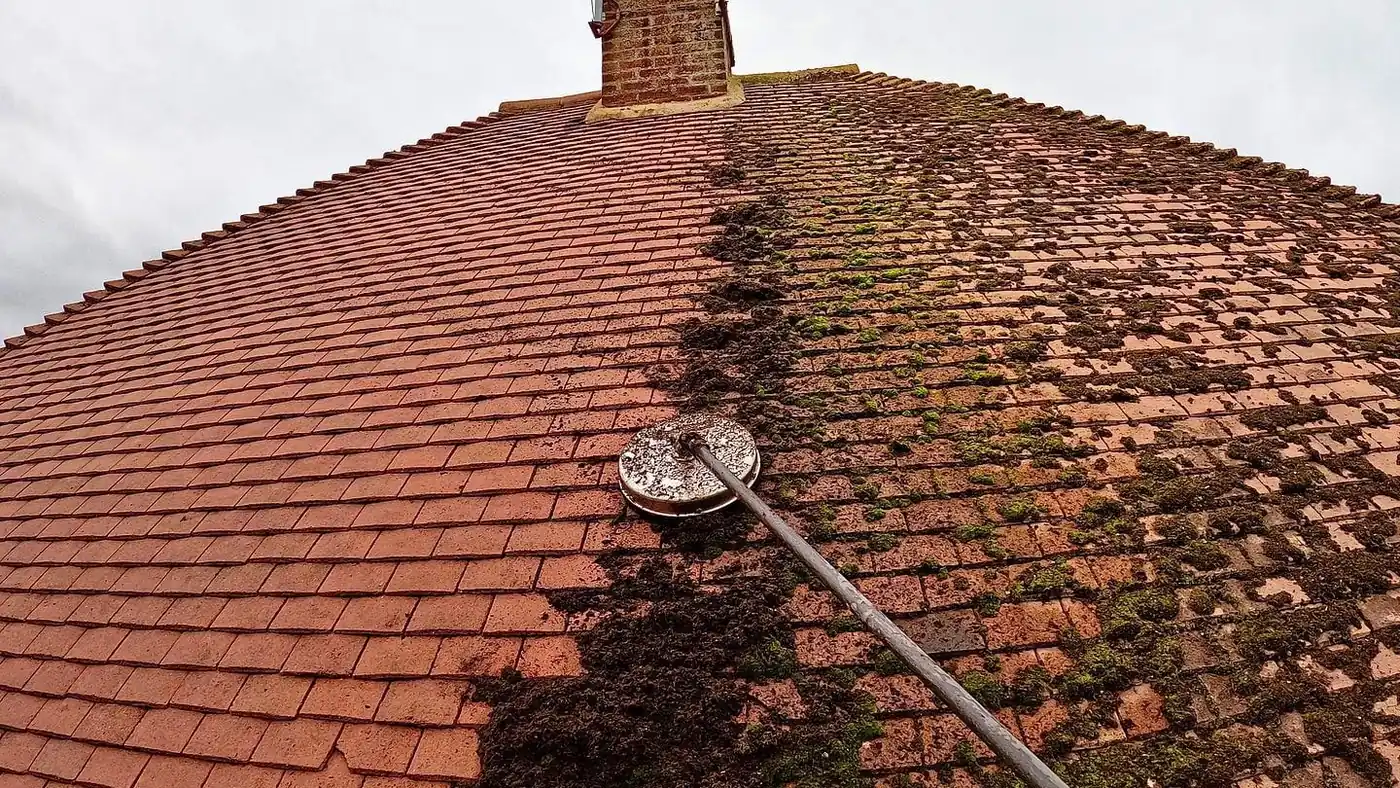
Lichen can be scraped or treated. Scraping risks damaging the tile surface because lichen grips so tightly whereas a treatment lets it fade without harm. Moss and algae hold water, and that is the start of most problems.
Leaving it longer rarely makes the job smaller. Build-up and small faults tend to get worse, not better, which can mean more work next time. If you’re not sure what’s needed, get in touch on 01342 344 936, or through the quote form and we will give you a straight view and a fixed quote.
Why Pyecombe homeowners choose us
- Safe access planned for each job
- We take the waste with us
- Covering London and the South East
- Sludge and dirty water kept out of surface water drains
Take a look at what affects the cost or which method suits your roof.
Do you need roof biocide treatment in Pyecombe?
Hand removal can’t catch every spore. Tiny fragments of moss and algae stay in the texture of the tiles, ready to grow again. A biocide deals with what’s left.
If you notice any of these, it’s worth a closer look:
- Black lines on the tiles
- Algae on an older roof
- An old treatment that has worn off
- Algae on the slope that gets the least sun
Roads near schools such as Downlands Community School can be busy at drop-off and pick-up. Tell us about it when you ask for a quote, and the start can be timed to suit.
Questions to ask before booking
- Who clears up afterwards
- Whether ladders, a tower or scaffold are allowed for in the price
- If the quote is a fixed price or an estimate
- Whether they’ll use hand removal, soft wash, steam or pressure
Honest limits
We’ll always give you a straight answer, so here’s what this work cannot put right:
- Cracked, slipped or missing tiles (repairs are quoted separately)
- Fading and old staining in the tile
- Lichen vanishing on the day
If you’re not sure, just send a message through our quote form, or give us a call on 01342 344 936 and we will give you a straight answer before you book.
Surfaces we cover
- Lichen patches
- Shaded roof slopes
- Tile and slate surfaces
- Ridge and hip tiles
- Algae and black streaks
- Roofs cleaned by hand