Hampshire · Biocide roof treatment
Biocide roof treatment in Portmore, Hampshire
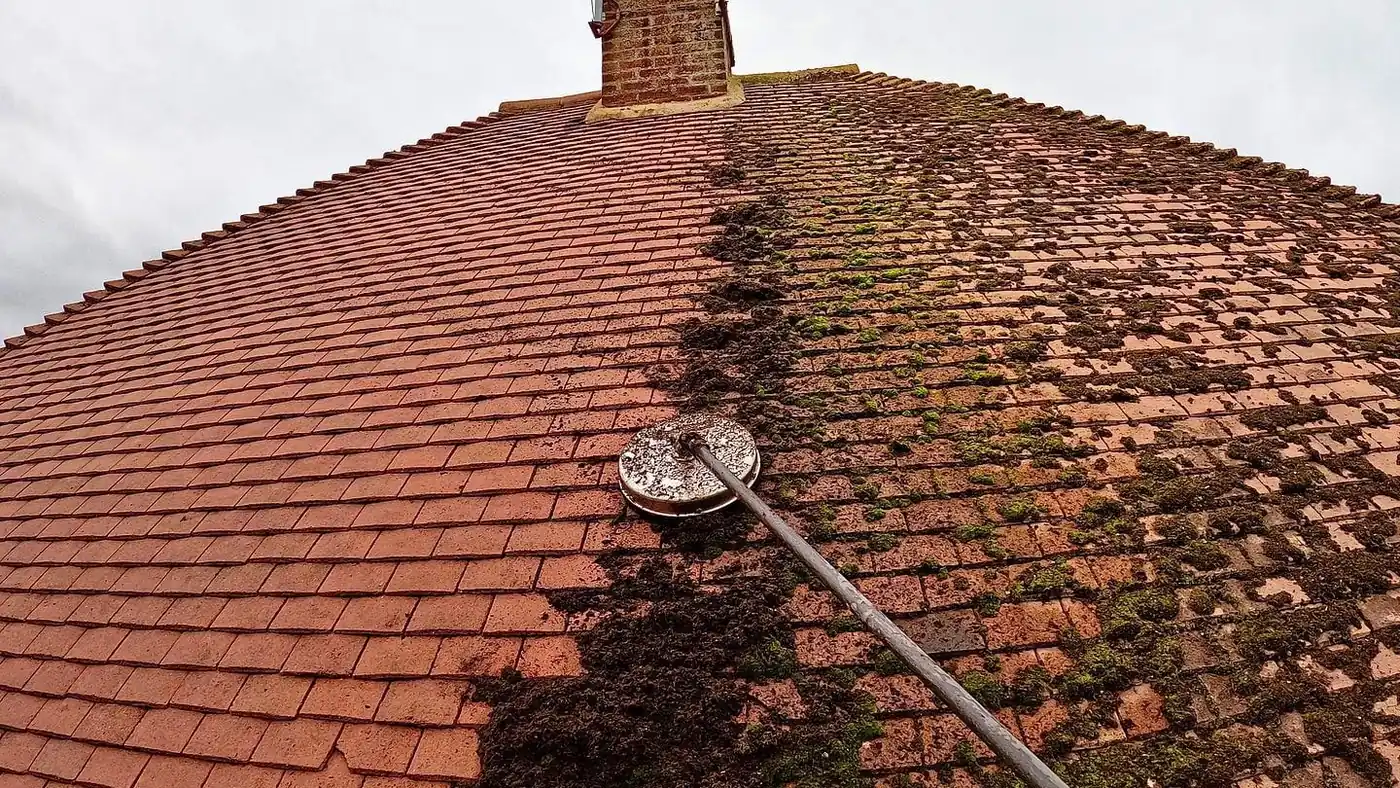
We cover Portmore for biocide roof treatment to kill remaining moss, algae and lichen spores and slow regrowth. The gentlest method that does the job, a fixed quote and a 12-month workmanship guarantee in writing with each job.
- Orange or yellow lichen on the ridge
- The first patches of moss
- New moss on a cleaned roof
How we handle roof biocide treatment in Portmore
With 20 years’ experience, we are straightforward about what a biocide can do. It holds growth back for a while, not forever and dead growth takes time to weather away. The work is fully insured, backed by a 12-month written guarantee covering our workmanship, and we’re a Checkatrade member. If you have clinging growth that would mark the tiles if scraped and a green film over the tiles, we can help, from ridge and hip tiles, tile and slate surfaces and lichen patches onwards.
In a rural spot like Portmore, access may mean a long drive, a narrow lane or a gate to get through, and it helps to know about turning space and parking. Mature trees around a home in a village like Portmore tend to mean heavier moss and fuller gutters.
You may see promises that outside surfaces will stay clean for years. We’d rather be straight with you: growth comes back in time, faster in shade and damp. What we do give you is a written 12-month workmanship guarantee covering our work.
- Location
- Portmore (SO41)
- Wider area
- Hampshire
- Our guarantee
- 12-month workmanship guarantee, in writing
- Quotes
- Fixed, not estimated
- Background
- Two decades in the trade, fully insured
- Telephone
- 01342 344 936
- Updated
- 30 October 2026
Signs you need roof biocide treatment in Portmore
Lichen takes years to build up, but it’s stubborn once it does. It grips the surface firmly which is why a biocide is the usual answer.
Signs it’s time to call us include:
- The first patches of moss
- Growth on tiles too fragile to scrape hard
- A north-facing slope that greens up fast
- Regrowth since the roof was last cleaned
Period houses close to churches such as Saint Nicholas Chapel tend to have clay or slate on top, and we only ever clean that kind of roof by hand.
Before booking anyone
- What happens if they find damage, and whether repairs are quoted first
- Whether they are fully insured
- Whether the waste is taken away
- Whether the workmanship is guaranteed in writing
Also near Portmore
More services for Portmore
What affects the cost of roof biocide treatment
A fixed price needs a few facts first. We look at:
- Parking, and how far we carry equipment
- The amount of build-up
- Any extra work added to the job
- The method, from hand removal to soft wash or steam
A single home or a handful of properties, we price it on the same basis: what needs doing, how we reach it and how long it takes. You will have a fixed price before work begins.
Helping us quote
We can often price from photos taken from the ground. The most useful are:
- Where the property is and whether it’s a house, bungalow or flat
- Any past cleaning, coating or repairs you know about
- Anything you’ve noticed, such as slipped tiles, overflowing gutters or damp patches
- Shots of the heaviest build-up
Some jobs can be priced from pictures; others need us to see them. Big jobs, awkward access and anything that’s hard to see from the ground are normally looked at in person. Either way, the price is fixed before anything is booked.
Why act early in Portmore
A treatment on its own will not lift thick moss. Killed moss falls away slowly, much of it into the gutters so we hand-remove it before treating. Growth that is left holds moisture against the surface beneath it.
What you pay reflects the actual work. That’s why each job is looked at first, and why the quote is fixed before any work starts.
Why book with us
- Access planned to suit the property
- Workmanship guaranteed in writing for 12 months
- Run-off controlled and drains protected
- We have 20 years’ experience
How the job changes from site to site
Historic and listed roofs
Historic roofs need gentle handling, and a biocide is applied without force. We look at the tiles, fixings and mortar beforehand, and treat lichen rather than scraping it.
Natural slate
Slates crack underfoot and lift under pressure. We apply the biocide gently and plan access to avoid walking on them.
The process
There are three stages on the day: getting ready, doing the work and clearing up. Getting ready means protecting the area and setting up access, while clearing up means bagging the waste and taking it away. The middle part takes longest, and that takes a few hours on the day, while the treated growth weathers away over the following months. Plants, borders and anything below the work are protected before we start.
- We check the roof and the growth on it.
- We agree the treatment and any hand removal first, at a fixed price.
- Dry weather matters, so we pick the day and protect the ground below.
- The biocide is applied by soft wash, following the label.
- We clear up and explain how long the dead growth takes to go.
Getting ready for the day
- Mention any problems you’ve noticed
- Leave side gates unlocked so we can reach the back
- Let us know where we can park
Ask for a quote
For a fixed quote, get in touch by phone on 01342 344 936, or by the quote form and tell us roughly what needs doing and where. Photos taken safely from the ground make it easier to price, though they are not essential.
Related advice
FAQs for Portmore
My home in Portmore is near trees: does that matter?
It often does. Ancient woodland such as Walhampton Wood West lies some 0.5 miles south of Portmore. Trees mean shade and leaf litter, so moss typically comes back sooner and gutters fill faster.
Is parking a problem for roof biocide treatment in Portmore?
The closer the van can be to the house, the better. Streets near Lymington Town station, about 1.1 miles south-west of Portmore, can be busy with commuter parking, so tell us about your drive or the nearest space when you book.
What happens to the waste?
Everything we clear is bagged and leaves with us, whether it’s moss, leaves, silt or debris. We do not leave it behind.
What is a biocide treatment for roofs?
It treats the growth rather than removing it by force. It’s ideal for lichen, which is hard to remove safely by hand, and it slows regrowth after a clean.
Do you give a guarantee?
Every job comes with a 12-month workmanship guarantee in writing. It covers our workmanship, not regrowth, because nobody can honestly promise that moss or algae will not come back.
What happens if there’s a nest?
Active nests are protected under the Wildlife and Countryside Act 1981, so we look before working near eaves, gutters or roof spaces. Let us know if you’ve noticed birds nesting when you get in touch.
Do you cover Portmore?
Yes. We take on work in Portmore, as part of our area across London and the South East, and one phone number covers it all.
Do you pressure wash?
Not by default. The method is always the gentlest one that does the job: hand scraping, soft wash or steam for most roofs, with pressure kept for surfaces that can take it. High pressure can damage tile finishes, strip colour from concrete tiles and force water under the laps.
Between visits
After the work, a few habits help it last:
- Judge the result after a few months, not a few days
- Leave the treated roof alone
- Check the roof annually
- Don’t wait for thick moss to return
Your treatment comes with a written 12-month workmanship guarantee. It’s about our workmanship rather than a regrowth guarantee, because spores keep landing.
Cut back trees that shade the tiles. A roof that dries quickly regrows slowly, and fewer leaves gather in the gutters.
Can I do it myself?
Scraping moss off sounds simple, but technique matters. Lichen grips tightly, so scraping it can damage the tile, so it’s better treated and allowed to weather off. For the roof itself, it’s safer to call us.
Solar panels need particular care. Follow the panel maker’s care guidance, and don’t use a pressure washer or harsh chemicals. Most panels sit on a roof, so the same height warnings apply.
Portmore roofs and what affects them
Portmore lies within about 1 mile of the sea. Being near the sea does not change the run-off rule: surface water drains lead straight to the environment, so moss and wash water are kept out of them. Portmore is within about 4 miles of the New Forest National Park. Homes near protected countryside like the New Forest can include many older properties with clay or slate roofs, and trees and damp hillsides can mean heavier moss. The area’s older buildings include Beaulieu Palace House, about 4.5 miles north-east of Portmore. Roofs on buildings like that have lasted because they were looked after, not because they were left alone.
Roads within walking distance of a station like Lymington Town station, roughly 1.1 miles south-west of Portmore, often fill with parked cars, and our van needs to be fairly close to the house, so let us know the options. If your home backs onto green space such as Boldre Foreshore, about 2 miles south-east of Portmore, you are likely to see more shade, leaves and bird droppings. Where a slope gets little sun, moss usually comes back quicker after a clean.
Portmore is about 2 miles north-east of Lymington, in Hampshire. For roof biocide treatment in and around Portmore, please pick up the phone and call 01342 344 936, or use the quote form for a fixed quote. Our area covers London and the South East, including Portmore. Across Hampshire, we cover 683 places, Portmore among them. We also work in Reading, about 52 miles from Portmore.
Work in SO41 is quoted and carried out the same way as anywhere else. We cover properties on Warborne Lane, Jordans Lane and Main Road and the roads around them. Nearby, we also carry out roof biocide treatment in Warborne (1 mile west), Pilley (1 mile north-west), Bull Hill (1 mile north), Pilley Bailey (1 mile north) and Walhampton (1 mile south). Within a short drive, we also cover Eastleigh (15 miles north-east), Fareham (15 miles east), Totton (10 miles north), Hedge End (14 miles north-east), Romsey (15 miles north) and Hythe (8 miles north-east).
Landmarks near Portmore
In Portmore, the houses around William Gilpin Church of England Primary School, Priestlands School and Walhampton Arms are covered too, along with the rest of Portmore. The closest station to Portmore is Lymington Town station, about 1.1 miles south-west of the centre. Well-known places in the area include St Barbe Museum and Art Gallery (1.4 miles south-west) and Yarmouth Castle (4.8 miles south). Green spaces nearby include Boldre Foreshore.