Greater London · Biocide roof treatment
Biocide roof treatment in Plaistow, Greater London
Roof biocide treatment for Plaistow and the surrounding area: a fixed quote first, then the work, done gently, and a full clear-up. Ask us for a fixed quote.
- Small tufts of moss on the tiles
- A roof cleaned a few years ago that needs retreating
- Growth on delicate tiles that can’t be jet washed
What roof biocide treatment looks like in Plaistow
Plaistow has about 17 conservation areas within a couple of miles; the closest is the Three Mills (Part in Newham) conservation area, about 1.4 miles west of the centre of Plaistow. Gentle cleaning is simple maintenance in a conservation area; it’s changes to a roof’s appearance, such as new tiles, that Newham council may need to agree. Some London homes have slate on the main roof and a different tile on a later extension, and each is cleaned to suit. Historic buildings nearby include Queen's House, roughly 3.2 miles south of Plaistow. Roofs on buildings like that have lasted because they were looked after, not because they were left alone.
If your home is near Kaizen Primary School or another school, the school run can fill the road twice a day. Tell us about it when you ask for a quote, and the start can be timed to suit. If your home backs onto green space such as Keir Hardie Park, roughly 0.9 miles south-west of Plaistow, you are likely to see more shade, leaves and bird droppings. Where a slope gets little sun, moss normally comes back quicker after a clean.
Plaistow is about 5 miles east of London, in Greater London. From the centre of Plaistow to the outskirts, we cover roof biocide treatment for every kind of home, from a terrace to a large detached house. Across Greater London, we cover 764 places, and Plaistow is one of them.
Every address in E13, E16 and E6 is covered for roof biocide treatment, from busy streets to back roads. You’ll find streets such as Eve Road, Ivy Road and May Road, all of which we cover for roof biocide treatment. Plaistow sits on or near the A1011, which makes travel easy for roof biocide treatment. If your home is just outside Plaistow, we cover Greengate (1 mile north-east), Canning Town (1 mile south), Upton Park (1 mile north-east), West Ham (1 mile north-west) and Upton (1 mile north). Further out, we also cover London (5 miles west), City of Westminster (8 miles west), Marylebone (7 miles west), Kensington (10 miles west), St Pancras (6 miles west) and Shoreditch (4 miles west).
What’s near Plaistow
Locally, the streets close to Keir Hardie Park, The Service for Deaf and Partially Hearing Children and The Earl Of Derby Public House fall within our area as well. The nearest railway station is West Ham station, about 0.9 miles west. Other landmarks nearby include West Ham United Football Club Museum (0.9 miles north-east) and Greenwich Castle (3.4 miles south). Open spaces near Plaistow include Old Ford Island and Hollow Pond.
How we handle roof biocide treatment in Plaistow
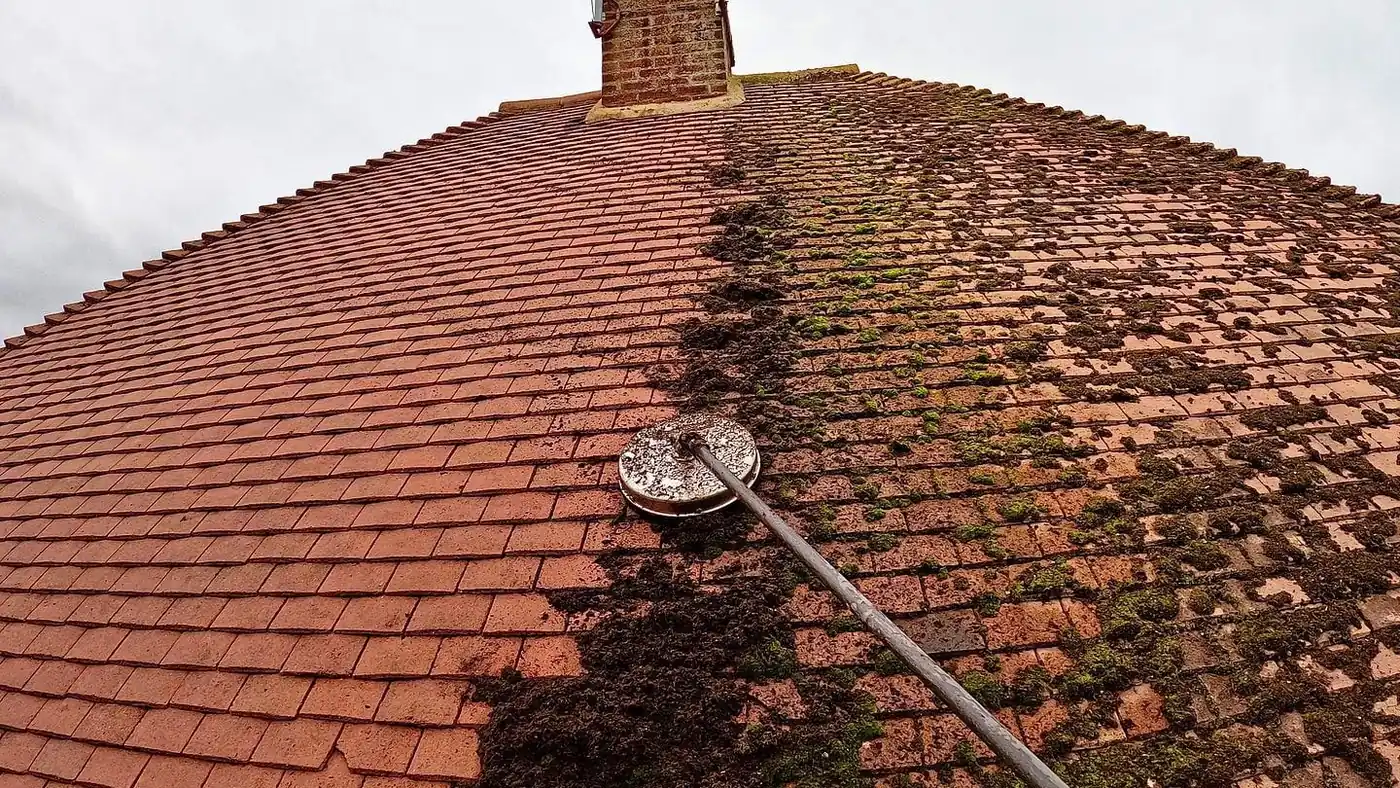
We take care of the ground, plants and drains below. Gullies and drain outlets are protected and we make sure no biocide runs into surface water drains. Plants and paths are protected as well. Typical jobs include lichen spots across the tiles and small tufts of moss on the tiles, on algae and black streaks, roofs cleaned by hand and tile and slate surfaces.
Work on a London roof normally starts with access: ladders from the street, a tower in the garden or a way through the house to the back. If a scaffold or tower has to stand on the pavement, it may need a licence from the council, and the van may need a visitor permit or a suspended bay. We talk this through when we quote.
We’ve got 20 years’ experience, and we stand behind what we do: a written 12-month workmanship guarantee comes with every job. We are also fully insured and a Checkatrade member.
- Where
- Plaistow (E13, E16, E6)
- Region
- Greater London
- Cover
- A written 12-month guarantee on our workmanship
- Quote
- A fixed quote up front
- Track record
- Checkatrade member, fully insured
- Call
- 01342 344 936
- Checked
- 30 October 2026
Plaistow questions
How do parking and access work for roof biocide treatment in Plaistow?
That depends on access. Equipment on the pavement may need a licence from the council, and a parking permit or bay suspension may be needed for the van. We will tell you what applies when we quote.
How does a conservation area in Plaistow affect roof biocide treatment?
It mainly matters for changes, not cleaning: a coating or new tiles alter how the roof looks, so check those with Newham council. There are about 17 conservation areas within two miles of Plaistow, the nearest being the Three Mills (Part in Newham) conservation area, roughly 1.4 miles west of central Plaistow.
Do you work for landlords and letting agents?
Yes. Let us know who to contact and how to reach the tenant, and we will arrange the visit. Anything we notice is passed on to whoever booked the work.
How long does a biocide treatment last?
No one can give a fixed figure honestly. Typically around one to a few years, depending on shade and aspect, because spores keep arriving on every roof.
Will the chemicals harm my garden?
Not each job uses chemicals; solar panels, for instance, get soft brushes and clean water. Where we do use a biocide, we only use ones approved or authorised for this use in Great Britain, as the law requires. We will let you know how long to keep pets off treated areas.
What do you do with what you remove?
We take it away at the end of the job. Paths, patios and drives are swept clear before we go, so the property is left tidy.
What about my neighbours?
It’s a good idea to let them know, especially if we will be near the boundary or parking nearby. We protect their side as carefully as yours.
How do you deal with roof lichen?
By treating it, not scraping it. Lichen bonds tightly to tiles and slates and scraping can leave marks. Treated lichen weathers away gradually.
What we do, step by step
We start by comparing what we see with what we priced. Anything unexpected, like damage that wasn’t visible from the ground, is raised with you before we go further. After that, the work takes an hour or two for a small roof and longer for a large one. Work from the pavement in Plaistow may need the council’s permission, so it’s covered in the quote.
- First we look at the growth, from photos or in person.
- Thick moss is planned for hand removal before treatment.
- The ground below is protected and drains covered.
- An authorised biocide is applied gently across the tiles.
- Everything is cleared away before we leave.
Getting ready for the day
- Close windows, doors and roof lights near the work
- Mention a conservatory or flat roof underneath
- Mention any permits or parking limits
Your fixed quote
A good quote tells you more than the price. Ours covers the work, the method and the access, with a price that’s fixed. For yours, reach us by phone on 01342 344 936, or by the quote form.
Related advice
What happens if it’s left?
A clean and a biocide treatment are not the same thing. Cleaning removes the growth you can see and the treatment deals with spores and slows it coming back. They work best together. On a shared terrace, keeping your part in order helps the whole row.
No two properties are the same, so each one gets its own fixed quote. Size, height, access, the condition of the surface and the method all play a part.
Why Plaistow homeowners choose us
- A 12-month written guarantee covering our workmanship
- Members of Checkatrade
- We take the waste with us
- The gentlest effective method
Take a look at how our quotes work and how we choose the method.
Let and managed properties
Outside maintenance is easy to forget on a rental. Tenants don’t often check the roof or gutters, so planned work helps catch moss, blockages or slipped tiles before they grow into a bigger job.
From a single let house to a portfolio, the standard is the same: a fixed price up front, the gentlest method that will do the job, a proper clear-up and a written 12-month guarantee on our workmanship.
What the work involves, part by part
Fibre cement slates
From the ground, artificial slates can look just like natural slate. We confirm the material before starting, since older fibre cement may contain asbestos.
Clay tiles
A biocide suits clay tiles because it’s applied without force. Clay can delaminate when it stays damp, so keeping growth down helps.
Also near Plaistow
Other services in Plaistow
What’s safe to do yourself
Walking on a tiled roof does more harm than people think. Weight on a tile can leave hairline cracks that are not visible, and frost can open those cracks up over the following winters. Proper access, planned to suit the roof, avoids that.
A pressure washer from a hire shop might look like a quick fix for the roof. Roof tile makers’ guidance advises against high-pressure washing, because they can damage tile finishes, strip colour from concrete tiles and force water into the laps and interlocks.
When something else is needed
Before you book, it helps to know what’s not included:
- Weathering from age
- Broken ridge mortar
- Lichen vanishing on the day
If in doubt, pick up the phone and call 01342 344 936, or use the quote form and we will say what we think.
What we work on in Plaistow
- Roofs cleaned by hand
- Tile and slate surfaces
- Shaded roof slopes
- Ridge and hip tiles
- Lichen patches
- Algae and black streaks
Common problems we fix in Plaistow
Lichen takes years to build up, but it’s stubborn once it does. It grips the surface firmly which is why a biocide is the usual answer.
Look out for any of the following:
- Slowing moss coming back after cleaning
- Growth on delicate tiles that can’t be jet washed
- Lichen best left to a treatment rather than a scraper
- Lichen that will not scrape off
Commuters often leave their cars on the roads around West Ham station, roughly 0.9 miles west of Plaistow, and ladders have to be carried from the van, so the closer the space the better.
Questions to ask before you book
- Whether the workmanship is guaranteed in writing
- Whether they’ll use hand removal, soft wash, steam or pressure
- What happens to the dirty water and sludge
- What happens to the moss and debris