Essex · Biocide roof treatment
Navestock Common roof biocide treatment
Roof biocide treatment across Navestock Common and nearby, with the area protected and left tidy and backed by a written 12-month guarantee on our workmanship.
- A north-facing slope that greens up fast
- Lichen best left to a treatment rather than a scraper
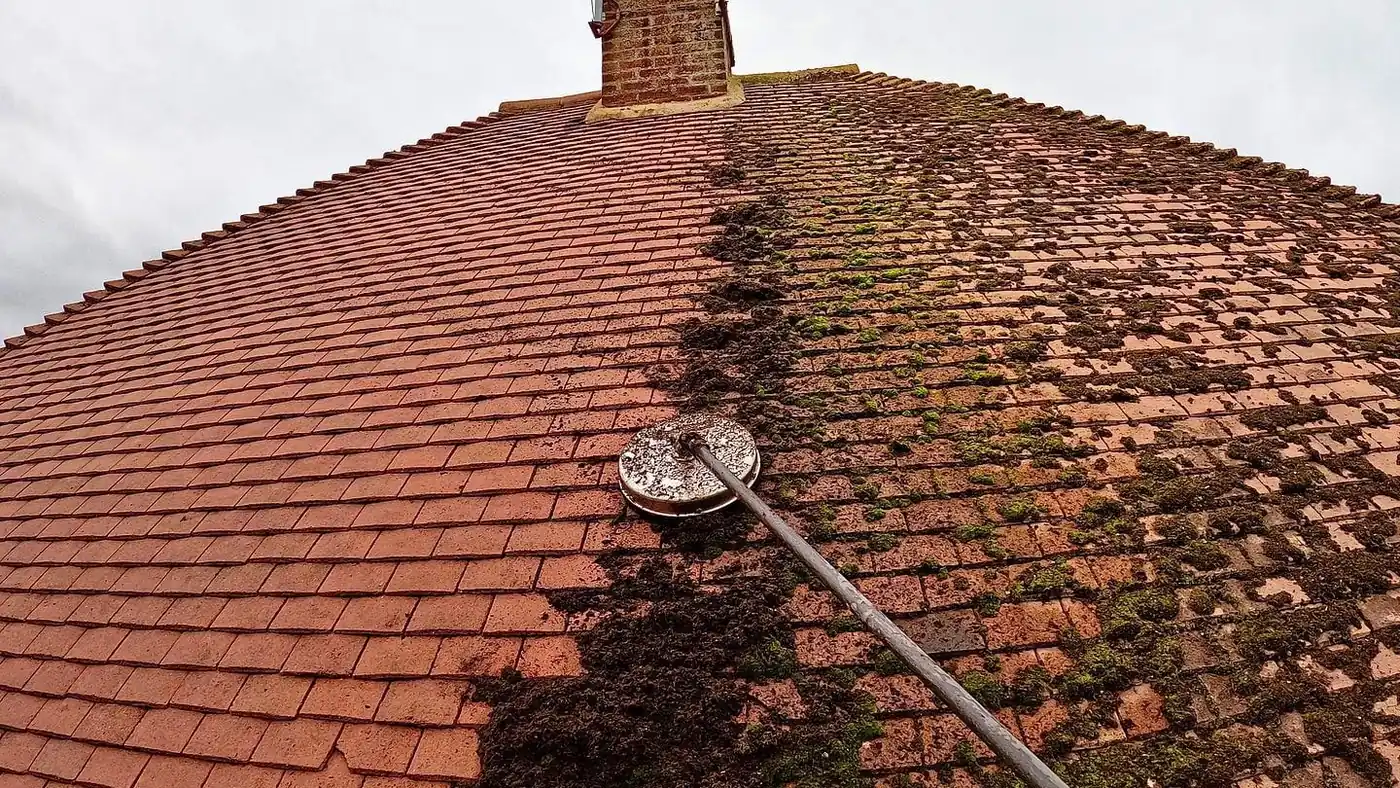
- Light moss starting to show
Roof biocide treatment in Navestock Common
Has the roof started to green up or collect lichen? Describe the roof and the growth when you pick up the phone and call 01342 344 936 or fill in the quote form and we’ll recommend the right approach before fixing the price. If you have bright lichen patches on ridge and hip tiles and slowing moss coming back after cleaning, we can help, from shaded roof slopes, roofs cleaned by hand and lichen patches onwards.
Villages like Navestock Common often include older cottages and barns with clay tiles or slate, alongside newer houses. Old clay tiles in particular can flake when they stay damp, so they are cleaned by hand, gently, with no pressure washing.
You may see promises that outside surfaces will stay clean for years. We prefer to be honest: growth comes back in time, faster in shade and damp. What we do give you is a written 12-month workmanship guarantee covering our work.
- Where
- Navestock Common (CM14)
- Region
- Essex
- Our guarantee
- Written 12-month workmanship guarantee
- Quotes
- A fixed price before we start
- Track record
- 20 years’ experience; Checkatrade member
- Call
- 01342 344 936
- Checked
- 30 October 2026
Doing it yourself: an honest view
For a quick check from a ladder, make sure it’s on firm, level ground, footed or tied, and do not overreach. Never step off it onto the roof and never do it on your own.
It’s tempting to hire a jet washer for the roof, but it isn’t a good idea. Tile manufacturer guidance warns against high-pressure jet washers on roofs, because they can damage tile finishes, strip colour from concrete tiles and force water into the laps and interlocks.
Fixed quotes for roof biocide treatment in Navestock Common
We look at the job before pricing it. The main factors are:
- Whether a tower, scaffold or powered access is needed
- Parking, and how far we carry equipment
- Whether several jobs are done in one visit
- Any extra work added to the job
A few details change how long a job takes. Fragile surfaces, heavy build-up, a conservatory underneath or tricky access all take more time, so they are built into the quote. Either way, you know the price before work begins.
Asking for a quote
Please don’t climb a ladder to take pictures: shots from the garden, the street or an upstairs window are fine. Useful things to send:
- The address and the type of property
- Anything you’ve noticed, such as slipped tiles, overflowing gutters or damp patches
- Any listing you know about
- Conservatories, porches or extensions under the area
We do not publish a price list, because no two properties are the same. Instead, we see the job first, from photos or in person, then send you a fixed quote. To start, use the quote form, or phone 01342 344 936.
Why deal with it now?
Lichen can be scraped or treated. Because it bonds to the tile, scraping can damage it, while a biocide kills it and lets it weather off over time. In a village like Navestock Common, keeping original materials in good order is usually better than replacing them.
The cost depends on the size of the area, the height and access and how much there is to clear. We give you a fixed price before any work starts, so you know where you stand.
Why us?
- We choose the gentlest method that does the job
- One number for London and the South East
- We take the waste with us
- Workmanship guaranteed in writing for 12 months
Take a look at how our quotes work and which method suits your roof.
Rented properties in Navestock Common
If you are an agent or property manager, you can deal with us directly. Tell us the property, the work and the access arrangements and we’ll come back with a fixed quote.
If you manage properties from a distance, we let you know when the work is done and flag anything that needs attention, such as a slipped tile or a downpipe that is not running. Nothing extra is done without your say-so.
Navestock Common: your questions answered
My home in Navestock Common is near trees: does that matter?
Usually, yes. Tench Pond Plantation, an ancient wood, is roughly 0.9 miles south of Navestock Common. Shade keeps a roof damp, and moss grows best on damp, shaded slopes, so roofs under trees may need cleaning more frequently.
Who should I ask about a listed home in Navestock Common?
Navestock Common comes under Brentwood council. Its planning or conservation team can tell you whether your home is listed or in a conservation area. For listed homes, the council’s conservation officer is the person to ask before anything beyond gentle cleaning.
Do you work on listed or historic buildings?
Yes, carefully. We don’t use pressure on historic surfaces, and we won’t apply a coating without the council’s advice, and we’ll suggest the gentlest method that does the job. The council’s conservation officer can tell you if consent is needed.
Are you insured?
Yes. Superior Roof Cleaning is fully insured, and we are happy to show you the details.
How does a roof biocide work?
It kills growth so it can weather away. It’s ideal for lichen, which is hard to remove safely by hand and helps keep a cleaned roof clearer.
Do you belong to any trade schemes?
Yes. Superior Roof Cleaning is a Checkatrade member, and we are fully insured.
Will the work affect next door?
It’s a good idea to let them know, particularly where we will be near a shared boundary or drive. Their windows, cars and paths get the same protection as yours.
Do nesting birds affect the work?
We work around active nests. Any active nest is left alone, as the law requires, and that area can be done once the nest is no longer in use.
Towns and villages near Navestock Common
What else we do in Navestock Common
Navestock Common roofs and what affects them
There are about 6 areas of ancient woodland within two miles of Navestock Common, the nearest being Tench Pond Plantation, some 0.9 miles south of Navestock Common. Homes near woodland like this tend to get more shade and leaf litter, and moss grows best on damp, shaded roofs. At about 16 miles from central London, Navestock Common sits well inside the area we cover for roof biocide treatment. With 20 years’ experience, we are fully insured and a Checkatrade member. Historic buildings nearby include Hare Hall, roughly 3.3 miles south of Navestock Common. They’re proof that a roof treated gently can stay in good order for a very long time.
Period houses close to churches such as Church of St Thomas tend to have clay or slate on top, and we only ever clean that kind of roof by hand. Roads near schools such as Drapers' Academy can be busy at drop-off and pick-up. If that’s your street, mention it, and the ladders can go up before the road fills. If your home backs onto green space such as Dagnam Park, about 1.8 miles south-east of Navestock Common, you are likely to see more shade, leaves and bird droppings. Shade slows how quickly a roof dries, and a roof that stays damp suits moss.
Navestock Common is about 4 miles north of Romford, in Essex. We treat roof biocide treatment in Navestock Common the same as anywhere in Essex: carefully, with a fixed price and a written guarantee on our workmanship for 12 months. Our Essex coverage runs to 644 places, Navestock Common among them. Our London page covers homes nearby, about 16 miles away.
We work across the CM14 postcode area for roof biocide treatment and the streets around it. Neighbouring places we cover for roof biocide treatment include Waterhales (1 mile north-east), St Vincent's Hamlet (1 mile east), Noak Hill (1 mile south-east), Horseman Side (2 miles north-east) and Navestock Heath (2 miles north). We also work in nearby towns such as Chelmsford (14 miles north-east), Basildon (12 miles east), Harlow (10 miles north-west), Brentwood (4 miles east), Billericay (9 miles east) and Loughton (6 miles west).
Near you in Navestock Common
Locally, the streets close to Dagnam Park are on our patch, like the rest of Navestock Common. For rail, the closest station is Harold Wood station, about 3 miles south. Other landmarks nearby include Romford Shopping Hall (3.8 miles south). Not far away are Bedfords Park.
How it works
Protection comes first: gullies and drain covers are protected, and anything nearby is covered or moved out of the way. Then the work starts. It takes an hour or two for a small roof and longer for a large one, and we clear up before we go. Garden furniture and pots near the work are moved or covered first.
- You send photos or we visit to see what’s growing.
- Thick moss is planned for hand removal before treatment.
- The ground below is protected and drains covered.
- An authorised biocide is applied gently across the tiles.
- Everything is cleared away before we leave.
Before we arrive
- Tell us about dogs, cats or other pets in the garden
- Let neighbours know if we’ll be near a shared boundary or drive
- Move cars off the drive and away from the work
Pricing your job
Here’s what helps us quote: the address and roughly what needs doing, a few pictures from the ground and anything you know about the history, such as earlier cleaning or repairs. Then pick up the phone and call 01342 344 936 or fill in the quote form.
Related advice
How the job changes from site to site
Natural slate
Lichen is common on slate. Scraping it risks marking the slate so a biocide is the gentle answer.
Concrete tiles
A biocide avoids the colour loss that high pressure can cause on concrete. It’s applied at low pressure and does its work over time.
Between visits
A yearly look from the ground goes a long way. Beyond that:
- Cut back overhanging trees
- Check the roof annually
- Check gutters after heavy rain
- Leave lichen to weather off after treatment
Expect lichen to be the slowest to fade. It’s killed by the treatment but stays attached for a while, then weathers off. That’s normal and part of doing it safely.
Treat again when regrowth first shows. Small amounts are easy to treat, while letting it build up means a full clean.