Kent · Biocide roof treatment
Lynsted roof biocide treatment
Roof biocide treatment in Lynsted from a team with 20 years’ experience. Fully insured, with a 12-month written guarantee covering our workmanship.
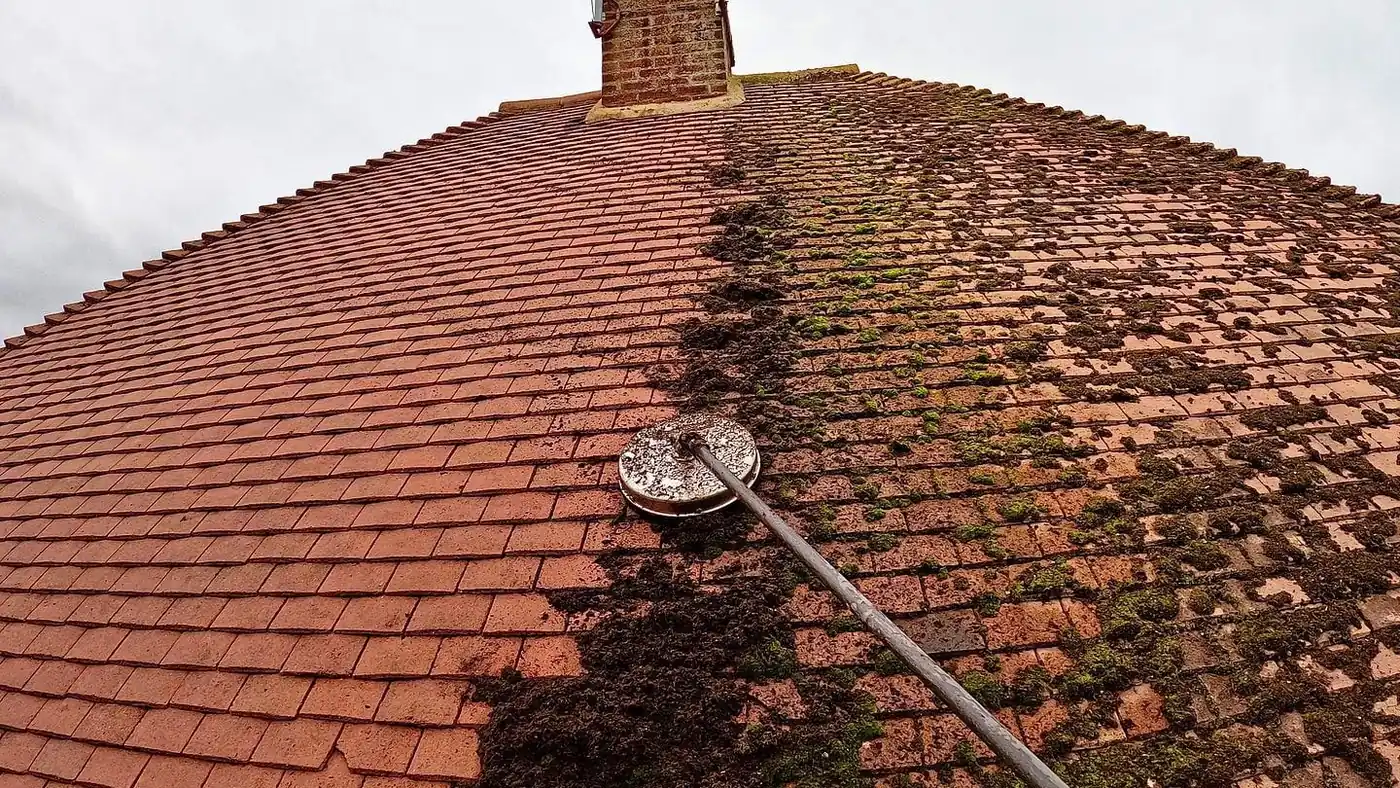
- Growth on delicate tiles that cannot be jet washed
- Black lines on the tiles
- Algae on the slope that gets the least sun
About our roof biocide treatment in Lynsted
Has the roof started to green up or collect lichen? Tell us what you can see when you pick up the phone and call 01342 344 936, or use the quote form and we’ll recommend the right approach, with a fixed quote. The work covers shaded roof slopes, algae and black streaks and tile and slate surfaces, and people most often call us about small tufts of moss on the tiles and lichen spots across the tiles.
Older villages often have listed buildings and conservation areas, which makes gentle cleaning even more important. Cleaning doesn’t change how a roof looks, but a coating or a change of tiles can, so check with the council before anything like that.
It’s worth knowing exactly what a guarantee covers. Ours is a written 12-month workmanship guarantee, and it covers the quality of our work. It is not a promise that moss, algae or dirt won’t return, because nobody can honestly promise that outdoors.
- Where
- Lynsted (ME9)
- Wider area
- Kent
- Cover
- Written 12-month workmanship guarantee
- Quotes
- Fixed price, set before we begin
- Background
- Checkatrade member with 20 years’ experience
- Phone
- 01342 344 936
- Checked
- 30 October 2026
What affects the quote in Lynsted
Seeing the job comes before the price. The main factors are:
- The access the job needs, from ladders to scaffold
- The method, from hand removal to soft wash or steam
- Repairs found during the job, quoted before they are done
- How much moss, algae or dirt there is
What you pay reflects the actual work. That’s why each job is looked at first, and why the quote is fixed before we start.
What to send for a quote
A few details help us quote accurately. When you get in touch, it helps to send:
- Anything below the work, such as a conservatory, porch or extension
- Any signs of trouble, from cracked tiles to blocked downpipes
- Parking near the property
- Photos showing the whole area to be worked on
We don’t publish a price list, because every job is different. We look at yours first, from pictures or on a visit, then send you a fixed quote. To start, give us a ring on 01342 344 936, or send photos through the quote form.
When to call us in Lynsted
Shaded, slow-drying slopes regrow fastest. Slopes out of the sun dry slowly, so they’re where a treatment wears off first.
Common reasons people call us include:
- Small tufts of moss on the tiles
- Dark algae stains
- A roof greening up
- Growth coming back on a treated roof
If you live near Teynham station, roughly 1.6 miles north-east of Lynsted, on-street parking may be busy in the day, so tell us where a van can park when you book.
What your quote should include
- Whether ladders, a tower or scaffold are allowed for in the price
- What happens to the moss and debris
- Whether VAT is included
- How they’ll protect your property and control run-off
When something else is needed
Not every problem is solved by roof biocide treatment, and we’d rather say so up front. It does not solve:
- Thick moss (it needs removing by hand first)
- Weathering from age
- Stopping new spores landing
Not sure which it is? You can ring 01342 344 936 or use the quote form and we’ll tell you honestly before booking.
What we work on in Lynsted
- Lichen patches
- Roofs cleaned by hand
- Shaded roof slopes
- Algae and black streaks
- Ridge and hip tiles
- Tile and slate surfaces
Keeping it in good shape
Aftercare is simple, and it makes the next visit easier:
- Leave lichen to weather off after treatment
- Trim branches that shade the roof
- Book a repeat treatment early
- Look for regrowth on the shady slope once a year
Regrowth is slowed for typically around one to a few years; shade and aspect decide how long. A yearly look tells you how it’s doing, and book a repeat treatment when new growth appears.
Keep gutters and downpipes clear. Blocked gutters keep the lowest tiles wet, which is where regrowth often starts.
The process
The weather plays a part in when we work. If frost, heavy rain or strong wind is forecast, we may suggest another day, as safety and the result come first. On a suitable day, it takes an hour or two for a small roof and longer for a large one. Let us know about gates, steps and slopes on the way to the work.
- We start by checking what’s growing and where.
- The price is fixed and thick moss planned for removal before treatment.
- A dry spell is chosen and the area below is protected.
- The treatment goes on at low pressure, evenly across the tiles.
- The site is cleared and you are told what to expect over the coming months.
Getting ready for the day
- Tell us about anything you already know, such as leaks or loose tiles
- Tell us about dogs, cats or other pets in the garden
- Take in any washing and move pots out of the way
How to get a quote
Every quote starts with a look at the job, from your pictures or, where that is not enough, a visit. After that, you get a fixed price before any work is booked.
Related advice
Landlords, letting agents and property managers
On a let property, the outside is easy to overlook. Few tenants look up at the roof or into the gutters, so planned work helps catch moss, blockages or slipped tiles before they grow into a bigger job.
Whether it’s one rental or many, you get the same service: a fixed price up front, the gentlest effective method, a proper clear-up and a written guarantee on our workmanship for 12 months.
Roof biocide treatment around Lynsted: what to know
From Lynsted, the Kent Downs National Landscape is no more than about 8 miles away. If your home sits on a wooded or north-facing slope near the Kent Downs, moss can build up faster, so a biocide treatment after cleaning may be worth considering. Among the historic houses near Lynsted is Belmont House and Gardens, about 3.8 miles south-east of Lynsted. Roofs on buildings like that have lasted because they were looked after, not because they were left alone. Lynsted is about 40 miles from central London, well inside the area where we carry out roof biocide treatment across London and the South East. We have 20 years’ experience and are fully insured.
Homes on school roads, near Lynsted and Norton Primary School for instance, can face busy mornings and afternoons. If that’s your street, mention it, and the ladders can go up before the road fills. If you live near Church of St Peter and St Paul, or on any of the older streets in Lynsted, your roof may be clay or slate, which is cleaned gently by hand.
Lynsted is about 3 miles south-east of Sittingbourne, in Kent. If you need roof biocide treatment in Lynsted, it’s easy to get a fixed quote: please send details through the quote form, or ring us on 01342 344 936. We work across London and the South East, including Lynsted. Our Kent coverage runs to 922 places, and Lynsted is one of them. Maidstone is in our area too, about 12 miles from Lynsted.
Here we cover the ME9 postcode area for roof biocide treatment. If you need roof biocide treatment at a property on The Street, St Pauls Court and Ludgate Lane or anywhere close by, we can take on the work. Nearby, we also carry out roof biocide treatment in Bogle (1 mile north-east), Erriottwood (1 mile south), Bapchild (1 mile west), Newbury (1 mile south-west) and Radfield (1 mile north). Further out, we also cover Maidstone (12 miles west), Ashford (12 miles south), Canterbury (13 miles east), Sittingbourne (3 miles north-west), Whitstable (11 miles east) and Faversham (4 miles east).
Near you in Lynsted
Roofs on the roads around Sittingbourne Community College and Black Lion Public House fall within our area as well. The closest station to Lynsted is Teynham station, roughly 1.6 miles north-east of the centre. Well-known places in the area include Newnham Castle (2 miles south) and Sittingbourne Heritage Museum (2.6 miles north-west).
Questions from Lynsted
Is Lynsted close to the Kent Downs?
Lynsted is within about 8 miles of the Kent Downs National Landscape. Older roofs in the countryside are cleaned by hand, with no pressure on clay or slate.
Is Lynsted within the area you cover?
Yes. Villages and rural homes across the South East are part of our work, Lynsted included. Let us know about access, parking and narrow lanes when you book.
Will my insurer care about maintenance?
It can. Insurers can exclude damage that happens gradually or through wear and tear, so looking after the roof, gutters and walls is sensible. Your own policy is what decides it, or ask your insurer directly.
Where does the dirty water go?
We control it throughout the job. We protect gullies and drains, so sludge, dirty water and biocide don’t reach the surface water drains, which lead straight to the environment.
Do you use a pressure washer?
Sometimes, after checking the surface. Most hard paving, and robust concrete tiles in good condition, can take controlled pressure; clay tiles, slate, older or fragile tiles and solar panels can’t. You will know the method before booking.
What does a biocide roof treatment do?
Applied by soft wash, it kills moss, algae and lichen. The dead growth then weathers away over weeks and months so it’s not an overnight change.
What about plants and pets during treatment?
Every treatment follows the label, which sets out the precautions. We protect planting and the ground below, drains and gullies are covered and we will explain what to do while it dries.
How often does a roof need treating?
There’s no fixed answer. It depends on shade and aspect, typically around one to a few years, because spores keep arriving on every roof.
Part by part
Clay tiles
On clay, any thick moss is lifted by hand first. Then the treatment is applied gently, and no pressure washing is involved.
Fibre cement slates
From the ground, artificial slates can look just like natural slate. We check which you have first because it changes how we work.