Hampshire · Biocide roof treatment
Biocide roof treatment in Lower Farringdon, Hampshire
Roof biocide treatment for Lower Farringdon, from people with 20 years’ experience. Fully insured, Checkatrade members and a 12-month written guarantee covering our workmanship.
- Lichen that won’t scrape off
- A shaded slope that turns green quickly
- Growth on tiles too fragile to scrape hard
Different parts, different methods
Fibre cement slates
A low-pressure biocide avoids aggressive scraping and pressure. It’s often the most suitable approach once we’ve checked them.
Natural slate
Slates crack underfoot and lift under pressure. The treatment goes on at low pressure and plan access to avoid walking on them.
How we handle roof biocide treatment in Lower Farringdon
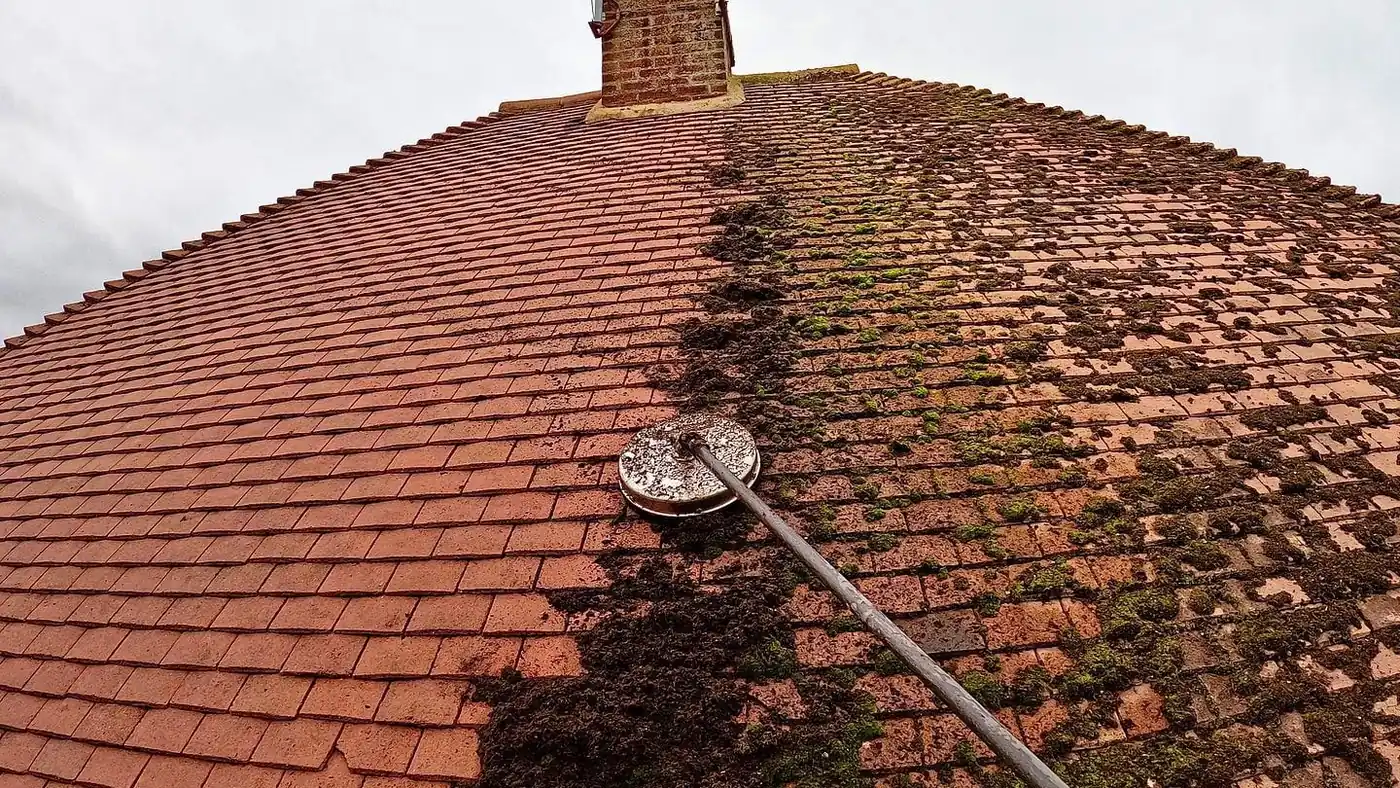
We apply the biocide by soft wash, at low pressure. Low pressure is safe for delicate tiles as well as robust ones, because nothing is forced under the tiles. Thick moss is removed by hand first, so the biocide reaches the tile. The work covers lichen patches, ridge and hip tiles and algae and black streaks, and common reasons people get in touch are dark algae stains and crusty grey and yellow lichen.
Older villages often have listed buildings and conservation areas, which makes gentle cleaning even more important. Cleaning doesn’t change how a roof looks, but a coating or a change of tiles can, so check with the council before anything like that.
Should you have a question about the work after we have left, just give us a call. The written 12-month workmanship guarantee covers our workmanship, and it’s set out clearly so you know what’s included.
- Place
- Lower Farringdon (GU34)
- Wider area
- Hampshire
- Cover
- 12 months on workmanship, in writing
- Quote
- Fixed price, set before we begin
- Track record
- 20 years’ experience; Checkatrade member
- Call
- 01342 344 936
- Checked
- 30 October 2026
Why act early in Lower Farringdon
A treatment on its own will not lift thick moss. Killed moss falls away slowly, much of it into the gutters so we hand-remove it before treating. Old materials can be hard to replace like for like, which makes looking after them worthwhile.
Every property is different, so each one gets its own fixed quote. Size, height, access, the condition of the surface and the method all play a part.
Why us?
- Checkatrade member
- 20 years’ experience
- One phone number across our whole area
- Safe access planned for every job
Also near Lower Farringdon
Other services in Lower Farringdon
Common questions in Lower Farringdon
Who do I check with about listed building consent in Lower Farringdon?
Lower Farringdon comes under East Hampshire council. The council’s conservation officer can say whether your home is listed and what needs consent. If your home is listed, listed building consent is needed for works that affect its special character, so check with the council before a coating or any change to how the roof looks.
Does a conservation area in Lower Farringdon change anything about roof biocide treatment?
Cleaning is fine; it’s changes to how the roof looks, such as a coating, that should be checked with East Hampshire council first. For reference, the Farringdon conservation area lies some 0.5 miles east of the middle of Lower Farringdon.
What about plants and pets during treatment?
Every treatment follows the label, which sets out the precautions. Plants and paving below are protected and drain outlets are protected and we will explain what to do while it dries.
Are you on Checkatrade?
Yes. We are a member of Checkatrade. On top of that, we are fully insured.
Do I need to tell my neighbours?
If we need access across a shared drive or from next door, they’ll need to agree, so please ask them in advance. Otherwise, we keep to your side and protect anything close by.
My home is listed. Can you help?
Yes. We use the gentlest methods on historic roofs and walls, like hand brushing and low-pressure steam where suitable. For anything that would change the appearance, such as a coating, check with the council first, because listed building consent can be needed for works affecting its special character.
How long does a biocide treatment last?
It varies, typically around one to a few years, depending on shade and aspect. It slows regrowth; it isn’t permanent, and shaded slopes come back first.
What is a biocide treatment for roofs?
A biocide is applied to the roof at low pressure, where it kills growth and slows regrowth. The dead growth then weathers away over weeks and months so it’s not an overnight change.
Can I do it myself?
Roof work is dangerous, even for people who do it every day. HSE says almost one in five deaths in construction work involve roof work, and it advises treating all roofs as fragile until a competent person has confirmed they are not. Anything that means going up onto a roof is best left to us.
A pressure washer from a hire shop might look like a quick fix for the roof. Roof tile makers’ guidance advises against high-pressure washing, because they can damage tile finishes, strip colour from concrete tiles and force water into the laps and interlocks.
Do you need roof biocide treatment in Lower Farringdon?
Shaded, slow-drying slopes regrow fastest. North-facing slopes and areas under trees stay wet after rain, so they are where a treatment wears off first.
The problems we’re asked about most are:
- Wanting to slow regrowth after a hand clean
- Crusty grey and yellow lichen
- Orange or yellow lichen on the ridge
- A green film over the tiles
Homes near open spaces like Red Hill, 2 miles west of Lower Farringdon, often have more trees around them. Moss grows fastest on shaded, damp slopes.
What your quote should include
- The method they’ll use, and why it suits your surface
- If the quote is a fixed price or an estimate
- What happens to the moss and debris
- What insurance they carry
Looking after it afterwards
Simple habits between visits make a real difference. We recommend:
- Do not rinse the roof after treatment
- Leave lichen to weather off after treatment
- Expect gradual change
- Cut back overhanging trees
After a biocide treatment, nothing much seems to happen at first. Over the following weeks and months, the growth dies back and weathers away, so the full effect builds slowly. You’ll know what to look for.
The SPAB notes that copper strips or sacrificial lead at drip points can help hold growth back. Traces of metal wash down the slope with the rain, which can slow regrowth.
How we price roof biocide treatment
Before we fix a price, we need to know a few things. We check:
- The method, from hand removal to soft wash or steam
- How big the job is
- Any extra work added to the job
- Combining work, like the roof and the gutters
You will not find a price list here, because the cost depends on the job in front of us. Call for a fixed quote, and we’ll explain what’s included.
What to send for a quote
There’s no need to go up a ladder for photos; the ground or an upstairs window is plenty. Useful things to send:
- Any past cleaning, coating or repairs you know about
- Parking near the property
- A wide photo of the whole roof or area, taken from the ground
- Anything below the work, such as a conservatory, porch or extension
Want a quote for roof biocide treatment? Please ring 01342 344 936 or use the form on our contact page with a few details. We will explain the method we’d use and give you a fixed quote before you commit to anything.
Roofs in Lower Farringdon: local notes
Ancient woodland is a feature around Lower Farringdon: about 30 areas lie within two miles, the closest being Kitcombe Copse, some 0.6 miles south-west of Lower Farringdon. If your roof is shaded by trees, it will stay damp for longer and moss will normally come back sooner than on an open roof. Lower Farringdon is about 47 miles from central London, well inside the area where we carry out roof biocide treatment across London and the South East. You get a fixed quote, a fully insured team and a written guarantee on our workmanship for 12 months. Historic buildings nearby include Bentworth Hall, some 3.5 miles north-west of Lower Farringdon. Houses of that age are a reminder that clay and slate roofs can last a very long time with care.
Live on one of the older roads by Church of All Saints? Clay tiles and slate are common on homes like yours, and both are treated gently.
Lower Farringdon is about 3 miles south of Alton, in Hampshire. From the centre of Lower Farringdon to the outskirts, roof biocide treatment is available for all kinds of property, from a terrace to a large detached house. Across Hampshire, we cover 683 places, Lower Farringdon among them. There’s also a page for Guildford, about 20 miles away.
Work in GU34 follows the same fixed quote, careful work and written 12-month workmanship guarantee as everywhere else we cover. We cover properties on Gosport Road, Brightstone Lane and Shirnall Meadow and the roads around them. We also cover the places around Lower Farringdon: Farringdon (1 mile east), Upper Farringdon (1 mile east), Chawton (2 miles north), Hartley Mauditt (2 miles east) and Alton (3 miles north). We also work in nearby towns such as Basingstoke (12 miles north-west), Winchester (14 miles west), Fleet (13 miles north-east), Horndean (14 miles south), Aldershot (14 miles north-east) and Petersfield (8 miles south).
Around Lower Farringdon
Roofs on the roads around Royal Oak pub are all within our usual area. For rail, the closest station is Alton station, roughly 3 miles north. Other landmarks nearby include The Romany Museum (2.6 miles south-east). Open spaces near Lower Farringdon include Red Hill.
The process
Protection comes first: gullies and drain covers are protected, and anything nearby is covered or moved out of the way. After that, we get on with the roof biocide treatment. It takes a few hours to apply on most roofs, and we clear up before we go. Access to the back garden decides where ladders or a tower go.
- We look at the roof to see whether it needs a clean before treatment.
- We fix the price and agree which slopes are treated.
- A dry spell is chosen, as the label requires.
- Gullies, plants and paths below are protected, then the biocide is applied at low pressure.
- You are told how the treated growth will weather off over time.
How to prepare
- Make space on the drive by moving cars
- Check with neighbours if we need to use a shared drive
- Tell us if you’ve seen birds nesting in the roof or gutters
How to get a quote
Getting a quote does not take long. Tell us about the job, add a few pictures if you can, and we will give you a fixed price. If we need to see it first, we’ll arrange a visit.