Hampshire · Biocide roof treatment
Biocide roof treatment in Little London, Hampshire
Professional roof biocide treatment in and around Little London, done carefully, with your property protected and backed by a 12-month written guarantee covering our workmanship.
- A roof cleaned a few years ago that needs retreating
- Wanting to slow regrowth after a hand clean
- New moss on a cleaned roof
Roof biocide treatment in Little London, done properly
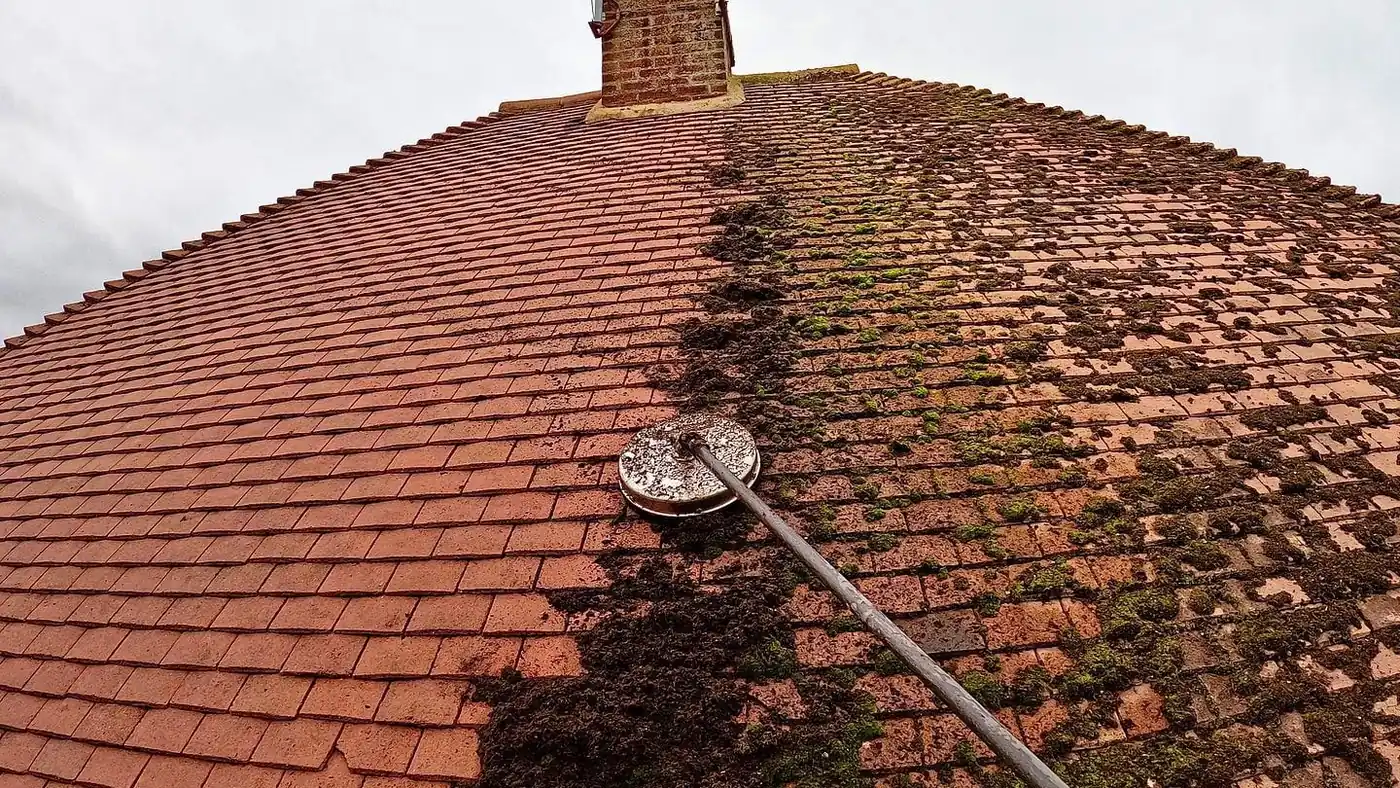
Some people have the roof treated as part of a clean; others book it separately. Where growth is light, treating it may be all that’s needed, while thick moss needs removing first. We’ll be honest about which your roof needs. The work covers algae and black streaks, ridge and hip tiles and tile and slate surfaces, and people most often call us about growth on delicate tiles that can’t be jet washed and lichen best left to a treatment rather than a scraper.
In a rural spot like Little London, access may mean a long drive, a narrow lane or a gate to get through, and it helps to know about turning space and parking. Trees around rural homes often mean more shade, more moss and more leaves in the gutters.
Insurance and a guarantee protect you in different ways. Our full insurance is in place while we work, and afterwards a written 12-month workmanship guarantee covers our workmanship.
- Location
- Little London (SP11)
- Wider area
- Hampshire
- Cover
- 12-month workmanship guarantee, in writing
- Quote
- One fixed price, quoted in advance
- Track record
- Fully insured, with 20 years’ experience
- Call
- 01342 344 936
- Reviewed
- 30 October 2026
Why deal with it now?
Scraping lichen and treating it give very different results. Because it bonds to the tile, scraping can damage it whereas a treatment lets it fade without harm. On older homes, original tiles, render and paving can be hard to match, so caring for what’s there makes sense.
One house or several rental properties, we price it on the same basis: the work involved, the access and the time on site. The price is fixed before any work starts.
What you get with us
- Access planned to suit the property
- A written guarantee on our workmanship for 12 months
- Biocides used as the law requires and as the label says
- A Checkatrade member
Aftercare tips
After the work, a few habits help it last:
- Retreat when regrowth first appears
- Clear leaves from the gutters each autumn
- Trim branches that shade the roof
- Keep off treated areas until they’ve dried
We give a written 12-month workmanship guarantee. It’s about our workmanship rather than a regrowth guarantee, because spores keep landing.
Keep gutters and downpipes clear. Blocked gutters keep the lowest tiles wet, which is where regrowth often starts.
Can I do it myself?
There are still useful things you can do from the ground: check the roof from the garden each year, keep paths and gullies clear of fallen moss and watch how the gutters cope in heavy rain. Anything at height is best left to a professional.
Please do not walk on the tiles. Tiles and slates can crack under your weight, sometimes with hairline cracks you can’t see, and frost can open those cracks up over the following winters. Access should always be planned to suit the roof.
Your questions about roof biocide treatment in Little London
Is Little London in your area for roof biocide treatment?
Yes. We work across London and the South East, and Little London is part of that. We are a Checkatrade member with 20 years’ experience. To start, speak to us on 01342 344 936 or fill in the quote form and tell us what needs doing.
Which council covers Little London for listed buildings and conservation areas?
That’s Test Valley council. The council’s conservation officer can say whether your home is listed and what needs consent. Cleaning does not change how a roof looks, but a coating can, so if your home is listed or in a conservation area, check with the council first.
Do you use a pressure washer?
Where it’s right for the surface, yes. Robust modern concrete tiles and most paving can take controlled pressure; clay tiles, slate, older or fragile tiles and solar panels can’t. You’ll know the method before you book.
Do you have insurance?
Yes. Superior Roof Cleaning is fully insured, and we can share the details if you need them.
Do you work on rented properties?
Yes. Let us know who to contact and how to reach the tenant and we will handle the rest. We will let whoever booked us know about anything that needs attention.
Are your biocides legal to use?
Every biocide we use is approved or authorised for this use in Great Britain, as the law requires. We follow the label every time, including dose, weather and precautions.
How do you deal with roof lichen?
By treating it, not scraping it. It grips the surface hard, so scraping risks damage. Once treated, it fades over the following months.
What do you do with what you remove?
We bag what we remove and take it away with us, from moss and leaves to silt and broken tiles. We do not leave it behind.
What we are called out for in Little London
Lichen grows where the air and roof suit it, often slowly over many years. Its crusts bond tightly to tiles and slates, so it’s best treated rather than scraped.
Most people get in touch after spotting something like this:
- Light moss starting to show
- Lichen that won’t scrape off
- Slowing moss coming back after cleaning
- Growth on delicate tiles that can’t be jet washed
Places like Anton Lakes, about 2.2 miles south-west of Little London, can bring trees and birds close to the houses around them. A roof that sits in shade for part of the day tends to grow moss sooner.
Before you book anyone
- Whether the figure could change on the day
- The method they’ll use, and why it suits your surface
- How VAT is shown on the quote
- Which treatment they’ll apply, if any
From first look to clear-up
Everything for the job comes with us, from protective sheeting to tools and any access equipment. You just need to give us clear access and space to park nearby. On site, it takes an hour or two for a small roof and longer for a large one. Plants, borders and anything below the work are protected before we start.
- First we decide whether to treat or clean and treat.
- The price is fixed and the date chosen for dry weather.
- We protect drains and gullies first.
- We hand-clear thick moss before treating at low pressure.
- The area is cleaned down and precautions explained.
Getting ready for the day
- Make space on the drive by moving cars
- Close windows, doors and roof lights near the work
- Take in any washing and move pots out of the way
How to get a quote
A good quote tells you more than the price. Ours covers the work, the method and the access, and the price is fixed. For yours, give us a ring on 01342 344 936 or send a few lines through the quote form.
Related advice
Roofs in Little London: local notes
The council for Little London is Test Valley council. If your home is listed, listed building consent is needed for works that affect its special character, so check with the council before a coating or any change to how the roof looks.
Live on one of the older roads by Christ Church? Clay tiles and slate are common on homes like yours, and both are treated gently. If your home is near Smannell and Enham Church of England (Aided) Primary School or another school, the school run can fill the road twice a day. Tell us about it when you ask for a quote, and the start can be timed to suit.
Little London is about 3 miles north-east of Andover, in Hampshire. Whether you’re in the middle of Little London or further out, we cover roof biocide treatment for every kind of home, from bungalows to large family homes. Little London is one of 683 towns, villages and districts in Hampshire where we work for homeowners and landlords. There’s also a page for Reading, about 25 miles away.
We work across the SP11 postcode area for roof biocide treatment and the roads nearby. Nearby, we also carry out roof biocide treatment in Smannell (1 mile south), Upper Enham (1 mile west), Enham Alamein (1 mile south-west), Finkley (1 mile south-east) and Knights Enham (1 mile south-west). Larger places within reach include Basingstoke (15 miles east), Winchester (14 miles south-east), Andover (3 miles south-west), Tadley (15 miles north-east), Hyde (14 miles south-east) and Tidworth (9 miles west).
Near you in Little London
Properties near The Oak pub are all part of the area we cover. The nearest railway station is Andover station, about 2.9 miles south-west of the centre. A little further out are Finkley Down Farm Museum (1.7 miles south). Open spaces near Little London include Anton Lakes and Mill Lake.
How the job changes from site to site
Historic and listed roofs
Old roofs can be fragile. We avoid walking on old tiles and flag any repairs worth doing.
Concrete tiles
Older concrete tiles regrow quickly. Treating them slows regrowth, typically for around one to a few years, depending on shade and aspect.
What affects the cost of roof biocide treatment
Jobs vary more than people expect. What affects the quote:
- What the surface is made of and the state it’s in
- The access the job needs, from ladders to scaffold
- The area to be worked on
- Repairs found during the job, quoted before they’re done
Putting the work off seldom makes it easier. Build-up and small faults tend to get worse, not better, which can mean more work next time. If you’re not sure what’s needed, get in touch on 01342 344 936, or use the quote form for honest advice and a fixed quote.
Photos for a quote
You do not need to know the technical terms. It helps if you can send:
- Any past cleaning, coating or repairs you know about
- Anything you’ve noticed, such as slipped tiles, overflowing gutters or damp patches
- Where we could park, and any restrictions
- Close-ups of the worst patches of moss, algae or dirt
Some jobs can be priced from pictures; others need us to see them. Big jobs, awkward access and anything that’s hard to see from the ground are normally looked at in person. Either way, the price is fixed before anything is booked.