Buckinghamshire · Biocide roof treatment
Biocide roof treatment in Ledborough, Buckinghamshire
Biocide roof treatment to kill remaining moss, algae and lichen spores and slow regrowth for homeowners, landlords and letting agents in Ledborough. 20 years’ experience, fully insured and a Checkatrade member.
- Lichen spots across the tiles
- Lichen best left to a treatment rather than a scraper
- Algae on an older roof
Roof biocide treatment in Ledborough
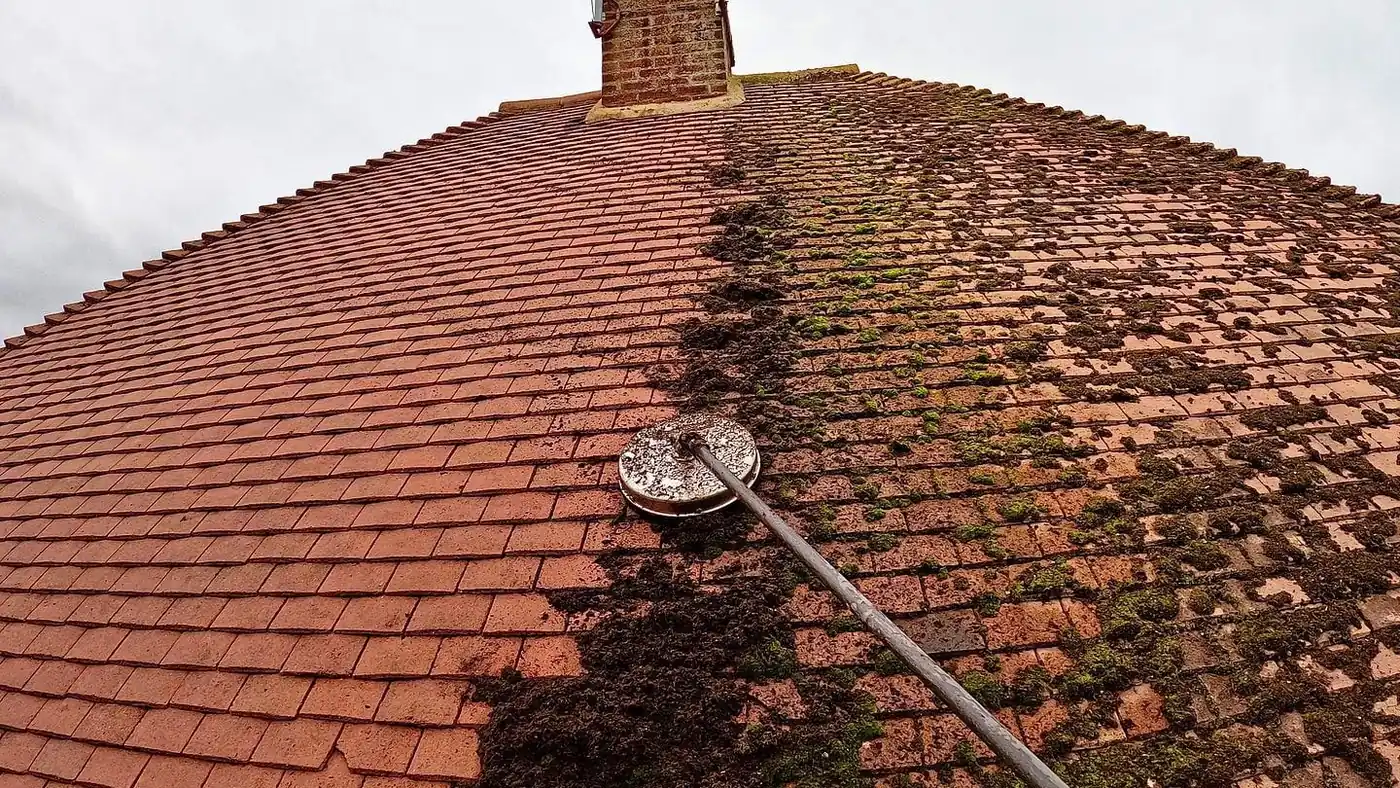
Some people have the roof treated as part of a clean; others book it separately. Where growth is light, treating it may be all that’s needed but heavy moss always comes off by hand first. We will tell you which applies. We are often asked to deal with lichen crusts along the ridge and dark algae stains, across tile and slate surfaces, shaded roof slopes and lichen patches.
Some homes in villages like Ledborough are listed or in a conservation area, which makes gentle cleaning even more important. For anything beyond cleaning, such as a coating, the council’s conservation officer is the person to ask first.
Each job is backed by a written 12-month workmanship guarantee, so you know where you stand. It covers our workmanship, and we are fully insured as well.
- Where
- Ledborough (HP9)
- Region
- Buckinghamshire
- Guarantee
- Written 12-month workmanship guarantee
- Quotes
- Fixed price, set before we begin
- Experience
- Checkatrade member, fully insured
- Phone
- 01342 344 936
- Page updated
- 30 October 2026
Do you need roof biocide treatment in Ledborough?
Regrowth is quickest where the roof stays damp. Slopes out of the sun dry slowly and they need treating most often.
Things you may spot from the ground include:
- A north-facing slope that greens up fast
- Dark algae stains
- Bright lichen patches on ridge and hip tiles
- Regrowth since the roof was last cleaned
Live on one of the older roads by Church of St Michael and All Angels? Clay tiles and slate are common on homes like yours, and both are treated gently.
Questions to ask before booking
- What happens to the dirty water and sludge
- What happens to the moss and debris
- Which parts of the property the price covers
- Whether ladders, a tower or scaffold are allowed for in the price
Aftercare tips
How long the results last depends on shade, damp and care. Here’s what we suggest:
- Cut back overhanging trees
- Look for regrowth on the shady slope once a year
- Book a repeat treatment early
- Leave the treated roof alone
Expect lichen to be the slowest to fade. It’s killed by the treatment but stays attached for a while before rain and weather take it away. That’s normal and part of doing it safely.
Trimming branches over the roof helps a treatment last longer. Sun and air dry the roof faster after rain and the gutters stay clearer.
For landlords and letting agents
If you manage properties from a distance, we will tell you how the job went and point out anything that needs looking at, like a cracked tile or a blocked downpipe. Nothing extra is done without your say-so.
Outside maintenance is easy to forget on a rental. Tenants do not often check the roof or gutters, so planned work helps catch moss, blockages or slipped tiles before they grow into a bigger job.
Towns and villages near Ledborough
What else we do in Ledborough
Common questions in Ledborough
I live in a conservation area in Ledborough: does that affect roof biocide treatment?
A clean leaves the roof looking as it should, so it is not the issue; new tiles or a coating are what Buckinghamshire council may need to agree. For reference, the Beaconsfield Old Town conservation area lies about 1 mile south of the centre of Ledborough.
Is Ledborough within the area you cover?
Yes. Small places get the same service as large ones, and Ledborough is on our list. A few pictures and directions help us plan the visit.
Where does the dirty water go?
The run-off is controlled throughout the job. Gullies and drain covers are protected, so sludge, dirty water and biocide don’t reach the surface water drains, because those drains discharge directly to the environment.
Is it safe to do it myself?
It depends on the job and the height. Paving at ground level is a reasonable DIY job, if you keep the run-off out of surface water drains; roofs, high gutters and solar panels are a different story.
How do you decide on the method?
The surface decides it. Clay tiles, slate and older roofs get hand methods and low pressure, robust concrete tiles may take controlled pressure after a check, and solar panels get soft brushes and clean water. You will know the method before you book.
How often does a roof need treating?
Typically around one to a few years, depending on shade and aspect. It slows regrowth; it isn’t permanent, and shaded slopes come back first.
How does a roof biocide work?
It kills growth so it can weather away. It’s ideal for lichen, which is hard to remove safely by hand and helps keep a cleaned roof clearer.
Do you tell me about problems you spot?
We tell you about anything we spot, such as slipped or cracked tiles, loose ridge tiles or a blocked downpipe. We can show you pictures of what we found, and any repair is quoted before anything is done.
Roofs in Ledborough: local notes
Count the conservation areas within two miles of Ledborough and you get about 3; the nearest is the Beaconsfield Old Town conservation area, roughly 1 mile south of central Ledborough. Cleaning does not change how a roof looks, but a coating can, so in a conservation area it’s worth checking with Buckinghamshire council before anything beyond a clean. The area’s older buildings include Cliveden, some 4.6 miles south-west of Ledborough. They’re proof that a roof treated gently can stay in good order for a very long time. Ledborough is about 25 miles from central London, well inside the area where we carry out roof biocide treatment across London and the South East. You get a fixed quote, a fully insured team and a written 12-month workmanship guarantee.
Roads near schools such as St Mary and All Saints CofE Primary School can be busy at drop-off and pick-up. It’s worth a mention when you book, as the van and ladders need space outside. Commuters often leave their cars on the roads around Beaconsfield station, roughly 0.5 miles south-west of Ledborough, and ladders have to be carried from the van, so the closer the space the better.
Ledborough is about 1 mile north-east of Beaconsfield, in Buckinghamshire. Whether you are in the middle of Ledborough or further out, we cover roof biocide treatment for every kind of home, from a terrace to a large detached house. Our Buckinghamshire coverage runs to 263 places, Ledborough among them. You can also see our page for Reading, about 19 miles away.
We work across HP9 for roof biocide treatment and the streets around it. Whether your home is on Wilton Road, Ledborough Lane and Oakdene or a nearby road, we can help. Nearby, we also carry out roof biocide treatment in Beaconsfield (1 mile south-west), Knotty Green (1 mile north-west), Seer Green (1 mile east), Forty Green (1 mile west) and Coleshill (2 miles north). Larger places within reach include High Wycombe (5 miles west), Chesham (7 miles north), Marlow (7 miles south-west), Amersham (4 miles north), Chalfont St Peter (3 miles east) and Southcourt (15 miles north-west).
Around Ledborough
In Ledborough, the houses around The Chiltern pub, Beaconsfield High School and Davenies School are on our patch, like the rest of Ledborough. The closest station to Ledborough is Beaconsfield station, roughly 0.5 miles south-west. Other landmarks nearby include High Wycombe Castle (5 miles west). For a walk, there’s Long Grove Wood.
How it works
Where the work is near a shared boundary, we protect their side too, and it helps to let them know beforehand. Windows, cars and paths close by are covered or kept clear of splashes. On site, it takes a few hours to apply on most roofs. Bigger gardens and outbuildings mean it’s worth telling us what’s included and how we reach it.
- We start by checking what’s growing and where.
- We agree the treatment and any hand removal first, at a fixed price.
- Dry weather matters, so we pick the day and protect the ground below.
- The treatment goes on at low pressure, evenly across the tiles.
- The site is cleared and you are told what to expect over the coming months.
How to prepare
- Let us know where we can park
- Let neighbours know if we will be near a shared boundary or drive
- Keep pets indoors while we work
Ask for a quote
To help us price the job: where the property is and what you’d like done, a few photos from the ground and anything you know about the history, such as earlier cleaning or repairs. Then send details through the quote form, or phone us on 01342 344 936.
Related advice
When it’s something else
In fairness, there are a few things this work won’t fix:
- Heavy moss cushions
- Colour lost over the years
- Broken ridge mortar
If in doubt, talk to us on 01342 344 936 or send details through the form on our contact page and we’ll say what we think.
What we work on in Ledborough
- Roofs cleaned by hand
- Algae and black streaks
- Tile and slate surfaces
- Ridge and hip tiles
- Lichen patches
- Shaded roof slopes
Why it’s worth doing now in Ledborough
Treating a roof now keeps the next clean smaller. Thin growth responds well, while years of build-up need removing first. It takes a few hours on the day, while the treated growth weathers away over the following months. Old materials can be hard to replace like for like, which makes looking after them worthwhile.
Some things add to the work. Fragile surfaces, heavy build-up, a conservatory underneath or tricky access all take more time, and that’s reflected in the quote. Either way, you know the price before any work starts.
Why us?
- A 12-month workmanship guarantee in writing
- Sludge and dirty water kept out of surface water drains
- Fully insured
- Biocides approved or authorised for this use in Great Britain, as the law requires
Different parts, different methods
Historic and listed roofs
On a historic roof, a low-pressure treatment is one of the gentler options. We still check the roof closely first, and treat lichen rather than scraping it.
Concrete tiles
Rough, weathered concrete holds spores well. Treating them slows regrowth, typically for around one to a few years, depending on shade and aspect.