Greater London · Biocide roof treatment
Biocide roof treatment in Hornsey, Greater London
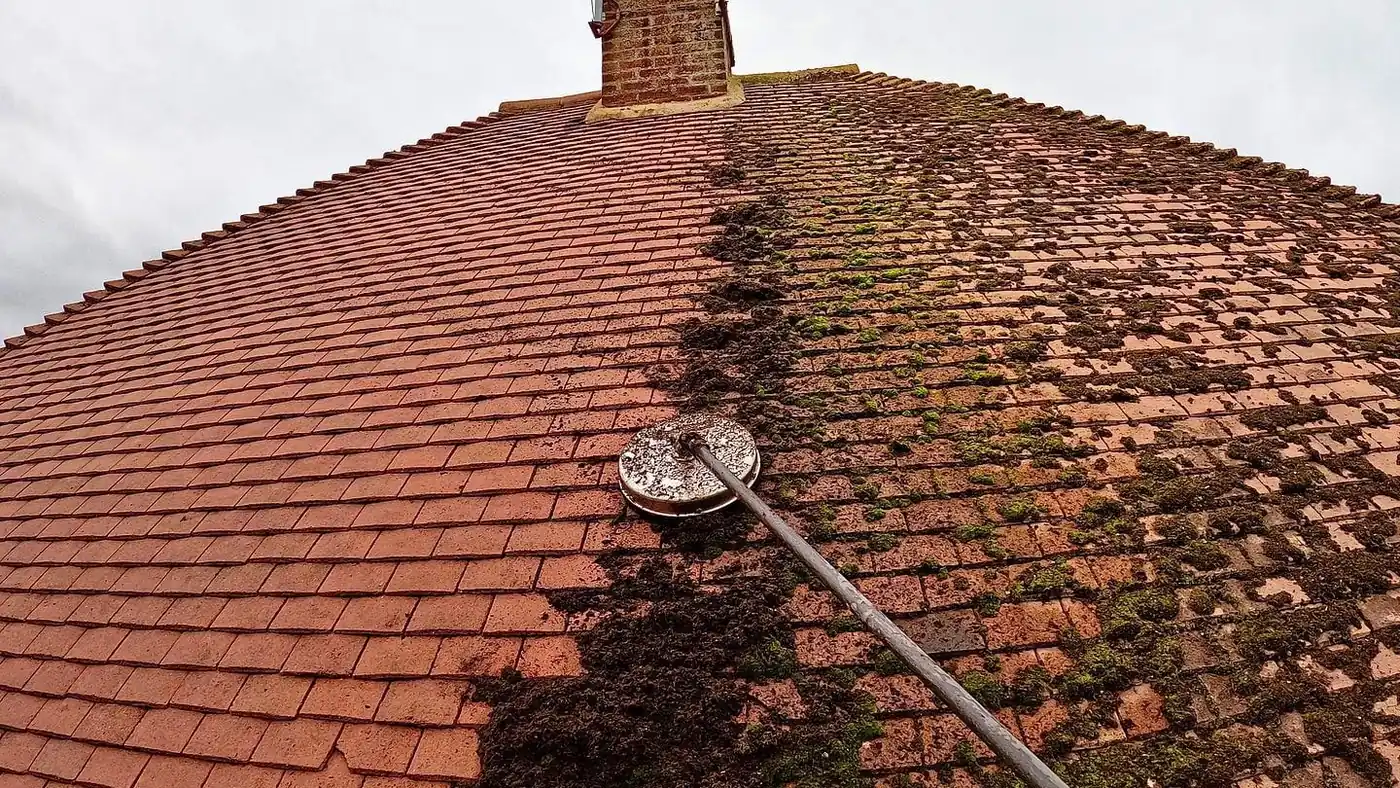
Roof biocide treatment for Hornsey and the surrounding area: a look at the job, a fixed price, the right method and a proper clear-up. Ask us for a fixed quote.
- A roof cleaned a few years ago that needs retreating
- Light moss starting to show
- Growth on delicate tiles that can’t be jet washed
Hornsey: your questions answered
Does tree cover around Hornsey affect roof biocide treatment?
Often, yes. Ancient woodland such as Queens Wood lies about 1.2 miles west of Hornsey. A shaded roof dries slowly, which suits moss, so a biocide treatment after cleaning can help slow regrowth.
What if my home in Hornsey is in a conservation area?
For a clean, very little beyond our usual gentle approach; anything that changes the roof’s appearance is a question for Haringey council. There are about 41 conservation areas within two miles of Hornsey, the nearest being the Hornsey High Street conservation area, roughly 0.1 miles north-west of central Hornsey.
Will the quote change once you start?
The quote is a fixed price for the work we have described. Anything new we find, like hidden damage, is quoted separately, and it’s your choice whether to go ahead.
How do you protect the garden during treatment?
Protecting the area below is part of the job. Plants, paths and drains are protected, and run-off is controlled, with nothing allowed into surface water drains. You will get clear advice on keeping pets and children clear.
Do you work in Hornsey?
Yes. We take on work in Hornsey, as part of our area across London and the South East.
How long will the treatment keep moss away?
That varies with shade and aspect, typically around one to a few years. Check the roof each year for regrowth, and treating early keeps the job small.
Where does the waste go?
Everything we clear is bagged and leaves with us, from moss and leaves to silt and broken tiles. We don’t leave it behind.
How do you deal with roof lichen?
Treatment kills it, and the weather does the rest. It’s slow, but it protects the tiles as the dead crust loosens and goes.
Roof biocide treatment in Hornsey
Some people have the roof treated as part of a clean; others book it separately. Where growth is light, treating it may be all that’s needed, while thick moss needs removing first. We will be honest about which your roof needs. If you are dealing with bright lichen patches on ridge and hip tiles and dark algae stains, we can put it right.
Many London roofs are shared at the edges, with party walls, shared gutters and a neighbour’s slope running into yours. We bag the moss as we go and keep the slurry out of next door’s gutter and the drains in the street.
Each job is backed by a 12-month written guarantee covering our workmanship, so you know where you stand. It covers our workmanship, and we are fully insured as well.
- Location
- Hornsey (N8, N22)
- Wider area
- Greater London
- Cover
- A written 12-month guarantee on our workmanship
- Quotes
- A fixed quote up front
- Experience
- Checkatrade member, fully insured
- Telephone
- 01342 344 936
- Checked
- 30 October 2026
How the job changes from site to site
Natural slate
Slate is brittle and can be lifted by pressure. We apply the biocide gently, with access planned to keep weight off the slates.
Fibre cement slates
From the ground, artificial slates can look just like natural slate. We confirm the material before starting because it changes how we work.
What happens on the day
The day has three parts: getting ready, doing the work and clearing up. Setting up covers protection, access and planning where any water will go, while clearing up means bagging the waste and taking it away. The middle part takes longest, which takes a few hours on the day, while the treated growth weathers away over the following months. Work from the pavement in Hornsey may need the council’s permission, so it’s covered in the quote.
- We look at the roof to see whether it needs a clean before treatment.
- We fix the price and agree which slopes are treated.
- A dry spell is chosen, as the label requires.
- After protecting what’s below, we apply an authorised biocide gently.
- We clear up and explain that the treatment works slowly, not overnight.
Helping the day go smoothly
- Have a word with next door if access is shared
- Let us know where we can park
- Park cars clear of the work area
Ask for a quote
Some jobs can be priced from photos; others need us to see them. Where access is tricky or the area is hard to see in photos, we normally come and look. Either way, the price is fixed before anything is booked.
Advice
Places near Hornsey
Also in Hornsey
Roof biocide treatment in Hornsey: the local picture
Hornsey has about 3 areas of ancient woodland within two miles, the closest being Queens Wood, some 1.2 miles west of Hornsey. Homes near woodland like this tend to get more shade and leaf litter, and moss grows best on damp, shaded roofs. The area’s older buildings include Bruce Castle, about 2 miles north-east of Hornsey. Old roofs like those last because they are maintained, and gentle cleaning is part of that. In London, a tower or scaffold on the pavement may need a licence from the council, and the van may need a parking permit, so access is planned before the day.
Commuters often leave their cars on the roads around Hornsey station, a short walk from the centre of Hornsey, and our van needs to be fairly close to the house, so let us know the options. Homes on school roads, near St Mary's CofE Primary School for example, can face busy mornings and afternoons. If that’s your road, mention it when you book, and setting up can be planned around the busy times.
Hornsey is about 3 miles east of Finchley, in Greater London. We provide roof biocide treatment for homeowners, landlords and letting agents in Hornsey and the rest of Greater London. Our area takes in 764 places across Greater London, from busy towns to small villages. London is in our area too, about 6 miles from Hornsey.
All of N8 and N22 is covered for roof biocide treatment, from the main roads to the quietest streets. Whether your home is on High Street, Brandon Place and Cross Lane or anywhere close by, we can take on the work. Neighbouring places we cover for roof biocide treatment include Turnpike Lane (1 mile east), Crouch End (1 mile south-west), Stroud Green (1 mile south-east), Wood Green (1 mile north-east) and Noel Park (1 mile north-east). Larger places within reach include London (6 miles south), City of Westminster (5 miles south), Marylebone (5 miles south), Kensington (7 miles south-west), St Pancras (4 miles south) and Shoreditch (5 miles south).
Local landmarks in Hornsey
Locally, the streets close to Great Northern Railway pub, Priory Park and Greek Secondary School of London sit inside the area we work in. There’s a railway station in Hornsey itself: Hornsey station. Other landmarks nearby include Broomfield House Museum (2 miles north) and The Mall Wood Green (0.6 miles north-east). For a walk, there’s Darland's Lake and Highgate Hill.
What we are called out for in Hornsey
Lichen takes years to build up, but it’s stubborn once it does. Its crusts bond tightly to tiles and slates which is why a biocide is the usual answer.
Keep an eye out for any of the following:
- Black lines on the tiles
- A shaded slope that turns green quickly
- New moss on a cleaned roof
- Lichen on clay or slate
If you live near Church of Holy Innocents, or on any of the older streets in Hornsey, your roof may be clay or slate, which is cleaned gently by hand.
Before you book anyone
- The method they’ll use, and why it suits your surface
- How they’ll keep drains, plants and paths protected
- How they’ll handle anything unexpected
- Whether a biocide is included, and that it’s authorised for this use
How we price roof biocide treatment
We quote each job individually. These are the things that affect it:
- How high and steep the work is
- Which method we use
- How big the job is
- What’s below the work area
No two properties are the same, so we price each job on its own. Size, height, access, the condition of the surface and the method all play a part.
Asking for a quote
When you call or use the quote form, these details help:
- Conservatories, porches or extensions under the area
- The route round the side or back of the property
- Parking near the property
- Details of any previous treatment
For roof biocide treatment in Hornsey, reach us by phone on 01342 344 936, or through the quote form. Tell us the address and what you’d like done, and mention anything that could affect access, like a conservatory below or a narrow side passage. A fixed quote follows from there.
Leave it or put it right?
Cleaning and treating do different jobs. Hand removal takes off the moss on the day and the treatment deals with spores and slows it coming back. They work best together. In London, bigger jobs at height can mean scaffold, licences and neighbours to consider, so looking after what you have is the simpler route.
A single home or a handful of properties, we price it on the same basis: the work involved, the access and the time on site. The price is fixed before any work starts.
Why book with us
- Only biocides authorised for the job in Great Britain, applied as the label says
- A fixed price, not an estimate
- Covering London and the South East
- The gentlest method that works
Take a look at what affects the cost and which method suits your roof.
Landlords, letting agents and property managers
For anyone managing more than one property, the work can go on one quote. Each property is priced on what it needs, so you can see what each one involves.
From a single let house to a portfolio, the standard is the same: a fixed price up front, the gentlest method that works, a proper clear-up and a written 12-month workmanship guarantee.
Keeping it in good shape
Aftercare is simple, and it helps at the next visit:
- Let more sun reach the tiles
- Watch for new green patches
- Leave lichen to weather off after treatment
- Keep off treated areas until they’ve dried
Expect lichen to be the slowest to fade. It’s killed by the treatment but stays attached for a while, then weathers off. It’s better than scraping it off.
Keep gutters and downpipes clear. Water backing up keeps the eaves damp, which is where regrowth often starts.