Essex · Biocide roof treatment
Biocide roof treatment in Hook End, Essex
We work in Hook End on biocide roof treatment. Fixed quotes, careful work and a written 12-month workmanship guarantee with every job.
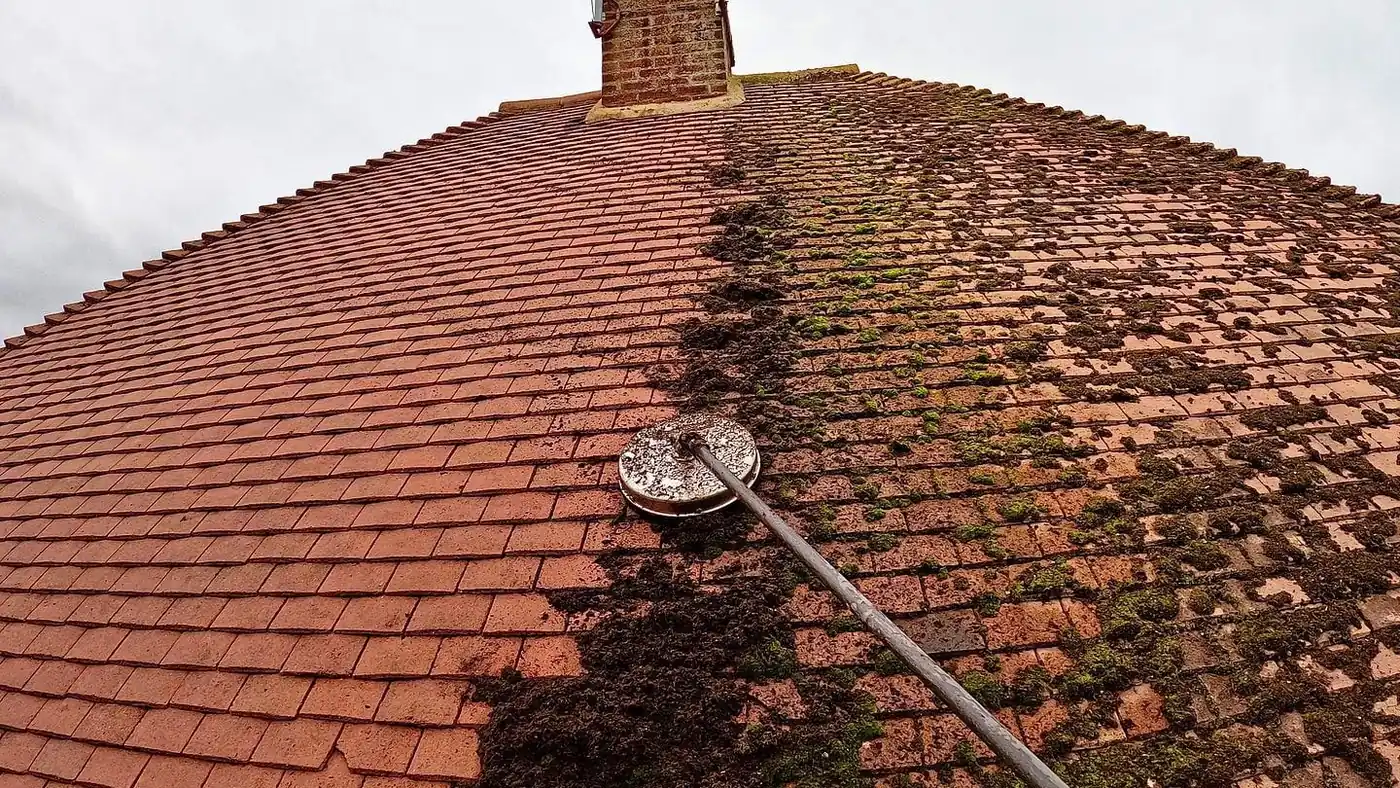
- Slowing moss coming back after cleaning
- Moss returning after a clean
- Light moss starting to show
Common questions in Hook End
How does a conservation area in Hook End affect roof biocide treatment?
For cleaning, very little changes, though we keep to gentle methods; a coating or anything that alters the roof’s look is one to check with Brentwood council. The nearest to Hook End is the Blackmore conservation area, about 1.3 miles north-east of the centre of Hook End.
Do you cover smaller places like Hook End?
Yes. Small places get the same service as large ones, and Hook End is on our list. Let us know about access, parking and narrow lanes when you book.
Does maintenance matter for my home insurance?
Many home insurance policies exclude gradual damage and wear and tear, so regular maintenance matters. The wording of your own policy is what counts.
How do you choose the method?
It depends on the surface and its condition. Clay, slate and older tiles are cleaned by hand or at low pressure, robust concrete tiles may take controlled pressure after a check, and solar panels get soft brushes and clean water. We explain our choice before you book.
Can you treat the roof without cleaning it first?
That comes down to the build-up. Thick moss stops the biocide reaching the tiles and falls away slowly once it’s dead so we remove it by hand before treating, while lighter growth can simply be treated.
Do you belong to any trade schemes?
Yes. We are a member of Checkatrade, so you can look us up there. On top of that, we are fully insured.
What is a biocide treatment for roofs?
It treats the growth rather than removing it by force. It’s ideal for lichen, which is hard to remove safely by hand and helps keep a cleaned roof clearer.
Are the products you use a risk to pets and plants?
Not each job uses chemicals: solar panels, for example, are cleaned with soft brushes and clean water. Where a biocide is part of the job, it’s one approved or authorised for this use in Great Britain, applied as the label says. We’ll let you know how long to keep pets off treated areas.
About our roof biocide treatment in Hook End
Cleaning takes growth off a roof; a biocide treatment helps keep it off. The treatment reaches the spores and traces of growth that hand removal leaves behind, and slows regrowth. It isn’t permanent, typically lasting around one to a few years, depending on shade and aspect. The work covers tile and slate surfaces, ridge and hip tiles and algae and black streaks, and people most often call us about a north-facing slope that greens up fast and clinging growth that would mark the tiles if scraped.
Some homes in villages like Hook End are listed or in a conservation area, and if yours is one of them, gentle methods matter even more. For anything beyond cleaning, such as a coating, the council’s conservation officer is the person to ask first.
Nothing about the guarantee is left to memory. Every job comes with a written 12-month workmanship guarantee, covering the work we carried out. Keep it somewhere safe for reference.
- Location
- Hook End (CM15)
- Region
- Essex
- Our guarantee
- 12-month workmanship guarantee, in writing
- Quotes
- A fixed price before work begins
- Track record
- Two decades in the trade, fully insured
- Phone
- 01342 344 936
- Checked
- 30 October 2026
Keeping it in good shape
A yearly look from the ground goes a long way. On top of that:
- Follow our advice on keeping pets and children away until dry
- Check gutters after heavy rain
- Don’t rinse the roof after treatment
- Check the roof annually
Lichen takes longest to go. It’s killed by the treatment but stays attached for a while before rain and weather take it away. It’s better than scraping it off.
Plan a retreat before growth gets thick. Light regrowth is quick and simple to deal with, while letting it build up means a full clean.
Roofs in Hook End: local notes
Waterworks Spring, roughly 0.9 miles south of Hook End, is the nearest of about 12 ancient woods within a couple of miles of Hook End. Homes near woodland like this tend to get more shade and leaf litter, and moss grows best on damp, shaded roofs. Among the historic houses near Hook End is Ingatestone Hall, roughly 4.1 miles east of Hook End. Buildings like that show how long clay and slate roofs can last when they are looked after. Hook End is about 21 miles from central London, well inside the area where we carry out roof biocide treatment across London and the South East. Every job carries a 12-month workmanship guarantee in writing.
Living close to Doddinghurst Infant School can mean parked cars and crowds at the start and end of the school day. A quick note about it when you book helps us plan where to unload.
Hook End is about 4 miles north of Brentwood, in Essex. Whatever kind of property you have in Hook End, we can take on roof biocide treatment. One number covers every area we work in, so booking is simple. 644 places in Essex are on our list, from busy towns to small villages. There’s also a page for London, about 21 miles away.
Every address in CM15 is covered for roof biocide treatment, from busy streets to back roads. Local streets include Hook End Lane, Tipps Cross Lane and St Georges Close, and we cover them all for roof biocide treatment. Nearby, we also carry out roof biocide treatment in Stondon Massey (1 mile north-west), Paslow Wood Common (1 mile north), Kelvedon Hatch (1 mile south-west), Doddinghurst Common (2 miles south-west) and Crow Green (2 miles south). Further out, we also cover Chelmsford (9 miles north-east), Basildon (10 miles south-east), Harlow (10 miles north-west), Brentwood (4 miles south), Billericay (6 miles south-east) and Rayleigh (14 miles south-east).
What’s near Hook End
The nearest railway station is Shenfield station, about 3.5 miles south-east.
What we are called out for in Hook End
Hand removal can’t catch every spore. Fragments sit in the pits and pores of the tile surface, ready to grow again. That’s why a treatment after cleaning helps.
Keep an eye out for any of the following:
- A roof cleaned a few years ago that needs retreating
- Lichen on clay or slate
- Regrowth since the roof was last cleaned
- Crusty grey and yellow lichen
If you live near Church of All Saints, or on any of the older streets in Hook End, your roof may be clay or slate, which is cleaned gently by hand.
Comparing quotes
- If the quote is a fixed price or an estimate
- How they’ll handle anything unexpected
- How they’ll keep drains, plants and paths protected
- Whether the workmanship is guaranteed in writing
What affects the quote in Hook End
We look at the job before pricing it. The main factors are:
- Combining work, like the roof and the gutters
- How heavy the growth or dirt is
- What’s below the work area
- The height and pitch, where the work is above ground
Where the work is at height, access can make a big difference. If a tower, scaffold or powered access is needed, it goes into the quote, and we explain why it’s needed.
What to send for a quote
When you get in touch, it’s useful to have:
- The address and the type of property
- How we’d get to the work, such as a side passage or back garden
- A wide photo of the whole roof or area, taken from the ground
- If the property is listed or historic
Here’s what helps us quote: where the property is and what you’d like done, a few photos from the ground and any past work you know about, like a previous clean or a repair. Then reach us by phone on 01342 344 936, or use the quote form.
Towns and villages near Hook End
What else we do in Hook End
Part by part
Concrete tiles
Concrete tiles often carry black algae streaks and moss in the interlocks. The interlocks are cleared by hand, then the biocide is applied so it gets to the surface.
Natural slate
Heavy moss on slate is hand-brushed first. The biocide then deals with the rest and slows regrowth.
What happens if it’s left?
Scraping lichen and treating it give very different results. Because it bonds to the tile, scraping can damage it, while a biocide kills it and lets it weather off over time. Where trees and hedges keep things shaded, growth returns faster, so regular care matters more.
A single home or a handful of properties, the quote is built the same way: what needs doing, how we reach it and how long it takes. You will have a fixed price before work begins.
Why book with us
- Each job backed by a written guarantee on our workmanship for 12 months
- Covering London and the South East
- Gentle methods first, pressure only where the surface can take it
- 20 years’ experience
How the job works
If the job involves water, the run-off is controlled. We do not let sludge, dirty water or biocide wash into the surface water drains, as surface water drains lead straight to the environment. On site, it takes part of a day for many homes, depending on the size of the roof and the access. Access to the back garden decides where ladders or a tower go.
- We check whether a treatment alone will do, or the roof needs a clean first.
- The price is fixed and the date chosen for dry weather.
- We protect drains and gullies first.
- We hand-clear thick moss before treating at low pressure.
- We clear up and go through anything you need to know.
How to prepare
- Mention any nests you know about
- Tell us about any conservatory, glass roof or extension below the work
- Unlock any gates we will need to get through
Get a fixed quote
Want a quote for roof biocide treatment? Please pick up the phone and call 01342 344 936, or use the quote form and tell us about the property. We will explain the method we’d use and give you a fixed quote before anything is booked.
Related advice
Can I do it myself?
Shop-bought moss treatments are an option for some surfaces, but only use one authorised for that job and follow the label to the letter. On a roof, applying it carries the same height risks as any roof work, and it must be kept away from drains and ponds.
Hard paving at ground level is a reasonable DIY job, and that’s fine. Just watch where the water goes: surface water drains run straight to the environment, so dirty water and cleaning products shouldn’t go down them.