Greater London · Biocide roof treatment
Biocide roof treatment in Holywell, Greater London
Careful roof biocide treatment for Holywell: a look at the job, a fixed price, the right method and a proper clear-up. Ask us for a fixed quote.
- Growth on delicate tiles that cannot be jet washed
- A shaded slope that turns green quickly
- Clinging growth that would mark the tiles if scraped
Roof biocide treatment for homes in Holywell
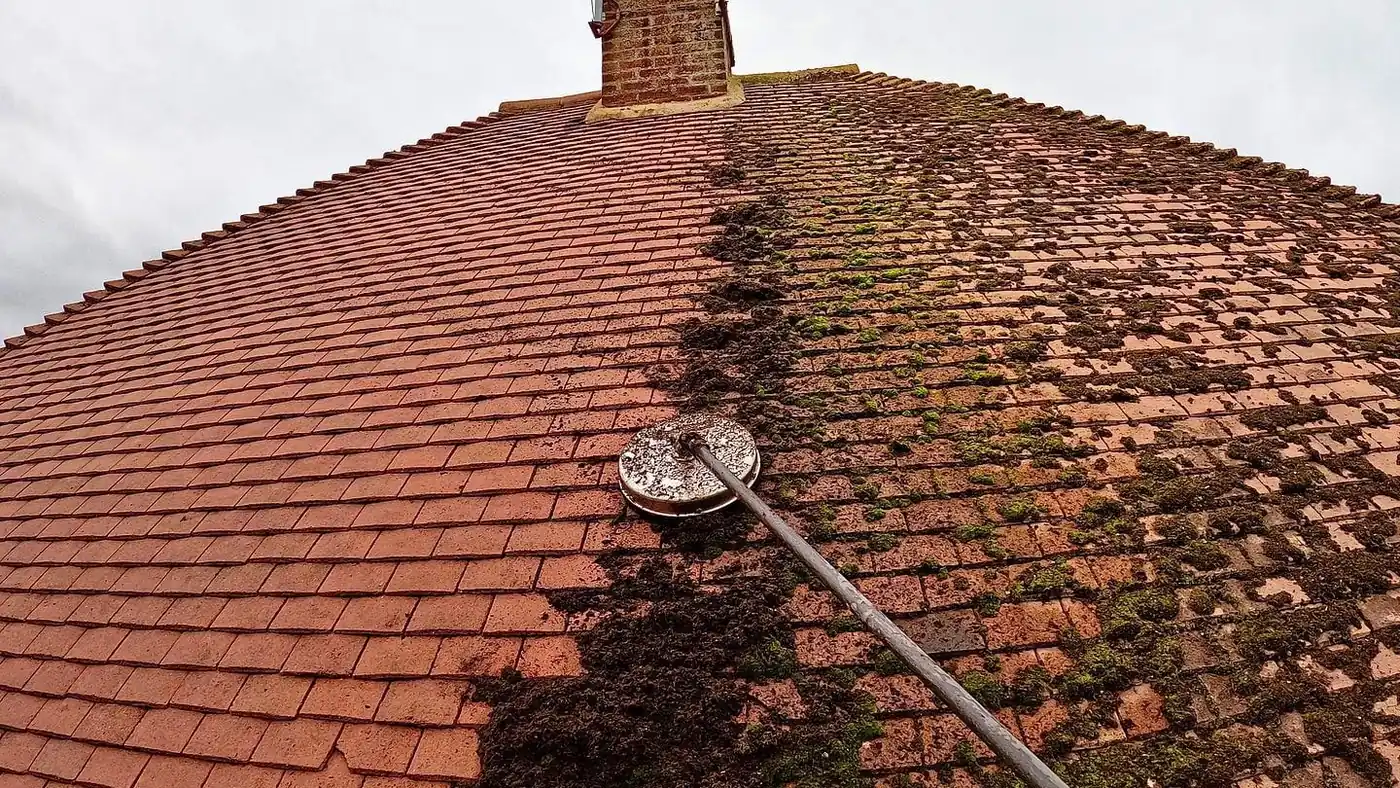
Is your roof in Holywell showing lichen, algae or the first signs of moss? Tell us what you can see when you talk to us on 01342 344 936, or use the quote form and we will recommend the right approach before fixing the price. We’re often asked to deal with small tufts of moss on the tiles and growth on delicate tiles that can’t be jet washed, across lichen patches, algae and black streaks and tile and slate surfaces.
London streets are full of terraces and conversions, many with a pitched front slope, a hidden valley roof behind the parapet and a mansard or dormer added later. If your home in Holywell is one of them, moss and debris tend to collect in the valleys and gutters you cannot see from the street. So the job is planned around every slope, not only the one on show.
We’ve got 20 years’ experience, and we stand behind what we do: each job carries a 12-month workmanship guarantee in writing. We are fully insured and members of Checkatrade.
- Where
- Holywell (WD18, WD3, WD99)
- Wider area
- Greater London
- Guarantee
- 12 months on workmanship, in writing
- Quote
- A fixed quote up front
- Background
- 20 years’ experience, fully insured
- Telephone
- 01342 344 936
- Reviewed
- 30 October 2026
What a clean won’t put right
A few issues sit outside what this work can do:
- Colour lost over the years
- Keeping growth away permanently (it slows regrowth; it is not permanent)
- Heavy moss cushions
Not sure which it is? You can talk to us on 01342 344 936, or use the quote form and we will tell you honestly.
What we clean
- Lichen patches
- Algae and black streaks
- Roofs cleaned by hand
- Ridge and hip tiles
- Tile and slate surfaces
- Shaded roof slopes
Aftercare tips
To keep things in good shape between visits:
- Let the biocide stay on the tiles
- Check the roof annually
- Keep gutters running freely
- Never scrape lichen yourself
The treatment slows regrowth, typically for around one to a few years, depending on shade and aspect. Check the roof once a year and retreat when the first signs come back.
Copper strips or sacrificial lead at drip points can inhibit growth, the SPAB notes. Rain carries a trace of the metal down the tiles, which can slow regrowth.
Can I do it myself?
Scraping moss off sounds simple, but technique matters. Lichen in particular clings hard, and forcing it off can mark the tile surface, which is why it’s typically treated and left to weather away. Leave the roof to someone with the right access.
It’s tempting to hire a jet washer for the roof, but it isn’t a good idea. Roof tile makers’ guidance advises against high-pressure washing, as it can damage the surface, strip colour from concrete tiles and drive water under the laps.
Roof biocide treatment in Holywell: the local picture
There are about 13 conservation areas within a couple of miles of Holywell, the nearest being the Square conservation area, about 1 mile north-east of the centre of Holywell. For homes in a conservation area, we keep to gentle cleaning, and anything that alters the roof’s appearance, such as a coating, is one to check with Watford council first. On a London terrace, the roof is often shared at the edges, so moss and run-off are kept out of next door’s gutter. Historic buildings nearby include High Elms Manor, some 4.1 miles north of Holywell. Houses of that age are a reminder that clay and slate roofs can last a very long time with care.
Around King George V Playing Fields, less than half a mile from the centre of Holywell, gardens often border trees and hedges, and that brings shade. Leaves on the tiles and in the gutters hold damp, and moss thrives on damp. Roads near schools such as Westfield Academy can be busy at drop-off and pick-up. It’s worth a mention when you book, as the van and ladders need space outside. Around Watford High Street station, roughly 1.4 miles east of Holywell, terraces and commuter homes can be short of parking, so a word about parking when you book helps us plan.
Holywell is about 2 miles south-west of Watford, in Greater London. We treat roof biocide treatment in Holywell the same as anywhere in Greater London: a fixed price first, careful work, a full clear-up and a written 12-month guarantee on our workmanship. Holywell is one of 764 places in Greater London where we work for roof biocide treatment. There’s also a page for London, about 17 miles away.
Postcode districts we cover here for roof biocide treatment: WD18, WD3 and WD99. If you need roof biocide treatment at a property on Epsom Road, Combe Road and Ascot Road or a nearby road, we can take on the work. You’ll find Holywell on the A4145, so it’s easy for us to get to for roof biocide treatment. Neighbouring places we cover for roof biocide treatment include Croxley Green (1 mile west), Colney Butts (1 mile east), Cassiobury (1 mile north-east), Moor Park (2 miles south) and Eastbury (2 miles south). Within a short drive, we also cover City of Westminster (15 miles south-east), Marylebone (15 miles south-east), Kensington (14 miles south-east), Hampstead (12 miles south-east), Ruislip (5 miles south) and Brompton (15 miles south-east).
Around Holywell
Properties near King George V Playing Fields, Croxley Danes School and The Red House fall within our area as well. The closest station to Holywell is Watford High Street station, roughly 1.4 miles east. Well-known places in the area include Hilfield Castle (3.9 miles east) and Hertfordshire Fire Brigade Museum (1.5 miles east). Not far away are Tumbling Bay and Chorleywood Common.
What we do, step by step
Where the work is near a shared boundary, we take the same care on their side, and it helps to let them know beforehand. Windows, cars and paths close by are covered or kept clear of splashes. The job takes part of a day for many homes, depending on the size of the roof and the access. London streets can be tight, so details of parking near your home in Holywell help us plan the day.
- We check whether a treatment alone will do, or the roof needs a clean first.
- You get a fixed quote and a date planned around the weather.
- Gullies and drain outlets are protected so nothing reaches surface water drains.
- We hand-clear thick moss before treating at low pressure.
- We clear up and go through anything you need to know.
Helping the day go smoothly
- Keep pets indoors while we work
- Mention any problems you’ve noticed
- Make sure we can get to the side and back of the property
How to get a quote
Want a quote for roof biocide treatment? Please send details through the quote form or call us on 01342 344 936 and tell us about the property. We’ll explain the method we’d use and give you a fixed quote before you commit to anything.
Advice
What affects the quote in Holywell
There’s no set price list, because properties vary so much. What we look at:
- The access the job needs, from ladders to scaffold
- Height and roof pitch
- Which method we use
- Where we can park and unload
For work at height, access is a big part of the price. Anything beyond ladders, such as a tower, scaffold or powered access, is built into the quote, and we tell you why.
Photos for a quote
What to send for a quote:
- The parts that bother you most, zoomed in if your phone allows
- Where the property is and whether it’s a house, bungalow or flat
- A wide photo of the whole roof or area, taken from the ground
- Any listing you know about
The quickest way to a quote is often a few pictures: a wide shot of the whole area, a closer one of the worst part and one showing how we’d get to it. Please take them from the ground, never from a ladder.
Common questions in Holywell
Do I need a permit or licence for work at my home in Holywell?
That depends on access. Equipment on the pavement may need a licence from the council, and a parking permit or bay suspension may be needed for the van. We’ll talk this through when we quote.
Who should I ask about a listed home in Holywell?
Holywell comes under Watford council. Its planning or conservation team can tell you whether your home is listed or in a conservation area. For listed homes, the council’s conservation officer is the person to ask before anything beyond gentle cleaning.
How long does a biocide treatment take?
That depends on the size of the roof and the access. As a guide, it takes a few hours to apply on most roofs, and the growth keeps dying back afterwards.
How does a roof biocide work?
It treats the growth rather than removing it by force. It’s ideal for lichen, which is hard to remove safely by hand and helps keep a cleaned roof clearer.
How do you decide on the method?
The gentlest method that does the job is always our starting point. That might be hand scraping and brushing, a low-pressure soft wash with biocide, steam, or controlled pressure on robust surfaces, depending on what we find.
Can I do it myself?
For anything at height, we’d say no. HSE says almost one in five deaths in construction work involve roof work, and HSE advises treating all roofs as fragile. Ground-level jobs, like a patio, are a different story.
How do you protect the garden during treatment?
We protect plants, paths and drains below and follow the label’s precautions. Run-off is controlled and kept out of surface water drains, and we will tell you how long to keep pets and children off treated areas.
Will my insurer care about maintenance?
It can. Insurers can exclude damage that happens gradually or through wear and tear, so looking after the roof, gutters and walls is sensible. Your own policy is what decides it, or ask your insurer directly.
What happens if it’s left?
Cleaning and treating do different jobs. Cleaning removes the growth you can see and the treatment deals with spores and slows it coming back. Many roofs benefit from both. On a London home, replacing anything outside can mean permits and scaffold, which makes regular care the easier option.
Whatever the property, the quote works the same way: the size of the job, the access, the condition and the method. Call for a fixed quote and we’ll explain each part.
What you get with us
- A Checkatrade member
- Sludge and dirty water kept out of surface water drains
- One number for London and the South East
- Biocides approved or authorised for this use in Great Britain, as the law requires
Different parts, different methods
Historic and listed roofs
On a historic roof, a low-pressure treatment is one of the gentler options. We still check the roof closely first and avoid scraping old surfaces.
Concrete tiles
Rough, weathered concrete holds spores well. A treatment after cleaning slows that, typically for around one to a few years, depending on shade and aspect.