Surrey · Biocide roof treatment
Biocide roof treatment in Heath End, Surrey
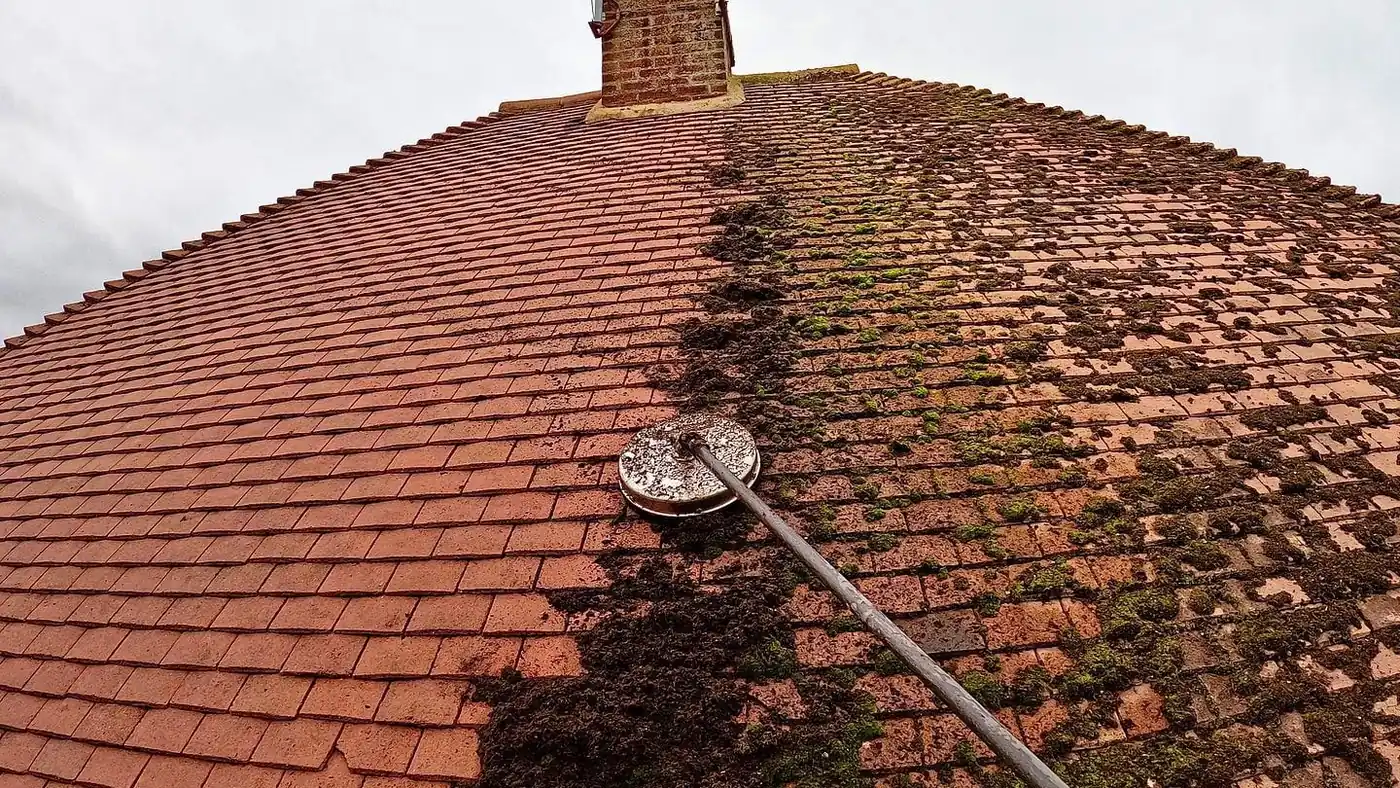
Biocide roof treatment to kill remaining moss, algae and lichen spores and slow regrowth for Heath End, quoted at a fixed price before any work. Fully insured, with a written 12-month guarantee on our workmanship.
- A roof greening up
- Algae on an older roof
- Moss returning after a clean
For landlords and letting agents
Who looks after the roof and gutters is normally set out in the tenancy agreement or lease. We can quote either party, and we will tell whoever books us what we found.
Landlords, letting agents and property managers book us as well as homeowners. If a tenant lives there, we can agree access with them or through you, as suits you.
About our roof biocide treatment in Heath End
Has the roof started to green up or collect lichen? Tell us what you can see when you use the quote form or give us a call on 01342 344 936 and we will recommend the right approach, with a fixed quote. We are often asked to deal with regrowth since the roof was last cleaned and bright lichen patches on ridge and hip tiles, on shaded roof slopes, algae and black streaks and ridge and hip tiles.
Some homes in villages like Heath End are listed or in a conservation area, and if yours is one of them, gentle methods matter even more. Cleaning does not change how a roof looks, but a coating or a change of tiles can, so check with the council before anything like that.
Every job is backed by a 12-month written guarantee covering our workmanship, set out on paper. It covers our workmanship, and we carry full insurance too.
- Place
- Heath End (GU9)
- Wider area
- Surrey
- Cover
- A written 12-month guarantee on our workmanship
- Price
- Fixed price, set before we begin
- Track record
- Checkatrade member, fully insured
- Phone
- 01342 344 936
- Page updated
- 30 October 2026
Doing it yourself: an honest view
A pressure washer from a hire shop might look like a quick fix for the roof. Tile manufacturer guidance warns against high-pressure jet washers on roofs, as it can damage the surface, strip colour from concrete tiles and drive water under the laps.
Please don’t walk on the tiles. Weight on a tile can leave hairline cracks that are not visible, and frost can open those cracks up over the following winters. Proper access, planned to suit the roof, avoids that.
FAQs for Heath End
Does a conservation area in Heath End change anything about roof biocide treatment?
It mainly matters for changes, not cleaning: a coating or new tiles alter how the roof looks, so check those with Waverley council. The nearest to Heath End is the Shepherd and Flock conservation area, about 1.2 miles south of the centre of Heath End.
Do you work in villages like Heath End?
Yes. Heath End is within the area we cover across London and the South East. A few photos and directions help us plan the visit.
What happens to the waste?
We collect it and take it with us. Moss, leaves and debris are gathered as the work goes on, so it doesn’t end up in gutters, drains or borders.
Do you control the run-off?
Dirty water and sludge are kept away from the surface water drains. Those drains carry water straight to the environment, not to a treatment works, so only clean water belongs in them.
What about plants and pets during treatment?
We take care of what’s underneath the roof. Plants, paths and drains are protected, and run-off is controlled, with nothing allowed into surface water drains. You will get clear advice on keeping pets and children clear.
Is it safe to do it myself?
It depends on the job and the height. Paving at ground level is a reasonable DIY job, if you keep the run-off out of surface water drains, while roofs, high gutters and solar panels are best left to us.
Will you need scaffold or a tower?
Not for each job. Every roof is treated as fragile until it’s confirmed otherwise, so we plan safe access before anything else, as the Work at Height Regulations 2005 require.
What if birds are nesting nearby?
Active nests are protected under the Wildlife and Countryside Act 1981, so we check before working near gutters, eaves and roof spaces. Let us know if you’ve noticed birds nesting when you book.
Signs you need roof biocide treatment in Heath End
Shaded, slow-drying slopes regrow fastest. Slopes out of the sun dry slowly and they need treating most often.
Most people get in touch after spotting one of these:
- Lichen spots across the tiles
- Black lines on the tiles
- Lichen best left to a treatment rather than a scraper
- Algae on an older roof
If you live near Aldershot station, roughly 1.4 miles north-east of Heath End, on-street parking may be busy in the day, which is worth mentioning when you ask for a quote.
Questions to ask before booking
- If the quote is a fixed price or an estimate
- Whether any biocide used is authorised in Great Britain for the job
- How long their workmanship guarantee lasts
- How they’ll clean without damaging the tiles or surface
Towns and villages near Heath End
What else we do in Heath End
What happens on the day
The day runs to the same pattern every time: cover and protect what’s nearby, set up the access the job needs, carry out the roof biocide treatment, tidy everything away and remove what we have cleared. The job itself takes part of a day for many homes, depending on the size of the roof and the access. Mention ponds, greenhouses or anything fragile near the work.
- We look at the roof to see whether it needs a clean before treatment.
- We fix the price and agree which slopes are treated.
- We plan the day around the weather, since the biocide needs a dry spell to work.
- We protect the area below and apply the biocide by soft wash.
- You’re told how the treated growth will weather off over time.
How to prepare
- Keep pets indoors while we work
- Clear pots, furniture and washing lines from the area
- Close windows, doors and roof lights near the work
How to get a quote
There’s no standard price list, because every job is different. We look at yours first, from pictures or on a visit, then send you a fixed quote. To get going, speak to us on 01342 344 936 or send details through the form on our contact page.
Related advice
Roof biocide treatment in Heath End: the local picture
There are about 4 areas of ancient woodland within two miles of Heath End, the nearest being Outridden Copse, about 1.6 miles north-west of Heath End. Tree cover means shade, and shade means moss, so a roof near woods may need cleaning more frequently. With central London about 35 miles off, Heath End is one of the many South East places on our list for roof biocide treatment. We have 20 years’ experience and are fully insured. Older buildings in the area include Farnham Castle, roughly 1.4 miles south-west of Heath End. Old roofs like those last because they are maintained, and gentle cleaning is part of that.
Older homes, like many found near churches such as St Mark the Evangelist Church, often have clay tiles or slate that call for a gentle approach. Places like Weybourne LNR, roughly 0.7 miles south-east of Heath End, can bring trees and birds close to the houses around them. Moss grows fastest on shaded, damp slopes.
Heath End is about 1 mile south-west of Aldershot, in Surrey. Whatever kind of property you have in Heath End, roof biocide treatment is something we can help with. The same phone number covers our whole area, so booking is simple. Heath End is one of 395 places in Surrey where we work for homeowners and landlords. You can also see our page for Guildford, roughly 9 miles from Heath End.
We cover every part of GU9 for roof biocide treatment and the roads nearby. If you need roof biocide treatment at a property on Farnborough Road, Alma Way and The Fairway or a nearby road, we can take on the work. Nearby, we also carry out roof biocide treatment in Upper Hale (1 mile west), Hale (1 mile south), Weybourne (1 mile east), Badshot Lea (1 mile south-east) and Aldershot (1 mile north-east). Within a short drive, we also cover Guildford (9 miles east), Woking (11 miles north-east), Camberley (7 miles north), Frimley (6 miles north-east), Haslemere (11 miles south) and Cranleigh (15 miles south-east).
What’s near Heath End
Roofs on the roads around The Six Bells pub, Weybourne LNR and Prince Consort's Library are all part of the area we cover. The closest station to Heath End is Aldershot station, roughly 1.4 miles north-east of the centre. Nearby you will also find Hart Shopping Centre (3.9 miles north-west) and Museum of Farnham (1.8 miles south-west). Green spaces nearby include Aunt's Pool and Rowhill Nature Reserve.
What affects the cost of roof biocide treatment
Every job gets its own quote. These are the things that affect it:
- Combining work, like the roof and the gutters
- Any extra work added to the job
- The amount of build-up
- Which method we use
You will not find a price list here, because each job is priced on what it involves. Call for a fixed quote, and we’ll talk you through it.
Asking for a quote
When you get in touch, it’s useful to have:
- Shots of the heaviest build-up
- A wide photo of the whole roof or area, taken from the ground
- Whether the building is listed
- The postcode and the kind of building
Getting a quote doesn’t take long. Tell us about the job, add a few pictures if you can, and we will give you a fixed price. If we need to see it first, we will arrange a visit.
Between visits
How long the results last depends on shade, damp and care. Here’s what we suggest:
- Check gutters after heavy rain
- Follow our advice on keeping pets and children away until dry
- Cut back overhanging trees
- Never scrape lichen yourself
Keep pets and children off treated areas until they’re dry, as we’ll advise on the day. We follow the label’s guidance, and we’ll go through it with you.
Copper strips or sacrificial lead at drip points can inhibit growth, the SPAB notes. Traces of metal wash down the slope with the rain, which can slow regrowth.
How the job changes from site to site
Fibre cement slates
We look at fibre cement slates first. Older fibre cement slates may contain asbestos and need a careful, low-impact approach and we will give you honest advice.
Concrete tiles
Older concrete tiles regrow quickly. A treatment after cleaning slows that though it isn’t permanent.