Kent · Biocide roof treatment
Roof Biocide Treatment in Hammill Park
We cover Hammill Park for roof biocide treatment. The gentlest method that does the job, a fixed quote and a 12-month workmanship guarantee in writing with each job.
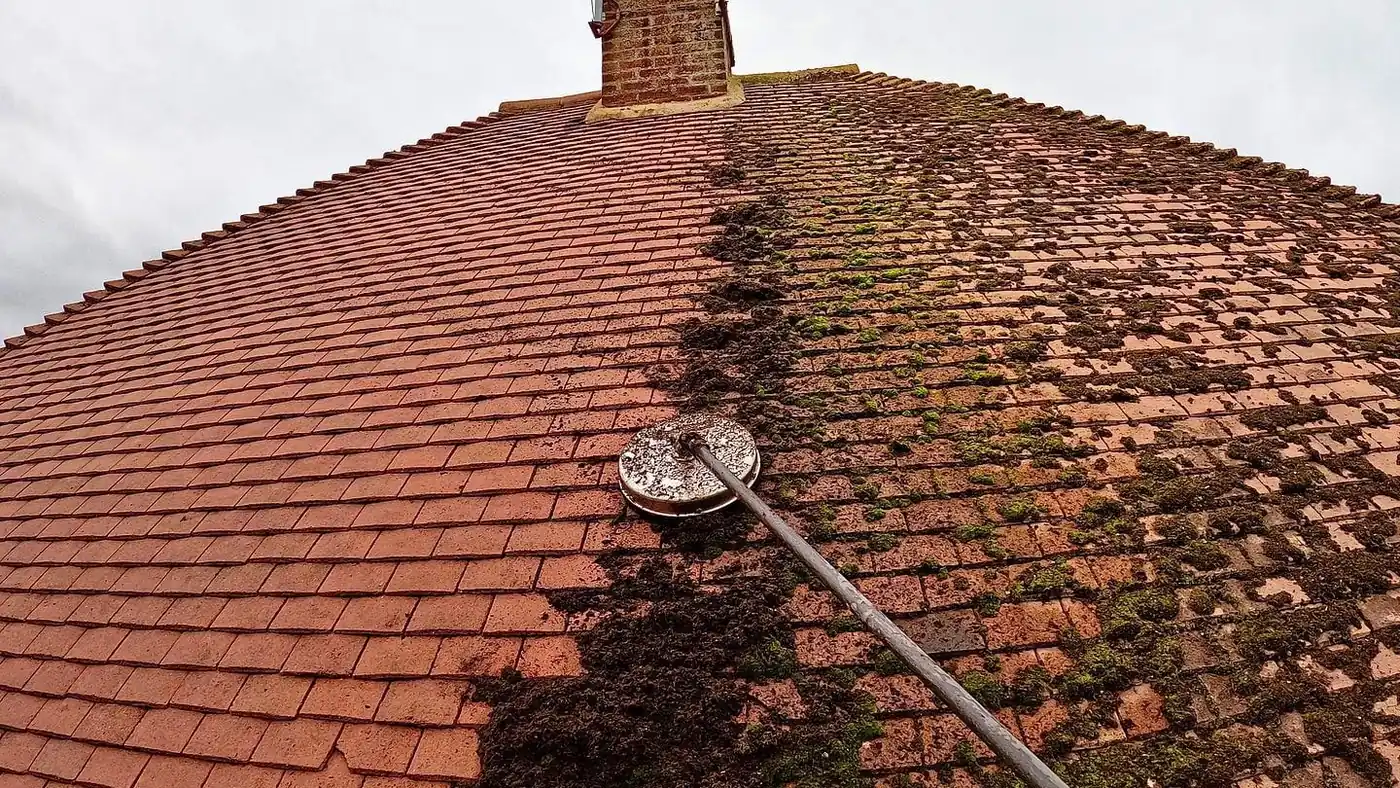
- Green algae on the roof
- Crusty grey and yellow lichen
- Black lines on the tiles
About our roof biocide treatment in Hammill Park
With 20 years’ experience, we’re straightforward about what a biocide can do. It slows regrowth; it isn’t permanent and dead growth takes time to weather away. We’re fully insured, a Checkatrade member and give a 12-month workmanship guarantee in writing. We’re often asked to deal with lichen best left to a treatment rather than a scraper and light moss starting to show, on roofs cleaned by hand, tile and slate surfaces and algae and black streaks.
In a rural spot like Hammill Park, access may mean a long drive, a narrow lane or a gate to get through, so tell us about the route and where we can park when you book. Mature trees around a home in a village like Hammill Park tend to mean heavier moss and fuller gutters.
We have 20 years’ experience in this work, and we are happy to put our name to it: every job carries a written 12-month workmanship guarantee. We are fully insured and members of Checkatrade.
- Location
- Hammill Park (CT13)
- Region
- Kent
- Our guarantee
- A written 12-month guarantee on our workmanship
- Quote
- One fixed price, quoted in advance
- Track record
- Checkatrade member with 20 years’ experience
- Phone
- 01342 344 936
- Page updated
- 30 October 2026
Honest limits
Before you book, it helps to know what’s not included:
- Keeping growth away permanently (it slows regrowth; it is not permanent)
- Weathering from age
- Deep moss in the interlocks
Not sure which it is? You can get in touch by phone on 01342 344 936, or by the quote form and we’ll tell you honestly.
Surfaces we cover
- Roofs cleaned by hand
- Tile and slate surfaces
- Shaded roof slopes
- Ridge and hip tiles
- Lichen patches
- Algae and black streaks
More services for Hammill Park
Why it’s worth doing now in Hammill Park
Cleaning and treating do different jobs. Hand removal takes off the moss on the day, while a biocide kills what’s left and slows regrowth. They work best together. Moss and algae hold water, and that is the start of most problems.
Where the work is at height, access can make a big difference. If a tower, scaffold or powered access is needed, it goes into the quote, and we tell you why.
Why book with us
- Access planned to suit the property
- We take the waste with us
- A Checkatrade member
- We have 20 years’ experience
See how roof cleaning is priced or how we choose the method.
Part by part
Historic and listed roofs
Historic coverings need care. We avoid walking on old tiles, and we will point out anything that needs a roofer.
Fibre cement slates
Fibre cement is easy to mistake for slate. We confirm the material before starting, since older fibre cement may contain asbestos.
Common questions in Hammill Park
Is Hammill Park within the area you cover?
Yes, smaller places are covered as well as towns. A few photos and directions help us plan the visit.
Does tree cover around Hammill Park affect roof biocide treatment?
Typically, yes. Home Wood, an ancient wood, is some 1.5 miles south-west of Hammill Park. Shade keeps a roof damp, and moss grows best on damp, shaded slopes, so roofs under trees may need cleaning more frequently.
Do you tell me about problems you spot?
You are told straight away. We never add work without asking, and any repair gets its own fixed quote. That way, the price you agreed for the original job doesn’t change.
Are you fully insured?
Yes, fully. We’re also a Checkatrade member and have 20 years’ experience.
What about my pets and plants?
Pets and plants are something we always plan for. Where a biocide is used, it’s one approved or authorised for this use in Great Britain, applied as the label says, and plants below are protected. Please keep pets indoors on the day.
Do you use a pressure washer?
Sometimes, after checking the surface. Most hard paving, and robust concrete tiles in good condition, can take controlled pressure; clay tiles, slate, older or fragile tiles and solar panels can’t. We will tell you which method we’d use before you book.
How do you choose the method?
We use the gentlest method that will do the job. That might be hand scraping and brushing, a low-pressure soft wash with biocide, steam, or controlled pressure on robust surfaces, depending on what we find.
What precautions do you take with the biocide?
We take care of what’s underneath the roof. Plants, paths and drains are protected, and run-off is controlled, with nothing allowed into surface water drains. We will advise on pets and children on the day.
Landlords, letting agents and property managers
Where a building is shared, such as a block of flats, outside work is often arranged by the freeholder or managing agent. We can quote for the whole building and deal with whoever is in charge.
Letting agents and property managers can book with us directly. Tell us the property, the work and the access arrangements, and we’ll give you a fixed quote.
What’s safe to do yourself
Some jobs are fine to do yourself, from the ground: check the roof from the garden each year, keep paths and gullies clear of fallen moss and watch how the gutters cope in heavy rain. Anything at height is best left to a professional.
For a quick check from a ladder, make sure it’s on firm, level ground, footed or tied, and do not overreach. Don’t climb from the ladder onto the roof, and don’t work at height alone.
Looking after it afterwards
After the work, a few habits help it last:
- Look for regrowth on the shady slope once a year
- Trim branches that shade the roof
- Do not rinse the roof after treatment
- Retreat when regrowth first appears
The site is left tidy: sheeting is removed and the ground cleaned, with nothing sent into surface water drains.
Copper strips or sacrificial lead at drip points can inhibit growth, the SPAB notes. Traces of metal wash down the slope with the rain and that can discourage moss and algae.
Step by step
We arrive at the time agreed with you and take a look around before anything else. Before work begins, we protect what’s around and below the work, such as plants, paving, windows and cars. On site, the job takes a few hours on the day, while the treated growth weathers away over the following months. Tell us if anything blocks access to the work, from a gate to a parked car.
- We look at the roof to see whether it needs a clean before treatment.
- We fix the price and agree which slopes are treated.
- The date is set for dry weather, following the label.
- After protecting what’s below, we apply an authorised biocide gently.
- You’re told how the treated growth will weather off over time.
A few things to sort first
- Let us know where we can park
- Clear pots, furniture and washing lines from the area
- Move cars off the drive and away from the work
Get a fixed quote
The quickest way to a quote is often a few photos: the whole area, the worst patches and the way in. There’s no need to climb anything; the garden or an upstairs window is fine.
Related advice
Roof biocide treatment in Hammill Park: the local picture
Ancient woodland is a feature around Hammill Park: about 5 areas lie within two miles, the closest being Home Wood, roughly 1.5 miles south-west of Hammill Park. Tree cover means shade, and shade means moss, so a roof near woods may need cleaning more frequently. Among the historic houses near Hammill Park is Goodnestone Park, about 2.6 miles west of Hammill Park. They’re proof that a roof treated gently can stay in good order for a very long time.
Streets near a church such as Church of St Mary the Virgin often include older homes, and older clay or slate roofs need hand cleaning rather than pressure. Places like Monk's Wall nature reserve, roughly 2.9 miles north-east of Hammill Park, can bring trees and birds close to the houses around them. Shade slows how quickly a roof dries, and a roof that stays damp suits moss. Homes on school roads, near Eastry Church of England Primary School for example, can face busy mornings and afternoons. If that’s your street, mention it, and the ladders can go up before the road fills.
Hammill Park is about 5 miles north-west of Deal, in Kent. From the centre of Hammill Park to the outskirts, roof biocide treatment is available for all kinds of property, from bungalows to large family homes. Across Kent, we cover 922 places, and Hammill Park is one of them. You can also see our page for Maidstone, roughly 33 miles from Hammill Park.
We cover every part of the CT13 postcode area for roof biocide treatment and the streets around it. Local streets include Elizabeth Drive and Colliery Lane, all of which we cover for roof biocide treatment. Other places close to Hammill Park include Flemings (1 mile north), Heronden (1 mile south), Barnsole (1 mile north-west), Coombe (1 mile north) and Staple (1 mile north-west). Larger places within reach include Canterbury (9 miles west), Margate (10 miles north-east), Dover (8 miles south), Folkestone (13 miles south-west), Ramsgate (8 miles north-east) and Broadstairs (10 miles north-east).
Near you in Hammill Park
Properties near Sandwich Technology School are covered too, along with the rest of Hammill Park. Hammill Park’s nearest station is Sandwich station, about 2.7 miles north-east. Other landmarks nearby include White Mill (2.6 miles north-east). Not far away are Monk's Wall nature reserve.