Hampshire · Biocide roof treatment
Fareham Common roof biocide treatment
Biocide roof treatment to kill remaining moss, algae and lichen spores and slow regrowth for homeowners, landlords and letting agents in Fareham Common. Checkatrade members with 20 years’ experience, fully insured.
- Black streaks down the slopes
- Growth on tiles too fragile to scrape hard
- Slowing moss coming back after cleaning
Roof biocide treatment in Fareham Common, done properly
With 20 years’ experience, we are straightforward about what a biocide can do. It slows regrowth; it isn’t permanent and dead growth takes time to weather away. The work is fully insured, backed by a 12-month workmanship guarantee in writing, and we’re a Checkatrade member. Typical jobs include growth on delicate tiles that can’t be jet washed and a roof cleaned a few years ago that needs retreating, across roofs cleaned by hand, ridge and hip tiles and lichen patches.
In a place like Fareham Common, you’ll often find older cottages alongside post-war houses and bungalows. Older roofs may be clay tiles or slate, which need gentle hand cleaning, while concrete tiles on newer homes can take a little more.
We bring Checkatrade membership, full insurance and 20 years’ experience to every job. On top of that, each job comes with a written guarantee on our workmanship for 12 months, so there’s something in writing if you need it.
- Location
- Fareham Common (PO16, PO14)
- Region
- Hampshire
- Cover
- 12-month workmanship guarantee, in writing
- Quote
- Fixed price, set before we begin
- Background
- Two decades in the trade, fully insured
- Call
- 01342 344 936
- Last updated
- 30 October 2026
Different parts, different methods
Concrete tiles
Concrete tiles often carry black algae streaks and moss in the interlocks. The interlocks are cleared by hand, then the biocide is applied so it gets to the surface.
Clay tiles
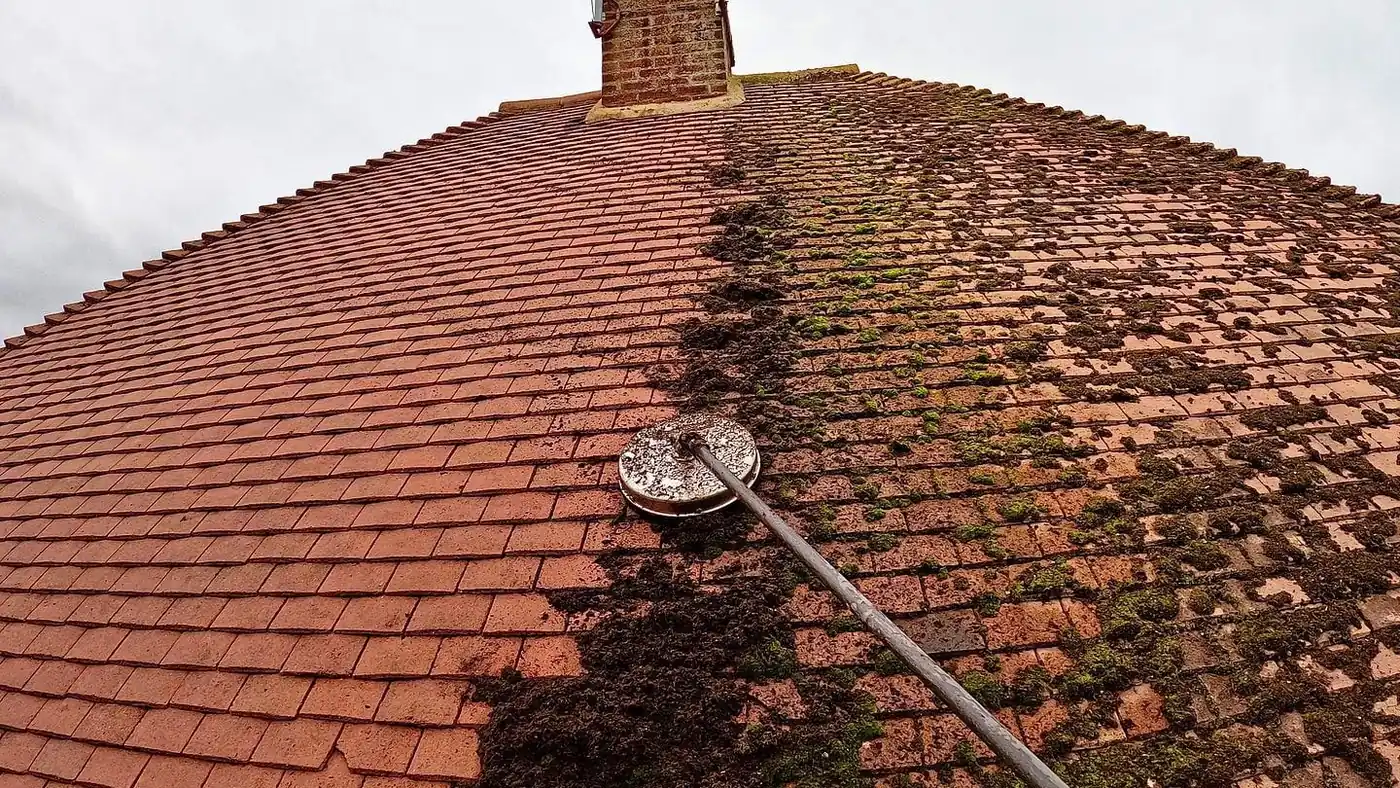
On clay, any thick moss is lifted by hand first. The biocide then goes on at low pressure, and no pressure washing is involved.
Nearby places to Fareham Common
Also in Fareham Common
How a job runs
At the end, you can look over the work with us if you are in. Anything we noticed, such as a slipped tile or a blocked downpipe, is pointed out there and then. The job takes a few hours to apply on most roofs. Bigger gardens in places like Fareham Common can mean a longer walk with equipment, so tell us how we reach the back.
- We check the roof and the growth on it.
- You get a fixed quote, and loose moss is removed first if needed.
- We book a dry day and protect plants, paths, gullies and drains.
- We apply an authorised biocide at low pressure, as the label says.
- The site is cleared and you’re told what to expect over the coming months.
Getting ready for the day
- Keep pets indoors while we work
- Make sure we can get to the side and back of the property
- Let us know about earlier repairs or treatments
Ask for a quote
Quoting starts with seeing what’s involved, from your pictures or, where that isn’t enough, a visit. After that, you get a fixed price so you know the cost up front.
Related advice
How we price roof biocide treatment
Seeing the job comes before the price. The main factors are:
- Parking, and how far we carry equipment
- How heavy the growth or dirt is
- Tile or surface type, and its condition
- Any repairs, which are always priced separately
What you pay depends on how big the job is, the height and access and how much build-up there is. You get a fixed price before any work starts, so you know where you stand.
What to send for a quote
You don’t need to know the technical terms. It helps if you can send:
- Details of any previous treatment
- Whether the building is listed
- Parking near the property
- Any side gates, passages or tight spots we’d need to get through
Getting a quote does not take long. Send a few details and pictures, and we will come back to you with a fixed price. Where we need a closer look, we arrange a time to come round.
When to call us in Fareham Common
Lichen grows where the air and roof suit it, often slowly over many years. It grips the surface firmly which is why a biocide is the usual answer.
The problems we’re asked about most are:
- Black streaks down the slopes
- A north-facing slope that greens up fast
- Regrowth since the roof was last cleaned
- Algae on an older roof
If you live near Parish Church of St Peter and St Paul, or on any of the older streets in Fareham Common, your roof may be clay or slate, which is cleaned gently by hand.
Before you book anyone
- Whether the waste is taken away
- A written guarantee, and what it actually covers
- How VAT is shown on the quote
- Whether any biocide used is authorised in Great Britain for the job
Questions from Fareham Common
Who should I ask about a listed home in Fareham Common?
It’s Fareham council, the local council for Fareham Common. Its planning or conservation team can tell you whether your home is listed or in a conservation area. If your home is listed, listed building consent is needed for works that affect its special character, so check with the council before a coating or any change to how the roof looks.
Do you need parking for a job in Fareham Common?
A space on the drive or close by makes the job easier. Roads around Fareham station, about 0.8 miles west of Fareham Common, can fill with commuters’ cars, so mention where we could park when you get in touch.
Can you price the job without visiting?
Yes, if we can see what we need. Otherwise, we arrange a time to see the job, and the fixed quote follows.
Do I need a roof clean before a biocide treatment?
It varies with the roof. Heavy moss blocks the treatment and ends up in the gutters as it dies, so it’s best removed first and light growth can be treated straight away.
What guarantee do you offer?
Each job comes with a written guarantee on our workmanship for 12 months. It covers our workmanship, not regrowth, because nobody can honestly promise that moss or algae will not come back.
Are you a Checkatrade member?
Yes. Checkatrade is the scheme we belong to, so you can look us up there. On top of that, we’re fully insured.
How do you deal with roof lichen?
Treatment kills it, and the weather does the rest. It takes time, but the tiles aren’t harmed as the dead crust loosens and goes.
How long will the treatment take to apply?
Applying it takes part of a day for many homes, depending on the size of the roof and the access. The effect builds over the following weeks and months.
Roof biocide treatment in Fareham Common: the local picture
At about 1 mile from the coast, Fareham Common is close enough for sea air to matter. Crusty lichen is a common sight on roofs near the sea, and because scraping it can mark the tiles, a biocide is the usual answer. The nearest ancient woodland to Fareham Common is Moor Coppice, some 1.9 miles north-east of Fareham Common. A roof close to old woodland often dries slowly after rain, which gives moss the damp it needs.
If your home backs onto green space such as Portsdown Hill, 2.8 miles east of Fareham Common, you’re likely to see more shade, leaves and bird droppings. Shade slows how quickly a roof dries, and a roof that stays damp suits moss. Homes on school roads, near Wykeham House School for instance, can face busy mornings and afternoons. If that’s your street, mention it, and the ladders can go up before the road fills.
Fareham Common is about 1 mile east of Fareham, in Hampshire. For roof biocide treatment in and around Fareham Common, please speak to us on 01342 344 936, or use the quote form for a fixed quote. Our area covers London and the South East, Fareham Common included. Across Hampshire, we cover 683 places, and Fareham Common is one of them. Our Guildford page covers homes nearby, about 38 miles away.
We take on work all over the PO16 and PO14 postcode area for roof biocide treatment and the streets around it. Roof biocide treatment is available to homes on Bath Lane, Osborn Road and High Street and nearby roads. Main roads around Fareham Common include the A32, which makes travel easy for the job. Close by, we work in Wallington (1 mile north-east), Fareham (1 mile west), North Fareham (1 mile north), Boarhunt (2 miles north-east) and Crockerhill (2 miles north). Within a short drive, we also cover Gosport (3 miles south), Havant (8 miles east), Eastleigh (11 miles north-west), Horndean (8 miles north-east), Totton (15 miles west) and Chandler's Ford (13 miles north-west).
What’s near Fareham Common
Properties near Harrison Primary School, The Red Lion Hotel and Cams Hill School are all part of the area we cover. The nearest railway station is Fareham station, about 0.8 miles west of the centre. Nearby you’ll also find Portchester Castle (2.8 miles east) and Fareham Shopping Centre (under half a mile north-west). The countryside around Fareham Common includes West of the River Alver and Portsdown Hill.
Keeping it in good shape
Simple habits between visits make a real difference. Our advice:
- Keep gutters running freely
- Leave the treated roof alone
- Retreat when regrowth first appears
- Follow our advice on keeping pets and children away until dry
Keep pets and children off treated areas until they’re dry, as we’ll advise on the day. The label sets out what’s needed, and we’ll go through it with you.
The SPAB suggests a seasonal brushing down to control the build-up. Only where it’s safe to reach the roof, but it makes each treatment go further.
Doing it yourself: an honest view
Patios and driveways are the one area many people clean themselves, and there’s nothing wrong with that. Just watch where the water goes: surface water drains run straight to the environment, so dirty water and cleaning products shouldn’t go down them.
Solar panels need particular care. The manufacturer’s care guidance comes first, and pressure washers and strong chemicals are best avoided. Most panels sit on a roof, so the same height warnings apply.
For landlords and letting agents
Letting agents and property managers can book with us directly. Tell us the property, the work and the access arrangements and we’ll come back with a fixed quote.
Who looks after the roof and gutters is normally set out in the tenancy agreement or lease. We’re happy to deal with either side, and we’ll keep whoever booked us informed.