Isle of Wight · Biocide roof treatment
Elmfield roof biocide treatment
Roof biocide treatment in Elmfield from a team with 20 years’ experience. Fully insured, with a written 12-month guarantee on our workmanship.
- Keeping a freshly cleaned roof clearer for longer
- A roof cleaned a few years ago that needs retreating
- Moss returning after a clean
Roof biocide treatment in Elmfield
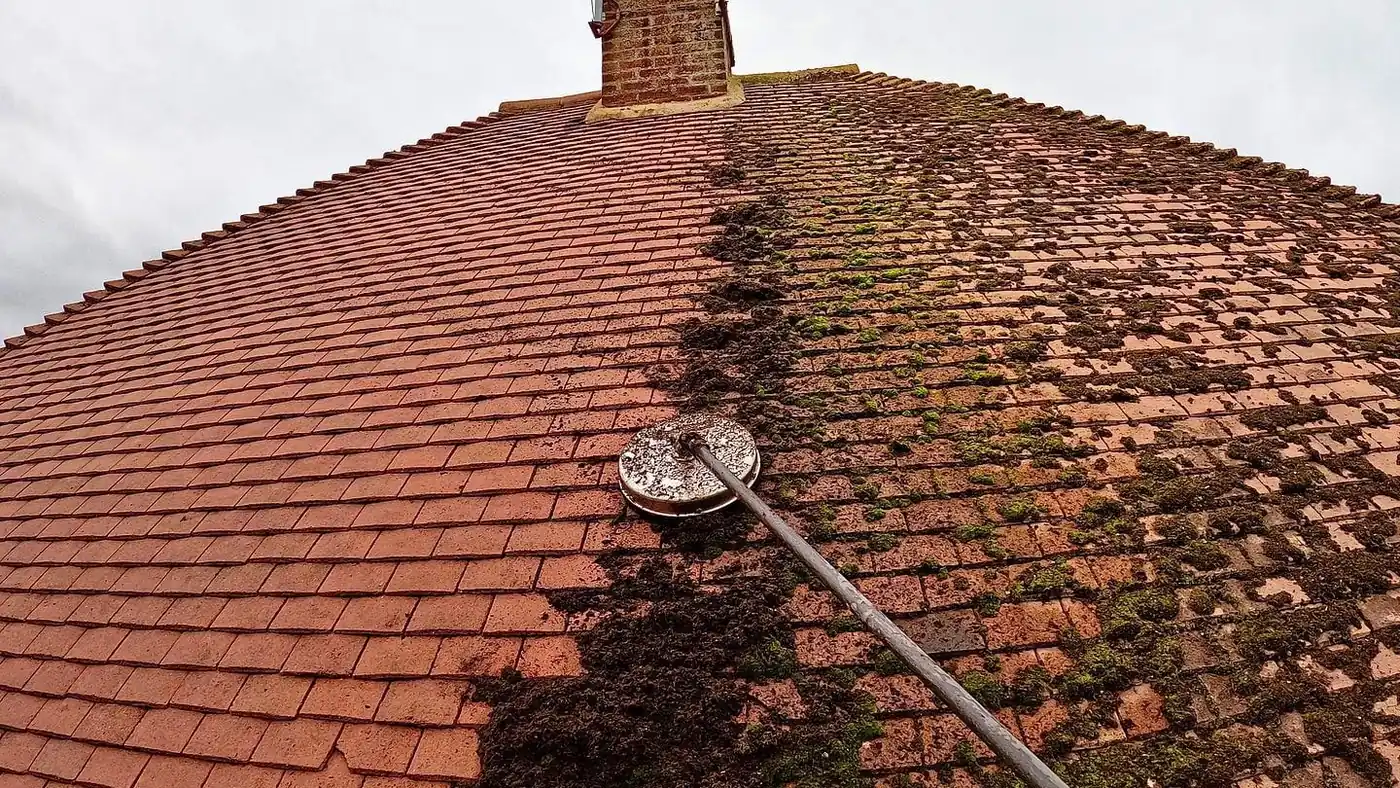
We apply the biocide by soft wash, at low pressure. That suits every kind of roof, from clay and slate to concrete since no water is driven into the laps. Heavy moss comes off by hand beforehand, so the treatment can reach the surface. If you have the first patches of moss and lichen that won’t scrape off, we can help.
In a place like Elmfield, low roofs on bungalows and extensions can often be reached from ladders, while taller houses may need a tower. Access is planned after we’ve seen the roof, from the ground, from photos or on a visit.
Should you have a question about the work after we’ve left, get in touch with us. Your written 12-month workmanship guarantee covers the work we did, and it’s set out clearly so you know what’s included.
- Location
- Elmfield (PO33)
- Wider area
- Isle of Wight
- Our guarantee
- 12-month workmanship guarantee, in writing
- Quote
- Fixed price, set before we begin
- Track record
- 20 years’ experience; Checkatrade member
- Call
- 01342 344 936
- Checked
- 30 October 2026
Elmfield questions
Where will your van park in Elmfield?
Ideally, the van parks on the drive or right outside. Streets near Ryde St Johns Road station, a short walk from the centre of Elmfield, can be busy with commuter parking, so tell us about your drive or the nearest space when you book.
Do you cover smaller places like Elmfield?
Yes. Elmfield is within the area we cover across London and the South East. Just mention lanes, gates or anything else about getting there when you book.
Is there anything I need to do beforehand?
Move cars off the drive, unlock side gates and keep pets indoors, and tell us about a conservatory, glass roof or nesting birds.
Is it safe to do it myself?
That depends on the job. Paving at ground level is a reasonable DIY job, if you keep the run-off out of surface water drains; roofs, high gutters and solar panels are a different story.
What if you find a problem while you are working?
We tell you about anything we spot, from cracked or slipped tiles to downpipes that aren’t running. We’re happy to show you photos, and repairs are only done once you’ve agreed a price.
Will dirty water go down the drains?
We keep it out of the surface water drains. Those drains carry water straight to the environment, not to a treatment works, so only clean water should go into them.
Are the products you use a risk to pets and plants?
Plants, ponds and borders below the work are protected and keep run-off under control. Any biocide is applied at low pressure, only as the label allows, using products approved or authorised for this use in Great Britain. Pets are best kept inside until we are done.
Is the biocide you use approved?
Biocides used on roofs have to be approved or authorised for that use in Great Britain, and ours are. The label is followed to the letter.
Landlords, letting agents and property managers
On a let property, the outside is easy to overlook. Few tenants look up at the roof or into the gutters, so planned work helps catch moss, blockages or slipped tiles before they grow into a bigger job.
Who looks after the roof and gutters is normally set out in the tenancy agreement or lease. We can quote either party, and we will keep whoever booked us informed.
Keeping it in good shape
Here’s our aftercare advice, short and simple:
- Do not pick at dead lichen
- Don’t wait for thick moss to return
- Judge the result after a few months, not a few days
- Clear leaves from the gutters each autumn
Lichen takes longest to go. It’s killed by the treatment but stays attached for a while before rain and weather take it away. It’s better than scraping it off.
The SPAB notes that copper strips or sacrificial lead at drip points can help hold growth back. Traces of metal wash down the slope with the rain, which can slow regrowth.
What we’re called out for in Elmfield
Every roof is exposed to spores, all the time. Wind brings them in, and when the roof stays damp, they grow. A biocide kills them and slows that cycle.
Look out for any of the following:
- New moss on a cleaned roof
- Crusty grey and yellow lichen
- A green film over the tiles
- Slowing moss coming back after cleaning
Roads near schools such as Oakfield Church of England Aided Primary School can be busy at drop-off and pick-up. If that’s your road, mention it when you book, and setting up can be planned around the busy times.
Questions to ask before booking
- Whether any biocide used is authorised in Great Britain for the job
- What access equipment they’ll use, if any
- Exactly what’s included, area by area
- The method they’ll use, and why it suits your surface
Roof biocide treatment in Elmfield: the local picture
From Elmfield, the sea is no more than about 1 mile away. Being near the sea does not change the run-off rule: surface water drains lead straight to the environment, so moss and wash water are kept out of them. Elmfield has about 21 areas of ancient woodland within two miles, the closest being Monktonmead, about 0.4 miles west of Elmfield. Homes near woodland like this tend to get more shade and leaf litter, and moss grows best on damp, shaded roofs. Historic buildings nearby include Nunwell House, about 2.6 miles south of Elmfield. Houses of that age are a reminder that clay and slate roofs can last a very long time with care.
Places like Alan Hersey Nature Reserve, 1.3 miles east of Elmfield, can bring trees and birds close to the houses around them. Shade slows how quickly a roof dries, and a roof that stays damp suits moss. Roads within walking distance of a station like Ryde St Johns Road station, within half a mile of the centre of Elmfield, often fill with parked cars, so a word about parking when you book helps us plan.
Elmfield is about 1 mile south-east of Ryde, in the Isle of Wight. Whether you are in the middle of Elmfield or further out, roof biocide treatment is available for all kinds of property, from a terrace to a large detached house. Elmfield is one of 125 towns, villages and districts in the Isle of Wight where we work for roof biocide treatment. There’s also a page for Guildford, about 44 miles away.
Here we cover the PO33 postcode area for roof biocide treatment. Roof biocide treatment is available to homes on Park Road, Rink Road and Hope Road and nearby roads. Main roads around Elmfield include the A3055, so getting to you is simple for roof biocide treatment. Neighbouring places we cover for roof biocide treatment include Oakfield (1 mile west), Appley (1 mile north-east), Westridge (1 mile south), Ryde (1 mile north-west) and Puckpool (1 mile north-east). We also work in nearby towns such as Newport (7 miles west), Cowes (7 miles west), Sandown (5 miles south), Shanklin (6 miles south), Ventnor (9 miles south) and East Cowes (6 miles west). If your property is somewhere remote, the job takes a little more planning, so let us know when you get in touch.
Local landmarks in Elmfield
Roofs on the roads around Ryde Academy, High Park Tavern and Ryde School with Upper Chine are on our patch, like the rest of Elmfield. Elmfield has its own railway station: Ryde St Johns Road station. A little further out are Sandown Castle (4.3 miles south) and Cothey Bottom Heritage Centre (0.8 miles south-east). Not far away are Brading Down and Alan Hersey Nature Reserve.
When something else is needed
We’d rather tell you now than sell you work that won’t help, so these are the things it will not cover:
- Lichen vanishing on the day
- Broken ridge mortar
- Keeping growth away permanently (it slows regrowth; it is not permanent)
If in doubt, talk to us on 01342 344 936 or send details through the form on our contact page and we will say what we think before booking.
What we clean
- Shaded roof slopes
- Lichen patches
- Tile and slate surfaces
- Ridge and hip tiles
- Algae and black streaks
- Roofs cleaned by hand
What affects the cost of roof biocide treatment
Jobs vary more than people expect. The main factors:
- What the surface is made of and the state it’s in
- Any towers, scaffold or powered access
- Any repairs, which are always priced separately
- A conservatory or extension below the work
Some things add to the work. A conservatory or extension below, a lot of moss, fragile tiles or no side access all mean extra care, so they are built into the quote. The price is still fixed before we start.
Helping us quote
When you get in touch, it’s useful to have:
- A few general shots from the garden or street
- Parking near the property
- The address and the type of property
- Any past cleaning, coating or repairs you know about
Getting a quote does not take long. Tell us about the job, add a few photos if you can, and we will give you a fixed price. Where we need a closer look, we arrange a time to come round.
Step by step
We start by comparing what we see with what we priced. If anything is different, such as damage we couldn’t see before, we talk to you before carrying on. From there, it takes a few hours to apply on most roofs. Garden furniture and pots near the work are moved or covered first.
- You send photos or we visit to see what’s growing.
- If the moss is thick, we agree to scrape it off first.
- We protect plants, paths and drain outlets.
- The biocide goes on evenly at low pressure, as the label says.
- The site is tidied and the waste taken away.
Preparing for the work
- Close windows, doors and roof lights near the work
- Make space on the drive by moving cars
- Tell us about any conservatory, glass roof or extension below the work
Pricing your job
Every quote starts with a look at the job, from your photos or, where that isn’t enough, a visit. After that, you get a fixed price so you know the cost up front.
Advice
What’s safe to do yourself
Shop-bought moss treatments are an option for some surfaces, but check the product is authorised for that use and follow the label exactly. On a roof, applying it carries the same height risks as any roof work, and run-off still has to be kept out of drains.
There are still useful things you can do from the ground: look the roof over once a year, watch for overflowing gutters and sweep up moss that falls onto paths. Anything higher than that is best left to us.