Isle of Wight · Biocide roof treatment
Biocide roof treatment in Dunsbury, Isle of Wight
Biocide roof treatment to kill remaining moss, algae and lichen spores and slow regrowth in Dunsbury, done the careful way. We plan the access, protect the area and take the waste with us.
- An old treatment that has worn off
- Algae on the slope that gets the least sun
- New moss on a cleaned roof
Roof biocide treatment in Dunsbury
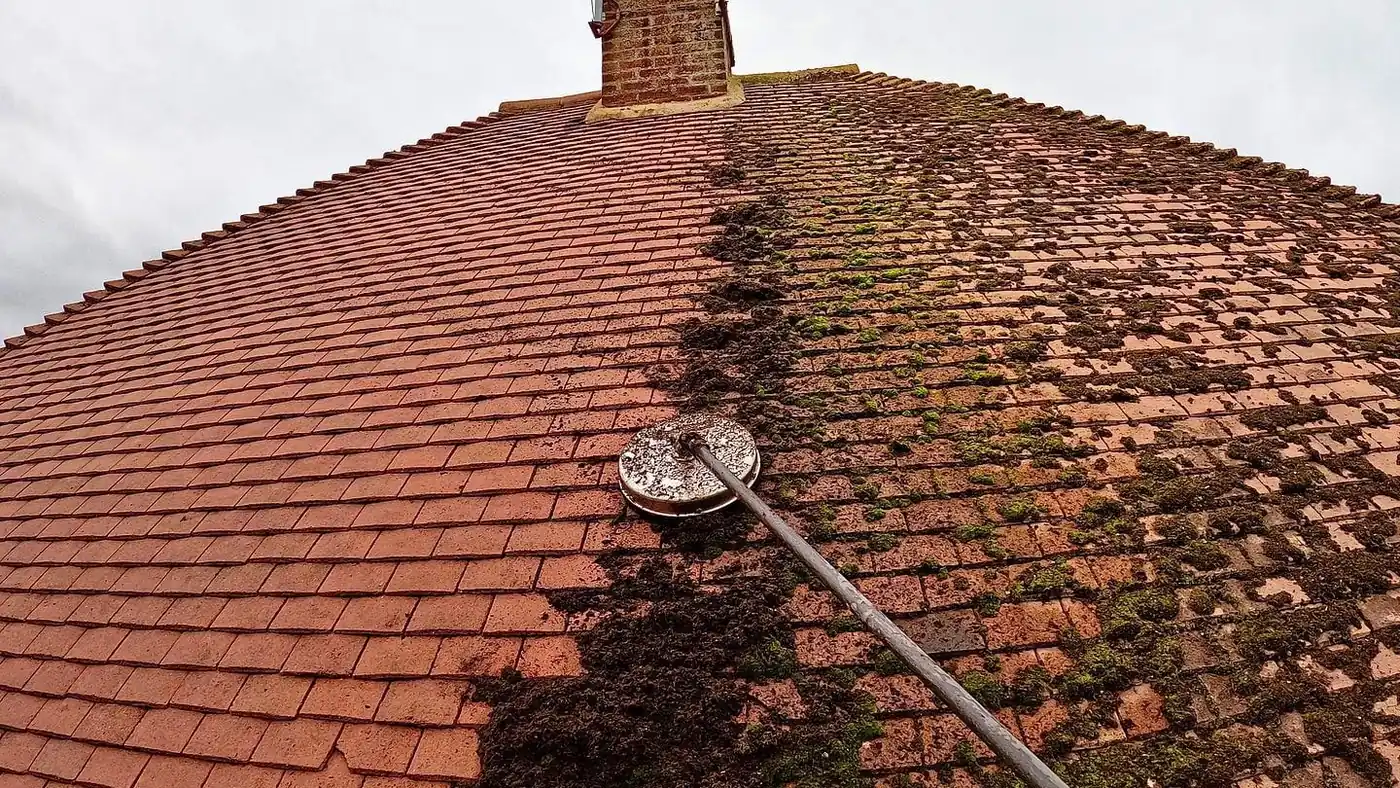
The treatment goes on at low pressure, evenly across the roof. Low pressure is safe for delicate tiles as well as robust ones, because nothing is forced under the tiles. Heavy moss comes off by hand beforehand, so the treatment can reach the surface. The work covers roofs cleaned by hand, algae and black streaks and ridge and hip tiles, and the jobs we see most are lichen crusts along the ridge and a shaded slope that turns green quickly.
Long drives, lanes and big gardens are part of working in a village like Dunsbury, so tell us about the route and where we can park when you book. Trees around rural homes often mean more shade, more moss and more leaves in the gutters.
We’re fully insured, Checkatrade members and have 20 years’ experience, with a written 12-month workmanship guarantee on each job. It’s given in writing, so it’s there if you ever need it.
- Where
- Dunsbury (PO30)
- Wider area
- Isle of Wight
- Cover
- Written 12-month workmanship guarantee
- Price
- A fixed quote up front
- Experience
- Two decades in the trade, fully insured
- Phone
- 01342 344 936
- Updated
- 30 October 2026
What’s safe to do yourself
Scraping moss off sounds simple, but technique matters. Lichen in particular clings hard, and forcing it off can mark the tile surface, so it’s better treated and allowed to weather off. Leave the roof to someone with the right access.
A pressure washer from a hire shop might look like a quick fix for the roof. Roof tile makers’ guidance advises against high-pressure washing, as it can damage the surface, strip colour from concrete tiles and drive water under the laps.
What a clean won’t put right
It’s worth knowing the limits before booking:
- Colour lost over the years
- Damaged tiles
- Lichen vanishing on the day
If in doubt, pick up the phone and call 01342 344 936 or fill in the quote form and we will say what we think.
What the work covers
- Ridge and hip tiles
- Roofs cleaned by hand
- Algae and black streaks
- Lichen patches
- Tile and slate surfaces
- Shaded roof slopes
Why it’s worth doing now in Dunsbury
Lichen can be scraped or treated. Because it bonds to the tile, scraping can damage it whereas a treatment lets it fade without harm. Moss and algae hold water, and that is the start of most problems.
What you pay depends on the size of the area, the height and access and how much there is to clear. You get a fixed price before any work starts, so you know where you stand.
Why us?
- We choose the gentlest method that does the job
- We take the waste with us
- Roofs treated as fragile until we know otherwise
- Fixed prices, agreed before any work
Read how our quotes work and our methods by tile type.
From first look to clear-up
Everything for the job comes with us, from protective sheeting to tools and any access equipment. You just need to give us clear access and space to park nearby. On site, it takes a few hours to apply on most roofs. Garden furniture and pots near the work are moved or covered first.
- We look at the roof and the growth on it.
- We fix the price and agree any hand removal first.
- A dry day is chosen and plants, paths and drains are protected.
- We apply the treatment evenly, following the label.
- We tidy up and explain how the growth will fade over time.
A few things to sort first
- Tell us if you’ve seen birds nesting in the roof or gutters
- Shut nearby windows and roof lights
- Mention any problems you’ve noticed
Pricing your job
If you need roof biocide treatment in Dunsbury, speak to us on 01342 344 936, or use the quote form. Tell us the address and what you’d like done, and mention anything that could affect access, like a conservatory below or a narrow side passage. A fixed quote follows from there.
Related advice
Roof biocide treatment around Dunsbury: what to know
Dunsbury lies within about 1 mile of the sea. Near the sea, roofs can collect lichen and green algae as well as moss, and lichen is treated with biocide rather than scraped, as scraping can damage the tile surface. Dunsbury has about 6 areas of ancient woodland within two miles, the closest being Brook House Wood, about 0.3 miles east of Dunsbury. Woods nearby can mean leaves on the tiles and shade for much of the day, and moss does well in both. Among the historic houses near Dunsbury is Mottistone Manor, about 1.2 miles east of Dunsbury. Buildings like that show how long clay and slate roofs can last when they’re looked after.
Places like Westover Down, 1.2 miles east of Dunsbury, can bring trees and birds close to the houses around them. Leaves on the tiles and in the gutters hold damp, and moss thrives on damp. Older homes, like many found near churches such as St. Mary's Church, often have clay tiles or slate that call for a gentle approach.
Dunsbury is about 7 miles south-west of Newport, in the Isle of Wight. Dunsbury gets the same approach as every job we take on: a fixed price, careful work, controlled run-off and a written guarantee on our workmanship for 12 months. 125 places in the Isle of Wight are on our list, large and small. There’s also a page for Guildford, roughly 56 miles from Dunsbury.
Here we cover the PO30 postcode area for roof biocide treatment. Nearby, we also carry out roof biocide treatment in Brook (1 mile south), Hulverstone (1 mile south-east), Brookgreen (1 mile south-east), Shalcombe (1 mile north-east) and Chilton Green (2 miles south-east). Within a short drive, we also cover Newport (7 miles north-east), Ryde (14 miles east), Cowes (9 miles north-east), Sandown (13 miles east), Shanklin (12 miles east) and Ventnor (12 miles east). If your property is somewhere remote, the job takes a little more planning, so mention it when you ask for a quote.
Around Dunsbury
A little further out are Yarmouth Castle (3.9 miles north-west) and Calbourne Water Mill And Rural Museum (2.3 miles north-east). Green spaces nearby include Westover Down.
Your questions about roof biocide treatment in Dunsbury
Who do I check with about listed building consent in Dunsbury?
That’s Isle of Wight council. They can confirm whether your home is listed or in a conservation area. If your home is listed, listed building consent is needed for works that affect its special character, so check with the council before a coating or any change to how the roof looks.
Do trees near my home in Dunsbury make a difference to roof biocide treatment?
Often, yes. Ancient woodland such as Brook House Wood lies some 0.3 miles east of Dunsbury. Trees mean shade and leaf litter, so moss typically comes back sooner and gutters fill faster.
Will you tell me if you find any damage?
We let you know and explain what we found, and we can show you pictures. Repairs are priced on their own and only go ahead with your agreement.
How long does a biocide treatment last?
No one can give a fixed figure honestly. It depends on shade and aspect, typically around one to a few years, because spores keep arriving on every roof.
Can neglect affect a home insurance claim?
Regular maintenance is sensible, as many policies exclude gradual damage and wear and tear. We cannot tell you what your policy covers, but well-kept roofs and gutters are part of good upkeep.
Do you give a guarantee?
A written guarantee on our workmanship for 12 months covers the work we carry out. You get it on paper, and we are fully insured too.
Can you work on an old or listed property?
Yes. Older and listed buildings get the gentlest approach, like hand brushing and low-pressure steam where suitable. For anything that would change the appearance, such as a coating, check with the council first, as listed building consent is needed for works that affect a listed building’s special character.
Do you use a pressure washer?
Not by default. We use the gentlest method that will do the job: hand scraping, soft wash or steam for most roofs, with pressure kept for surfaces that can take it. High pressure can damage tile finishes, strip colour from concrete tiles and force water under the laps.
Keeping it in good shape
So the work lasts as long as it can:
- Watch for new green patches
- Clear leaves from the gutters each autumn
- Never scrape lichen yourself
- Don’t rinse the roof after treatment
We clear up before we leave: sheeting is removed and the ground cleaned and run-off is dealt with properly.
Clear drainage helps the treated roof. Blocked gutters keep the lowest tiles wet, which is where regrowth often starts.
What the work involves, part by part
Historic and listed roofs
Historic coverings need care. We avoid walking on old tiles and flag any repairs worth doing.
Natural slate
Slate is brittle and can be lifted by pressure. We apply the biocide gently and plan access to avoid walking on them.
How we price roof biocide treatment
There’s no set price list, because properties vary so much. The quote depends on:
- Whether anything else is added, like clearing the gutters
- Access from the road to the work
- Glass roofs, conservatories or extensions underneath
- How heavy the growth or dirt is
Where the work is at height, access can make a big difference. Anything beyond ladders, such as a tower, scaffold or powered access, is built into the quote, and we tell you why.
Asking for a quote
Many jobs can be priced from photos and a few basics. Send what you can of the following:
- Where we could park, and any restrictions
- A few general shots from the garden or street
- Any past cleaning, coating or repairs you know about
- Anything below the work, such as a conservatory, porch or extension
To get a fixed quote, talk to us on 01342 344 936 or fill in the quote form and tell us roughly what needs doing and where. A few photos taken from the ground help a lot, but don’t worry if you can’t take any.